Skip to content
Winnipeg North Dental
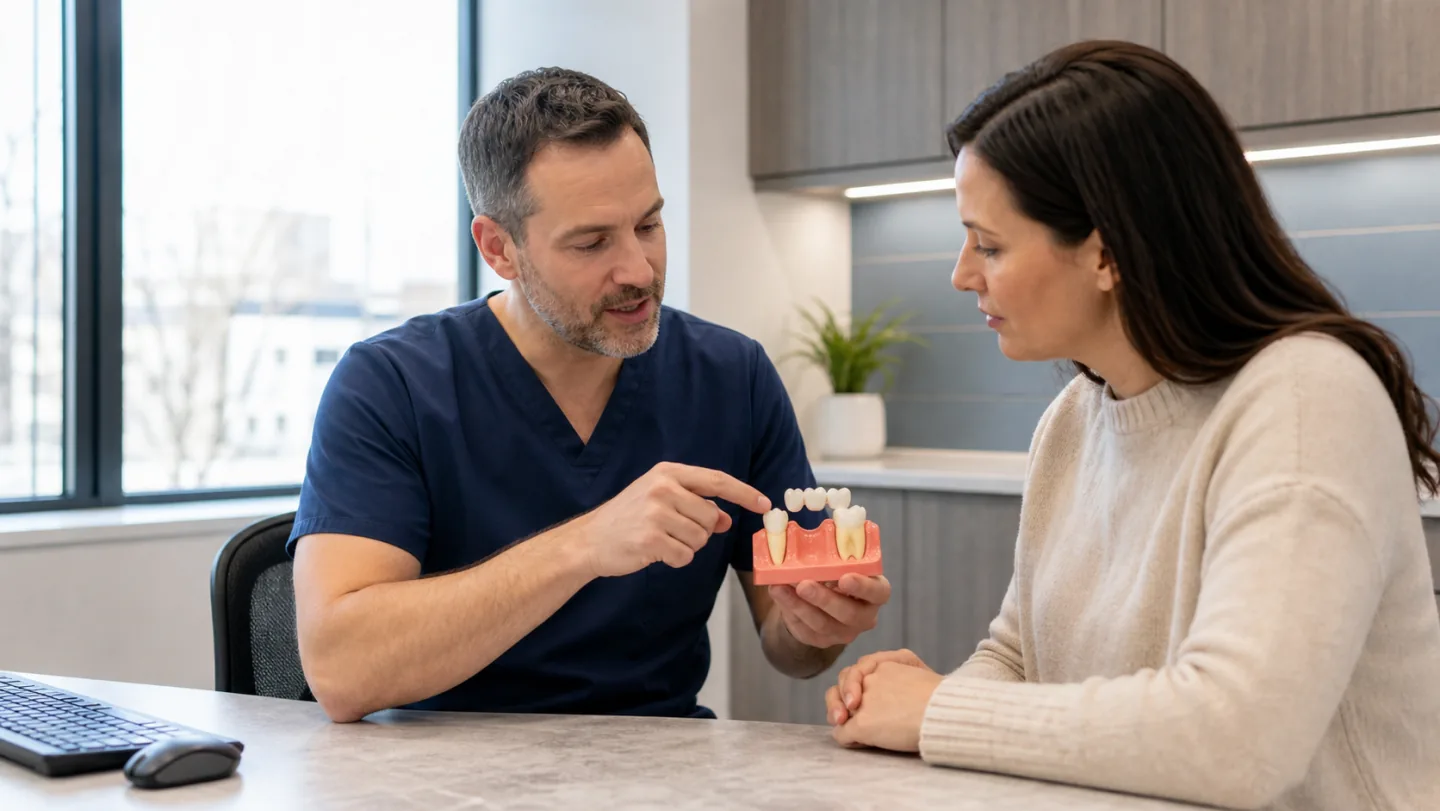
A dentist explaining how a fixed bridge can replace a missing tooth
The teeth your bridge will bite against

Dental Bridges for St. Vital Residents

Most people picture a bridge as something that fills a hole in one row of teeth. In practice it also has to work with the row above or below it, every time you chew, slide your jaw or close your mouth.

Let's find a time

Request an appointment

We’ll call to confirm your appointment. For urgent care, please call us directly.

Two rows, one bite

How the Opposing Jaw Shapes Your Bridge

The teeth that meet your bridge decide much of the stress it will face. How they touch it when you bite straight down, and how they glide across it when you move side to side, both feed into the shape and the material your dentist selects.

St. Vital is an area of Winnipeg, and residents there can have their bite and a missing tooth assessed together at our McPhillips Street clinic. Looking at both jaws gives a fuller picture than looking at the gap alone.

Explore dental bridges
Reclined aqua patient chair beside a compact sink and cabinets in a Winnipeg North Dental operatory
A reclined patient chair next to the sink and storage in a Winnipeg North Dental operatory.

Contact when closing

Where the opposing teeth land on the bridge affects how forces are spread.

Movement across it

Side-to-side jaw motion brings its own contacts, which are planned for as well.

Fine-tuned at fitting

The bite is checked and adjusted at try-in before the bridge is permanently secured.

Support meets force

Each design handles your bite differently.

The strength of the supports must match the forces your bite produces. That is one reason designs vary from one mouth to the next.

On crowned natural teeth

Crowns on suitable neighbours carry the replacement tooth, so those neighbours share the chewing load.

  • Their roots and gums must be able to bear the planned forces.
  • Existing restorations on them are reviewed first.
  • A one-sided cantilever suits only carefully chosen force patterns.

On dental implants

Implants can support a bridge spanning several missing teeth, taking the load without natural anchors being shaped.

  • Bone, general health and healing guide implant planning.
  • The connection is planned once implants have healed.
  • Longer spans change the mechanics the design must handle.

Opposing teeth and the way your jaw moves influence both the outline of the bridge and the choice of material.

Where the bite is checked

Stages of treatment, with the bite in mind.

Your bite comes into the process more than once. Here is where it typically appears.

Request your visit
  1. 01

    Assessing support and alignment

    Gums, alignment, root health and existing restorations of the possible anchors are reviewed, with attention to how your teeth meet.

  2. 02

    Getting supports ready

    Natural anchors are reduced for crowns where needed, or healed implants are assessed for how they will connect.

  3. 03

    Capturing your bite

    Along with scans or impressions and shade details, a bite record shows the lab how the opposing teeth come together.

  4. 04

    Checking contact before securing

    During fitting, the bite, contacts, margins, appearance and access for cleaning are examined before final attachment.

What you have noticed

Pay attention to how your teeth come together.

You know your bite better than you might think. Small observations about chewing and jaw movement can help your dentist understand the forces involved.

If a tooth in the opposite jaw has started to look longer or seems to have moved toward the space, point it out at your visit.

Observations to bring

  • Which side you tend to chew on most.
  • Whether your teeth ever feel sore after meals.
  • Health conditions you are treated for, and the medicines involved.
  • Old crowns or fillings on the teeth across from the gap.
Front desk at Winnipeg North Dental with a glass panel and a hallway running toward the treatment area
Ergonomic black chairs arranged around a white table in the Winnipeg North Dental consultation room

The front desk and a consultation table with black chairs at Winnipeg North Dental.

Questions are part of it

Feel free to ask what each test is measuring.

Bite checks involve a few unfamiliar steps. Understanding what they are for can make them feel less mysterious, so ask whenever something is new to you.

Ask what is being checked

If your dentist asks you to bite, slide or tap, you can ask what each movement reveals.

Describe what feels high

At try-in, mention any spot where the new tooth seems to hit first.

Take your time to answer

Close your teeth slowly and notice how it feels before giving your impression.

After the bite is set

Looking after both the bridge and its partners.

Once secured, the bridge depends on daily cleaning and periodic checks. Floss alone cannot get under the joined units, so a different technique is needed.

01

Cleaning beneath it

Our team will demonstrate tools for your bridge, which may be a floss threader, super floss, an interdental brush or a water flosser.

02

Noticing a shift

Contact the clinic if the bite feels different, the bridge moves, a surface chips, food packs in, gums bleed or swell, or a bad taste persists.

03

Routine examinations

Decay can develop at the edges of natural anchor teeth, so periodic checks remain important.

Something urgent with your bridge or bite should be phoned in to the clinic rather than sent through the form.

Talk with our team
Street view of the Winnipeg North Dental building with sign lettering above the dark entry doors

Winnipeg North Dental

Unit-5 2358 Mcphillips Street, Winnipeg, MB R2V 4J6
Get directions (opens in a new tab)
Visit for a bite check

Bite and Bridge Assessment on McPhillips Street

St. Vital patients have bridge planning, fitting and bite checks at Winnipeg North Dental, Unit 5, 2358 McPhillips Street, Winnipeg, MB R2V 4J6.

Submitting the form sends a request only. A staff member will get in touch to confirm a time that works.

Questions about coverage?

Talk with our team before your visit or learn about CDCP.

A little clarity before your visit

Your questions, answered.

Helpful details about dental bridges in St. Vital.

Ask our team
Why does the opposite jaw matter for a bridge?

The opposing teeth press on and slide across the bridge, so their position influences its shape, its material and the load on its supports.

What if my bite feels uneven after fitting?

A change in the bite is one of the things to report. Call the clinic so the bridge and your bite can be checked.

Can a bridge cope with replacing more than one tooth?

Some bridges replace several teeth. As the span lengthens, the quality of support and the forces involved become more important.

How does a bridge compare with a single implant?

A tooth-supported bridge relies on neighbouring teeth, while a single implant replaces the root and holds its own crown. Your health, anatomy, timing and goals affect which suits you.

Does decay ever start under a bridge?

The natural anchors can decay along the bridge margins, which is why daily cleaning and regular examinations matter.

How can St. Vital residents ask for a bite and bridge assessment?

Mention your bite along with the gap when you fill in this page’s form or phone (204) 338-3003, and the clinic will write or call back to set a date.

Look at the whole bite

Plan a bridge that works with both jaws.

St. Vital residents can request an assessment at our McPhillips Street clinic in Winnipeg, and staff will respond about scheduling.

Patient testimonials

Kind words from our patients

★★★★★ 5.0 from 440+ reviews on Google

Close to home

Areas we serve

Convenient dental care on McPhillips Street for families across northwest Winnipeg and nearby communities.

Explore all service areas

A healthier smile is one visit away

Ready for dental care that feels genuinely comfortable?

✓ New patients welcome ✓ Direct insurance billing ✓ Multilingual team

How can we help?

Our dental team is here for you.

Ready to book or have a question? Choose the option that works best for you.

For urgent dental concerns, please call us directly.

Send us a message

Our team will reply during clinic hours.



