Skip to content
Winnipeg North Dental
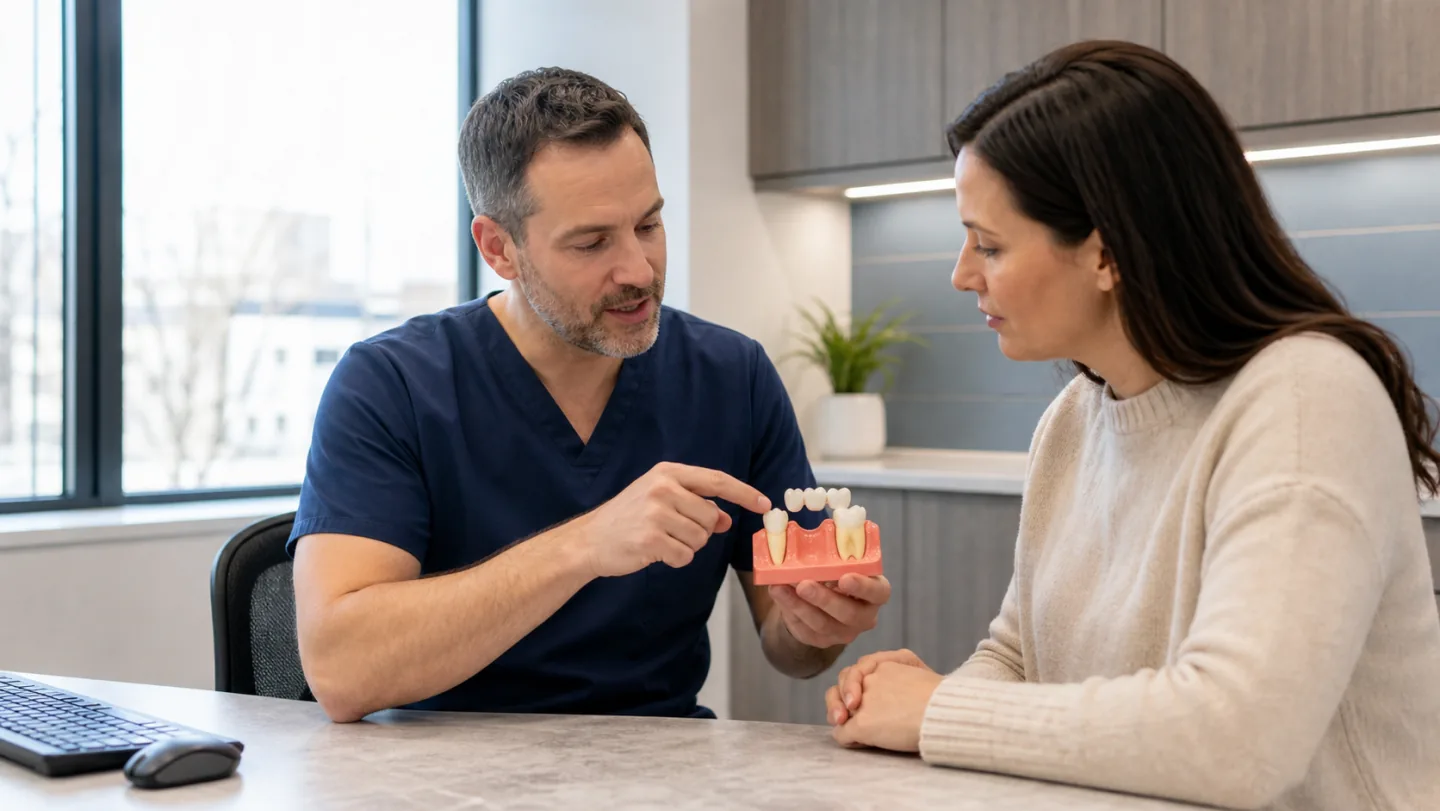
A dentist explaining how a fixed bridge can replace a missing tooth
When a gap changes how you sound

Dental Bridges for Robertson Residents

A lisp that was not there before, a whistle on some words, or a habit of covering your mouth while talking: these are good reasons to ask about replacing the tooth.

Let's find a time

Request an appointment

We’ll call to confirm your appointment. For urgent care, please call us directly.

Teeth help shape words

Speaking Comfort and Dental Bridges, for Robertson Patients

Your tongue and lips press against your teeth to form many everyday sounds. Take away a tooth, particularly toward the front, and air and tongue placement can change just enough for you to notice it, even if nobody else does.

A fixed bridge can give your tongue a surface to work against again, and speaking comfort is one aim of the treatment. Robertson is in Winnipeg, and anyone from the area can bring this concern to our McPhillips Street clinic for an assessment.

Explore dental bridges
Curved white reception counter with an orchid and a snake plant at Winnipeg North Dental
White orchids and a snake plant at the Winnipeg North Dental front counter.

Describe the sounds

Tell your dentist which words or letters feel different, since that points to what matters to you.

A shape planned with care

Tooth proportions and contacts are considered along with how the restoration relates to your bite.

Stays put when you talk

A fixed bridge is cemented or attached, so it is not something you remove or reposition yourself.

Sound and structure

Why speech belongs in the planning talk.

Fixing a sound is rarely the only goal, so your dentist considers how you talk together with the usual questions of support.

What you can report

You know your own voice. These observations give your dentist a picture of how the gap is affecting daily conversation.

  • Letters or words that now take more effort.
  • Air escaping, or a whistling noise when speaking.
  • Moments at work or on calls when you feel self-conscious.
  • Whether the difference began right after losing the tooth.

What your dentist examines

A restoration needs dependable support whatever the reason for wanting it, and speech is weighed with these clinical details.

  • Condition of the teeth or implants that would hold it.
  • Gum health around the space.
  • How opposing teeth meet and slide past each other.
  • Length of the gap and the design that suits it.

It would be wrong to promise that a bridge will restore a particular sound. Speech has many influences, so ask what can reasonably be expected in your situation.

A path with speech in view

When to bring up how you talk.

Treatment moves through several stages, and your voice can be part of the conversation in each of them.

Request your visit
  1. 01

    Explain the concern, then get examined

    Start with what you hear and feel when speaking. Support, gums, alignment and bite are reviewed next, ahead of any design suggestion.

  2. 02

    Set up the support

    If neighbouring teeth will act as anchors, they are prepared to receive crowns. An implant-supported plan calls for checking that the implants have healed.

  3. 03

    Capture the details, and try a temporary

    Records of your teeth, bite and shade go toward making the bridge. Where a temporary is placed, notice how talking feels with it and report back.

  4. 04

    Speak during the try-in

    Contacts, margins, looks and cleaning access are verified before the bridge is secured. It is a sensible moment to mention how your words feel.

Listen to yourself first

Notice which words trip you up.

Pay attention over a few conversations and jot down what stands out. A short list makes it easier to explain something that can be surprisingly hard to describe.

Ask for an estimate once a design has been proposed. Cost depends on what is recommended, and plan details are helpful if you have them.

For your notes

  • Sounds or phrases that have changed since the tooth went missing.
  • Situations when it bothers you, such as phone calls or presentations.
  • Whether you ever wore something removable, and how it felt to speak with it.
  • Your medications, and any insurance or CDCP information.
Blue bench below abstract paintings in the Winnipeg North Dental waiting area
Teal treatment chair with an overhead arm at Winnipeg North Dental

A bench in the waiting area and a chair in a treatment room at Winnipeg North Dental.

Self-conscious is understandable

No need to feel silly about a whistle.

A change in speech can be a real bother even when others insist they cannot hear it. Your concern counts, and you are welcome to describe it in your own way.

Say it however you like

You do not need clinical words here. Simply repeating a phrase that sounds off can explain plenty.

Ask between steps

When your mouth is busy, talking is difficult, so arrange how you will flag a question or a need to stop.

Raise any tenderness

Tell your dentist about sore or sensitive spots so comfort can be part of how care proceeds.

Talking with your new teeth

Give your tongue some time to adjust.

A new shape in your mouth can take some getting used to. Keep track of how talking feels, and do not hesitate to raise anything that is not settling.

01

Reading aloud at home

Trying out the words that once troubled you is a simple way to notice whether anything still feels unusual.

02

Bite or surface changes

Phone the clinic about a rough edge, a chip or a bite that feels altered, as these could also affect your tongue.

03

Cleaning beneath it

Connected units block regular floss. Ask our team to show you which threader, brush or water flosser suits your bridge.

Daily plaque removal still counts, because supporting natural teeth can develop decay at the margins.

Talk with our team
Winnipeg North Dental sign and logo over dark-framed glass doors

Winnipeg North Dental

Unit-5 2358 Mcphillips Street, Winnipeg, MB R2V 4J6
Get directions (opens in a new tab)
Robertson residents, this way

Talk About Your Speech Concerns at Our Clinic

Assessment and treatment for Robertson patients take place at Winnipeg North Dental, Unit 5, 2358 McPhillips Street, Winnipeg, MB, and the directions link can help you map your trip.

Reach out by form or phone and note that speaking is part of your concern. We reply to arrange the visit, since a submitted form is only a request.

Questions about coverage?

Talk with our team before your visit or learn about CDCP.

A little clarity before your visit

Your questions, answered.

Helpful details about dental bridges in Robertson.

Ask our team
Why do I whistle on some words since losing a tooth?

Air can pass through a space that used to be closed, and your tongue may lose a surface it relied on. Your dentist can look at the gap and talk through what might be contributing.

Will a bridge fix my lisp?

Restoring speaking comfort is one aim, but no specific result can be promised. A lisp can have causes beyond a missing tooth, so ask what is realistic after your assessment.

Does this matter if the missing tooth is further back?

Front teeth tend to play a bigger part in forming sounds, although people notice different things. Mention any change you have felt, wherever the space happens to be.

Can talking loosen a fixed bridge?

A fixed bridge is cemented or attached and meant to stay in place during normal use. If you ever notice movement, call the clinic so it can be examined.

Could speaking feel odd with a temporary?

It could, as a temporary is a short-term piece made to protect prepared teeth and maintain appearance. Tell your dentist what you notice while the final bridge is being made.

Is an implant-supported option different for speech?

Comparing the two means looking at your health, anatomy, timing and goals. Share your speech concerns during that discussion so they are weighed along with everything else.

How can Robertson residents bring this up when booking?

Call (204) 338-3003 or use the form here, and say that a change in speaking is what prompted you. Our Winnipeg clinic will then follow up about an appointment.

Say what you have been hearing

Bring your speech concern to a real conversation.

Robertson residents can ask our Winnipeg clinic for a bridge assessment. Someone will follow up with you to work out a time.

Patient testimonials

Kind words from our patients

★★★★★ 5.0 from 440+ reviews on Google

Close to home

Areas we serve

Convenient dental care on McPhillips Street for families across northwest Winnipeg and nearby communities.

Explore all service areas

A healthier smile is one visit away

Ready for dental care that feels genuinely comfortable?

✓ New patients welcome ✓ Direct insurance billing ✓ Multilingual team

How can we help?

Our dental team is here for you.

Ready to book or have a question? Choose the option that works best for you.

For urgent dental concerns, please call us directly.

Send us a message

Our team will reply during clinic hours.



