Skip to content
Winnipeg North Dental
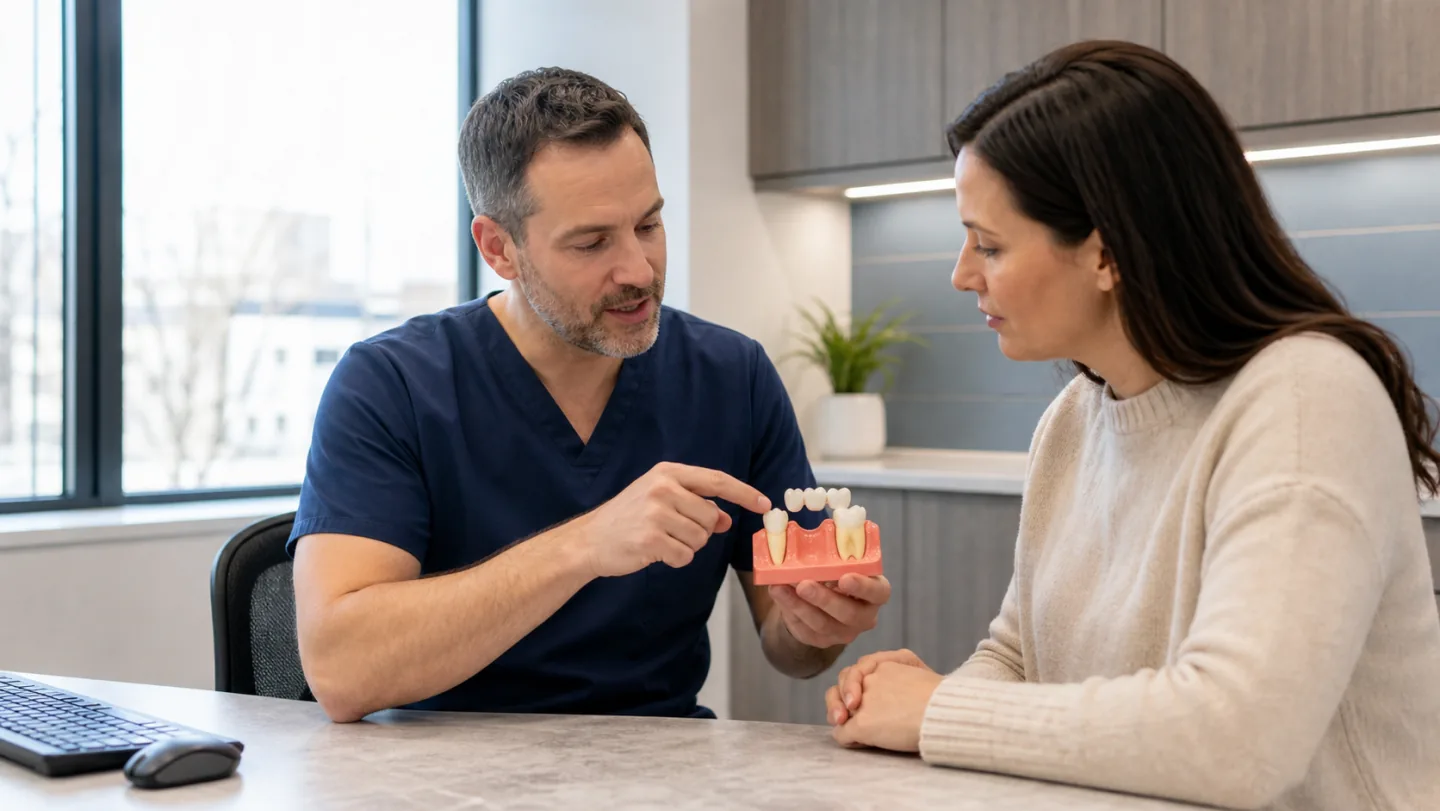
A dentist explaining how a fixed bridge can replace a missing tooth
Gaps in different parts of your mouth

Dental Bridges for Parkview Pointe Residents

A space on the upper left and another on the lower right are two separate problems that happen to share one mouth. Each could call for its own answer, and looking at them together can make the plan more sensible.

Let's find a time

Request an appointment

We’ll call to confirm your appointment. For urgent care, please call us directly.

Separate spaces, shared bite

Planning Around Scattered Gaps, for Parkview Pointe Patients

When teeth are missing in more than one area, the neighbouring teeth, gums and forces can differ from spot to spot. One space may have sturdy potential anchors, while another may not, so the same design is not automatically right for each.

Your upper and lower teeth also work as a system, which means a decision about one area can affect another. Care for Parkview Pointe residents is provided at our clinic on McPhillips Street in Winnipeg, where your dentist can look at the full arrangement before recommending anything.

Explore dental bridges
Reclined pale blue chair with a light arm and wood cabinets in a treatment room at Winnipeg North Dental
A reclined pale blue chair and wood cabinets at Winnipeg North Dental.

Each gap gets judged

Support, span and bite are looked at for every space on its own terms.

Then the whole mouth

The separate answers should fit together into a bite that functions well overall.

Order can be discussed

If everything cannot happen at once, you can ask what your dentist would suggest addressing first.

Mixing and matching

Why two gaps might end up with two solutions.

Fixed bridges, implants and partial dentures can each suit different circumstances, and some mouths may involve more than one.

What can vary by location

These are the points that may make one space a stronger candidate for a bridge than the other.

  • The condition of the teeth directly beside the space.
  • How many teeth are missing in that stretch.
  • How the opposing teeth meet that area.
  • Whether that spot could be realistically cleaned.

What joins the plan together

These are the broader considerations your dentist keeps in view while thinking through each location.

  • How forces are shared across your whole bite.
  • Overall gum health throughout your mouth.
  • Your bone, health and healing if implants are considered.
  • How many teeth remain, which may favour a different option.

When there are a number of missing teeth, a partial denture or a more extensive plan may be raised. Those options are part of the comparison, and what is suitable comes down to your assessment.

When more than one bridge is possible

How the work could be organized.

Each bridge follows the same basic path. Your dentist can explain whether yours might be done together or one at a time, and why.

Request your visit
  1. 01

    Map out your mouth

    The examination looks at every space, along with the gums, alignment, roots and restorations around each one. It ends in a discussion of the options, not a single quick answer.

  2. 02

    Prepare what each design needs

    Any natural anchors are prepared as required, and healed implants are reviewed for connection, according to the plan for each area.

  3. 03

    Take shared and specific records

    Scans or impressions and shade details inform each piece, and bite records show how they relate. Prepared teeth may be protected by a temporary in the interval.

  4. 04

    Check each one against the bite

    Before each bridge is attached, its contacts, margins, appearance and cleaning access are reviewed, and your bite is assessed with it in place.

Mapping it out yourself

Mark which spaces trouble you most.

You might notice that one gap bothers you far more than another when you chew or smile. Telling your dentist helps the plan reflect your priorities, not only what shows up in the examination.

Because several areas may be involved, ask for estimates that show each part, so that you can plan your budget around any stages. Coverage may vary, and depends on your plan.

Worth putting on paper

  • Which gap you notice most, and why.
  • Roughly when each tooth was lost, if you remember.
  • Your prescriptions, plus health news since your last visit.
  • Details of your insurance or CDCP coverage.
Small white child’s chair between two white chairs at a window, with a blue bench along the wall, at Winnipeg North Dental
Consultation room desk with a seascape print on the wall at Winnipeg North Dental

Chairs at a bright window and a seascape print at Winnipeg North Dental.

One area at a time

A big plan can be taken one section at a time.

Hearing about several missing teeth at once can feel overwhelming. Ask to go through your options one area at a time, and tell us if longer appointments would be difficult for you.

Ask for a simple summary

Ask your dentist to recap what each space needs, and jot it down so you can review it at home.

Discuss your own pace

Tell us about limits on your time or energy, so sequencing can be part of the conversation.

Be open about any fears

Several appointments can feel like a lot. Let us know if anxiety is part of why you have waited.

Upkeep in more than one place

Every bridge adds its own spot to your routine.

Different locations can be awkward in different ways. A method that works at the front may be harder at the back, so ask about each area.

01

Match your tools to each area

A floss threader, super floss, interdental brush or water flosser may each have a place. Ask us to demonstrate what suits each bridge.

02

Keep every area under review

Each natural anchor has margins where decay can start, so regular examinations are valuable in all of the treated areas.

03

Mention which side changed

If one bridge moves, chips or feels rough, or your bite shifts, tell the clinic where you notice it.

Persistent bad taste, swelling, bleeding or trapped food around any bridge are also worth a call.

Talk with our team
Winnipeg North Dental shopfront in blue and white, with a low planter along the sidewalk

Winnipeg North Dental

Unit-5 2358 Mcphillips Street, Winnipeg, MB R2V 4J6
Get directions (opens in a new tab)
Parkview Pointe patients, start here

Bring Your Whole Bite to McPhillips Street

All of your visits would take place at Winnipeg North Dental, Unit 5, 2358 McPhillips Street, Winnipeg, MB. You can open the directions link to figure out how you will get there.

Let us know on the form or by phone that you have more than one gap. The clinic reviews your request and then contacts you, since a time is not held automatically.

Questions about coverage?

Talk with our team before your visit or learn about CDCP.

A little clarity before your visit

Your questions, answered.

Helpful details about dental bridges in Parkview Pointe.

Ask our team
Can I have two separate bridges at the same time?

That may be possible, depending on the condition of each area and on your overall plan. Your dentist can explain whether doing them together or in stages makes more sense.

Could one gap get a bridge and another get an implant?

A mixed plan can be an option, because support and anatomy may differ between locations. Implants depend on bone, health and healing, so that is something to assess for each site.

Which gap should be treated first?

It depends on health needs, function and your priorities. Any active problems in the area are typically discussed first, and you can share which gap causes you the most trouble.

Would one long bridge work better than two short ones?

Separate gaps with healthy teeth between them are a different situation from one long span. Your dentist can explain what the support and forces in your mouth would allow.

When does a partial denture make more sense than bridges?

It can be worth discussing when several teeth are missing or the available support is limited. A partial is removable, and your dentist can compare it with fixed choices for you.

Does losing teeth in different places affect my bite?

Your bite relies on how upper and lower teeth meet across your mouth, so missing teeth can change that picture. An assessment can show what is happening in your case.

How do Parkview Pointe residents request a full review?

Use the form on this page or phone (204) 338-3003, and mention how many spaces you have. Your review would be at our McPhillips Street clinic in Winnipeg, and we’ll contact you to arrange it.

See the whole picture

Get your spaces looked at together.

Parkview Pointe residents can ask for a bridge assessment at our Winnipeg clinic. The team will call or write back to set up a time.

Patient testimonials

Kind words from our patients

★★★★★ 5.0 from 440+ reviews on Google

Close to home

Areas we serve

Convenient dental care on McPhillips Street for families across northwest Winnipeg and nearby communities.

Explore all service areas

A healthier smile is one visit away

Ready for dental care that feels genuinely comfortable?

✓ New patients welcome ✓ Direct insurance billing ✓ Multilingual team

How can we help?

Our dental team is here for you.

Ready to book or have a question? Choose the option that works best for you.

For urgent dental concerns, please call us directly.

Send us a message

Our team will reply during clinic hours.



