Skip to content
Winnipeg North Dental
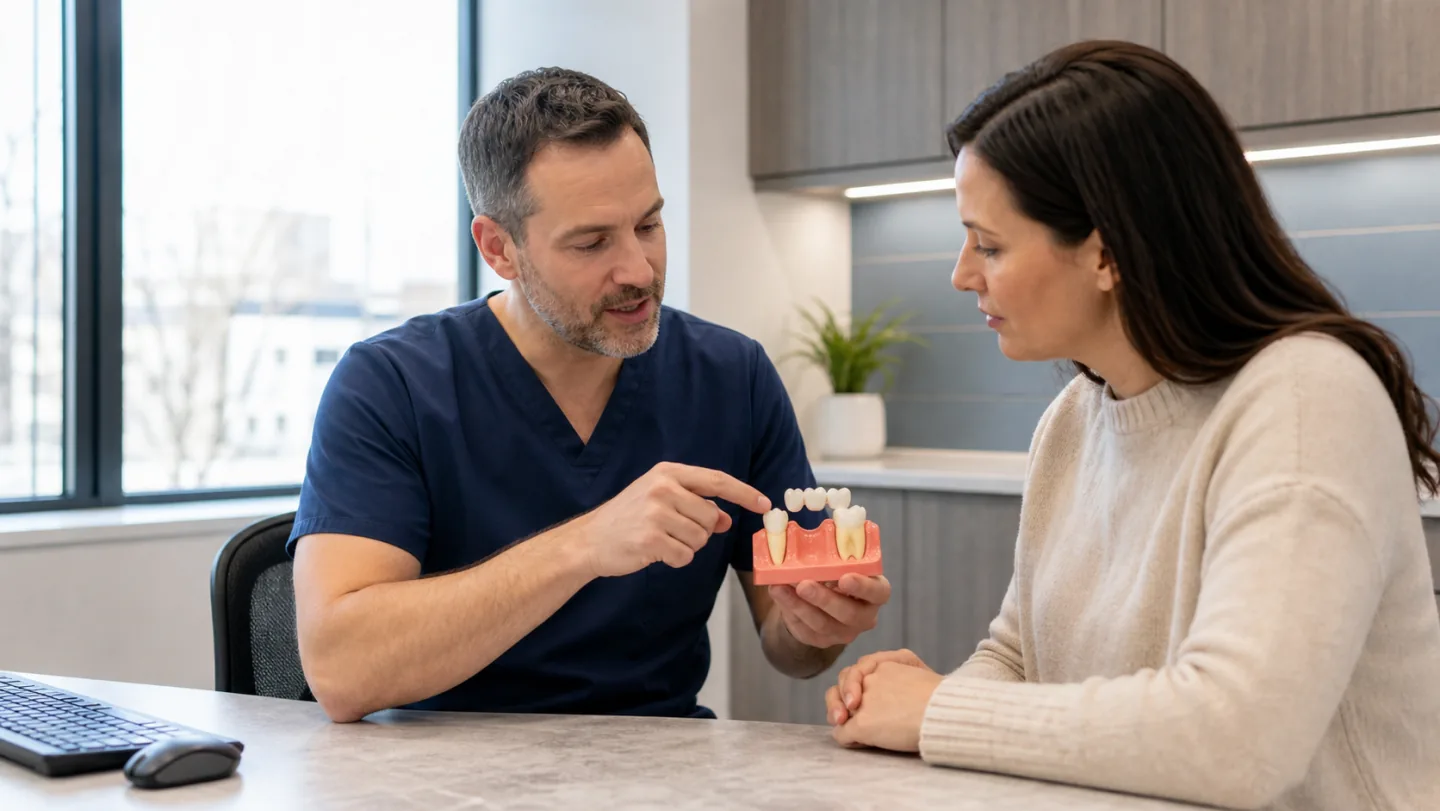
A dentist explaining how a fixed bridge can replace a missing tooth
A plain guide to bridge vocabulary

Dental Bridges for Park View Residents

Anchor, span, margin, unit: if those words went past you in a dental conversation, you are in good company. Here is what they refer to, so you can follow along and ask sharper questions.

Let's find a time

Request an appointment

We’ll call to confirm your appointment. For urgent care, please call us directly.

Decoding the terms

Bridge Language, Translated for Park View Patients

Dentistry has its own shorthand, and bridges bring a good share of it. Most of these terms describe simple ideas: the part that holds, the part that replaces, the distance between them, and the edge where restoration meets natural tooth.

Learning a few of them makes a treatment discussion much easier to follow, though the words alone will not tell you what your own mouth needs. For Park View residents, care takes place at our clinic on McPhillips Street in Winnipeg, and your dentist can show you what each term refers to in your case.

Explore dental bridges
Desk with a keyboard and four black chairs in a bright consultation room at Winnipeg North Dental
Four black chairs around a desk in a bright room at Winnipeg North Dental.

Anchor

A tooth or implant that holds the bridge in position. It has to be able to carry chewing forces.

Span

The length of the space being filled. Longer ones create different mechanical demands.

Margin

The edge where the restoration meets the tooth. Plaque here can contribute to decay.

Two short glossaries

Words for the parts, words for the designs.

Most of what you will hear falls into one of these two groups. Ask for a definition any time a new term comes up, too.

Parts of a bridge

These describe what the restoration is made up of. You may hear them mentioned when a plan is being explained.

  • Unit: one tooth-shaped section of the bridge.
  • Pontic: the artificial tooth that fills the space.
  • Abutment: a supporting tooth or implant, also called an anchor.
  • Connection: where the units join into one fixed piece.

Types of bridge

These tell you where the support is coming from. Which type is appropriate depends on what your examination finds.

  • Tooth-supported: crowns on neighbouring teeth hold it.
  • Implant-supported: dental implants hold it instead.
  • Cantilever: support comes from one side only.
  • Removable partial: a denture you take out, not a bridge.

Different offices may use slightly different words for the same thing. If a term on an estimate does not match this page, just ask what it refers to.

The terms in action

Following the treatment, one word at a time.

Here is how those words tend to appear as the work moves along. Each stage comes with its own bit of language.

Request your visit
  1. 01

    Evaluating abutments

    Potential anchors are examined for root health, gum condition, alignment and any existing restorations. This also reveals what the span and your occlusion, or bite, will demand.

  2. 02

    Preparing the support

    Prepared means that a natural anchor is reshaped to receive its crown, when this is required. Implants that have healed would be assessed for restorative connection.

  3. 03

    Taking records

    A scan or impression captures the shape of your mouth, while a bite record shows how teeth meet. A temporary is a short-term bridge that may protect your prepared teeth.

  4. 04

    Trying in and seating

    A try-in is a test fit covering contacts, margins, bite, looks and cleaning access. Bonded or cemented describes the final attachment after any adjustment.

Coming with your questions

Write down any word you did not catch.

If you have an earlier estimate or a note from another dental visit, circle the terms that puzzled you. They make a practical agenda for your conversation.

Estimates sometimes list a bridge unit by unit. Ask how the listed items relate to your treatment, and what your coverage may apply to.

A short list to prepare

  • Unfamiliar words from past estimates or letters.
  • Your current medications and any health changes.
  • The name of your previous dental office, if any.
  • Your insurance or CDCP details, where relevant.
Reception area with a white counter, wood floor and pale rug at Winnipeg North Dental
Treatment room with a blue chair and wood-toned lower cabinets at Winnipeg North Dental

A white counter on a wood floor and a blue dental chair at Winnipeg North Dental.

Understanding helps

Hearing it twice is not a problem.

Dental terms can be harder to absorb while you are lying back in a chair. Feel free to ask us to slow down, and save bigger questions for when you are sitting up.

Request everyday words

You never need to pretend you followed. Saying you lost the thread helps your team explain it better.

Ask to see a model or image

A picture can make an abstract term obvious, so feel free to ask whether one can be shown.

Tell us if you feel nervous

Worry makes it harder to take in information, and your team would rather know about it.

Words you will keep using

A few terms stay useful after the fitting.

Knowing the language can help when you describe a problem by phone. It lets you say where something feels different, and it helps you follow home-care directions.

01

Threader

This small loop pulls floss beneath a bridge, and it is one of several options, along with super floss, an interdental brush or a water flosser.

02

Recall

You may hear this word for routine return visits. They allow your supports, gums and margins to be checked over time.

03

Bite change

This simply means your teeth no longer meet in the way they did. Give us a call, as you would for looseness, chips or rough edges.

No special vocabulary is needed to report food packing, bleeding, swelling or a bad taste that will not go away.

Talk with our team
Glass entry doors and blue siding below the Winnipeg North Dental sign

Winnipeg North Dental

Unit-5 2358 Mcphillips Street, Winnipeg, MB R2V 4J6
Get directions (opens in a new tab)
Park View questions, answered in person

Ask What the Terms Mean at Our Clinic

Your consultation and any treatment are provided at Winnipeg North Dental, Unit 5, 2358 McPhillips Street, Winnipeg, MB. Follow the directions link to plan the way there.

When you contact us by phone or form, you can say you would like a plan explained. Your request gets a reply from the clinic, and that is when a time is settled.

Questions about coverage?

Talk with our team before your visit or learn about CDCP.

A little clarity before your visit

Your questions, answered.

Helpful details about dental bridges in Park View.

Ask our team
What is the difference between an abutment and an anchor?

In everyday bridge conversations they usually mean the same thing: a tooth or implant holding the restoration in place. Ask your dentist which one is being referred to if it is unclear.

What does three-unit bridge mean?

It usually describes a bridge made of three connected sections, commonly two crowned anchors with one artificial tooth between them. Your plan may be arranged differently, so ask to have it explained.

What does the word preparation involve?

It means shaping a natural tooth so that it can receive a crown, which is a part of many tooth-supported bridges. Ask what this would involve for the specific teeth in your plan.

When someone says bonded, is that the same as permanent?

Bonded or cemented means secured so that you do not take it out yourself. It does not imply the bridge will never need attention or repair, since all restorations require upkeep.

Why do people keep mentioning my occlusion?

That is the dental word for how your upper and lower teeth come together. It matters because opposing teeth and side-to-side movement affect the shape and material of a bridge.

Is pontic the same thing as a false tooth?

More or less. It is the artificial tooth that occupies the space in a bridge, supported by the units around it rather than by a root of its own.

How can Park View residents get a plan explained?

Fill in the form on this page or call (204) 338-3003 and mention what you would like clarified. Consultations are at our McPhillips Street clinic in Winnipeg, and we’ll get back to you about a time.

Make sense of your plan

Ask for it in words you can use.

Park View residents may ask us for a consultation about bridges at our Winnipeg clinic. Once your request arrives, we’ll contact you to arrange it.

Patient testimonials

Kind words from our patients

★★★★★ 5.0 from 440+ reviews on Google

Close to home

Areas we serve

Convenient dental care on McPhillips Street for families across northwest Winnipeg and nearby communities.

Explore all service areas

A healthier smile is one visit away

Ready for dental care that feels genuinely comfortable?

✓ New patients welcome ✓ Direct insurance billing ✓ Multilingual team

How can we help?

Our dental team is here for you.

Ready to book or have a question? Choose the option that works best for you.

For urgent dental concerns, please call us directly.

Send us a message

Our team will reply during clinic hours.



