Skip to content
Winnipeg North Dental
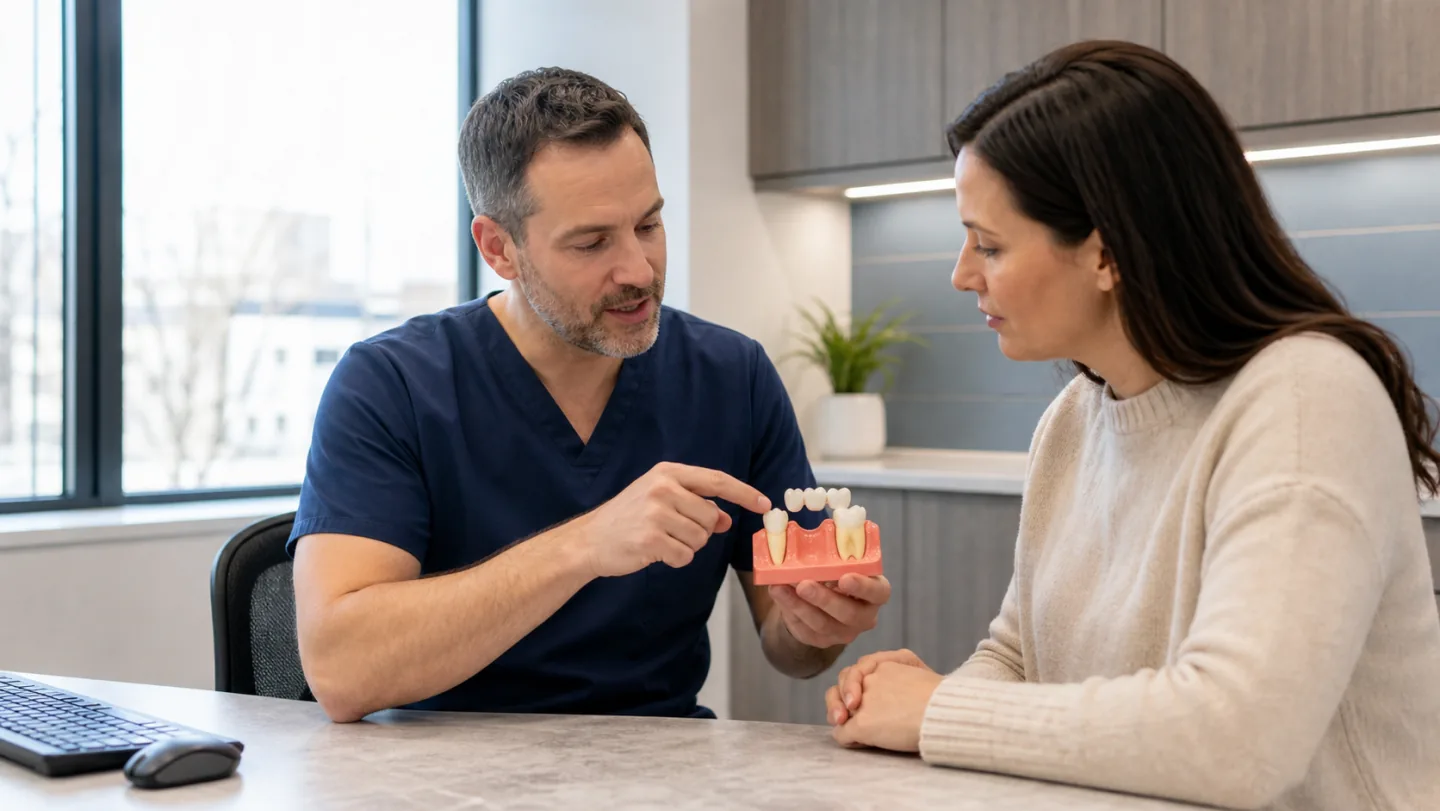
A dentist explaining how a fixed bridge can replace a missing tooth
Honest about your flossing habits

Dental Bridges for Meadows West Residents

Plenty of people skip the floss more often than they admit. If that sounds like you, it is better to say so before a bridge is planned, because the cleaning it needs ought to match what you will really do.

Let's find a time

Request an appointment

We’ll call to confirm your appointment. For urgent care, please call us directly.

Cleaning is part of the design

A Bridge You Can Keep Clean: Notes for Meadows West

One of the things a bridge has to provide is a realistic daily cleaning pathway beneath it and along its margins. That is a design consideration as well as a home-care issue, and it deserves a frank talk during planning.

Plaque left in place can irritate the gums and raises the risk of decay around natural anchor teeth, so this routine truly matters. Patients from Meadows West are seen at our clinic on McPhillips Street in Winnipeg, where you can tell your dentist what a typical evening at the sink looks like for you.

Explore dental bridges
Reception counter with white orchids and a blue bench on a wood floor at Winnipeg North Dental
Orchids on the reception counter, with a blue bench to one side, at Winnipeg North Dental.

Regular floss won’t pass

Connected units block the usual path between teeth, so a different tool has to go underneath.

You have several choices

Some people get on with a threader, while others prefer a small brush or a water flosser.

You will be shown how

Our team demonstrates the tools suited to your bridge, so you are not left working it out by yourself.

Tools and trade-offs

Finding a routine you will still follow next month.

No single tool wins for everyone. The one that helps most is the one that reaches your bridge and that you are willing to pick up each day.

The tools people try

Each of these may help clean below the replacement tooth and around its supports. Your team can suggest which fit your design.

  • A floss threader, which guides ordinary floss under the bridge.
  • Super floss, which has a stiffer end for threading through.
  • An interdental brush, for spaces that can accommodate one.
  • A water flosser, used as your team advises.

What to tell your dentist

Details about your habits can help your dentist plan more honestly. There is no need to make them sound better than they are.

  • How often you clean between your teeth right now.
  • Anything that makes reaching the back of your mouth awkward.
  • Whether your hands find small tools difficult.
  • How your gums have tended to react in the past.

If a fixed design looks difficult for you to maintain, ask what your alternatives are. A partial denture comes out for cleaning, and that is one of the differences worth comparing.

Cleaning checks along the way

The stages, with hygiene in mind.

Keeping a bridge clean is not an afterthought tacked on at the end. Your ability to reach under it is reviewed as the work progresses.

Request your visit
  1. 01

    Assess the starting point

    Your dentist looks at your gums, potential anchors, alignment, bite and old restorations. Any existing gum concerns should come up before planning goes further.

  2. 02

    Get the supports ready

    Neighbouring teeth are prepared if the design needs them. Where implants are healed and in position, they are assessed for connection instead.

  3. 03

    Send off the records

    The bridge is made from what gets captured here: your scan or impressions, how you bite, and the shade. You may wear a temporary in the meantime, which protects any prepared teeth.

  4. 04

    Trial the cleaning access

    At the try-in, the team confirms contacts, margins, bite and appearance, as well as whether cleaning access is adequate, before final attachment.

A candid starting point

Skip the pre-appointment flossing panic.

A last-minute burst of flossing will not change what your dentist needs to know, and neither will an apology. Simply describe your current routine as it is, including the parts you tend to leave out.

If you are tempted to buy a water flosser or any other gadget in advance, hold off and ask which tools suit your bridge once the design is known.

Notes to bring along

  • The cleaning products you currently use at home.
  • Any spots where your gums tend to bleed.
  • Anything new in your health or prescriptions.
  • Your coverage card or CDCP paperwork.
Consultation room with a window blind, snake plant and black chairs at Winnipeg North Dental
Light blue dental chair beside wood-toned cabinets at Winnipeg North Dental

A desk by a window blind and a light blue dental chair at Winnipeg North Dental.

No lectures here

Telling the truth about your routine should feel safe.

Being honest about how often you floss is useful information. It helps us recommend what you are able to keep up, and you are welcome to say when a suggestion feels unrealistic.

Say what feels awkward

Trouble with a certain angle or tool is worth mentioning, since another one may suit you more.

Ask for a second demonstration

Threading under a bridge often feels clumsy at first. Asking to see it again is completely reasonable.

Mention tender gums

If cleaning hurts or your gums bleed, tell your team instead of quietly avoiding that area.

Making the habit stick

Once a day, one tool, the same place.

Keep your cleaning tool where you will actually see it and pair it with something you already do each day. The aim is plaque removal you can sustain, even when it is not perfect.

01

Start with what you can manage

Ask your team to walk you through the tool chosen for your bridge, and try it with a mirror at home until the motion feels easier.

02

Let examinations back you up

Natural anchors can develop decay at bridge margins, which you may not be able to notice. Regular visits are a second set of eyes.

03

Treat signs as signals

If food keeps packing in, or you notice bleeding, swelling or a bad taste that persists, phone the clinic and describe it.

Also report any movement, chip, rough edge or change in your bite.

Talk with our team
Front of Winnipeg North Dental, with frosted windows on each side of the glass doors

Winnipeg North Dental

Unit-5 2358 Mcphillips Street, Winnipeg, MB R2V 4J6
Get directions (opens in a new tab)
Meadows West and your routine

Talk Through Bridge Cleaning at Our Clinic

Meadows West is in Winnipeg, and your bridge appointments take place at Winnipeg North Dental, Unit 5, 2358 McPhillips Street, Winnipeg, MB. A directions link is available for planning your visit.

Mention your cleaning concerns on the form or by phone. Submitting a request is not a booked slot, because the clinic confirms the appointment with you afterward.

Questions about coverage?

Talk with our team before your visit or learn about CDCP.

A little clarity before your visit

Your questions, answered.

Helpful details about dental bridges in Meadows West.

Ask our team
Will I be refused a bridge because I rarely floss?

Being honest should not count against you. Your dentist considers your gum health and how realistic the required cleaning is, and then discusses the choices that seem suitable.

Which cleaning tool is easiest to use?

That varies with the person and with how the bridge is shaped. Our team can demonstrate the tools suited to yours, and you can say which ones feel manageable in your own hands.

Do I have to clean under it every single day?

Daily plaque removal is what protects the gums and helps reduce decay risk near natural anchors. If that sounds like a stretch, say so while planning is still under way.

What happens if I fall out of the habit?

Plaque can build up beneath the bridge and along its edges, which may affect your gums and anchor teeth. Get back to your routine, and let the clinic know about any bleeding or bad taste.

Does a removable partial take less effort to clean?

It is taken out for cleaning, while a fixed bridge has to be cleaned in place. Each option has its own upkeep, so ask how the two would compare given your mouth and your routine.

Could the bridge be shaped to make cleaning simpler?

Cleanability is one of the things considered when a bridge is designed, along with support, span and bite. You can ask how your dentist would allow for access in your case.

How do Meadows West residents bring this up?

Note it on the form here or tell the team when you call (204) 338-3003. Your assessment would be at our McPhillips Street clinic in Winnipeg, and we’ll respond to work out a time.

Plan it around real life

Tell us how you actually clean your teeth.

Meadows West residents can ask about a bridge assessment at our McPhillips Street clinic. The team will contact you to set up your visit.

Patient testimonials

Kind words from our patients

★★★★★ 5.0 from 440+ reviews on Google

Close to home

Areas we serve

Convenient dental care on McPhillips Street for families across northwest Winnipeg and nearby communities.

Explore all service areas

A healthier smile is one visit away

Ready for dental care that feels genuinely comfortable?

✓ New patients welcome ✓ Direct insurance billing ✓ Multilingual team

How can we help?

Our dental team is here for you.

Ready to book or have a question? Choose the option that works best for you.

For urgent dental concerns, please call us directly.

Send us a message

Our team will reply during clinic hours.



