Skip to content
Winnipeg North Dental
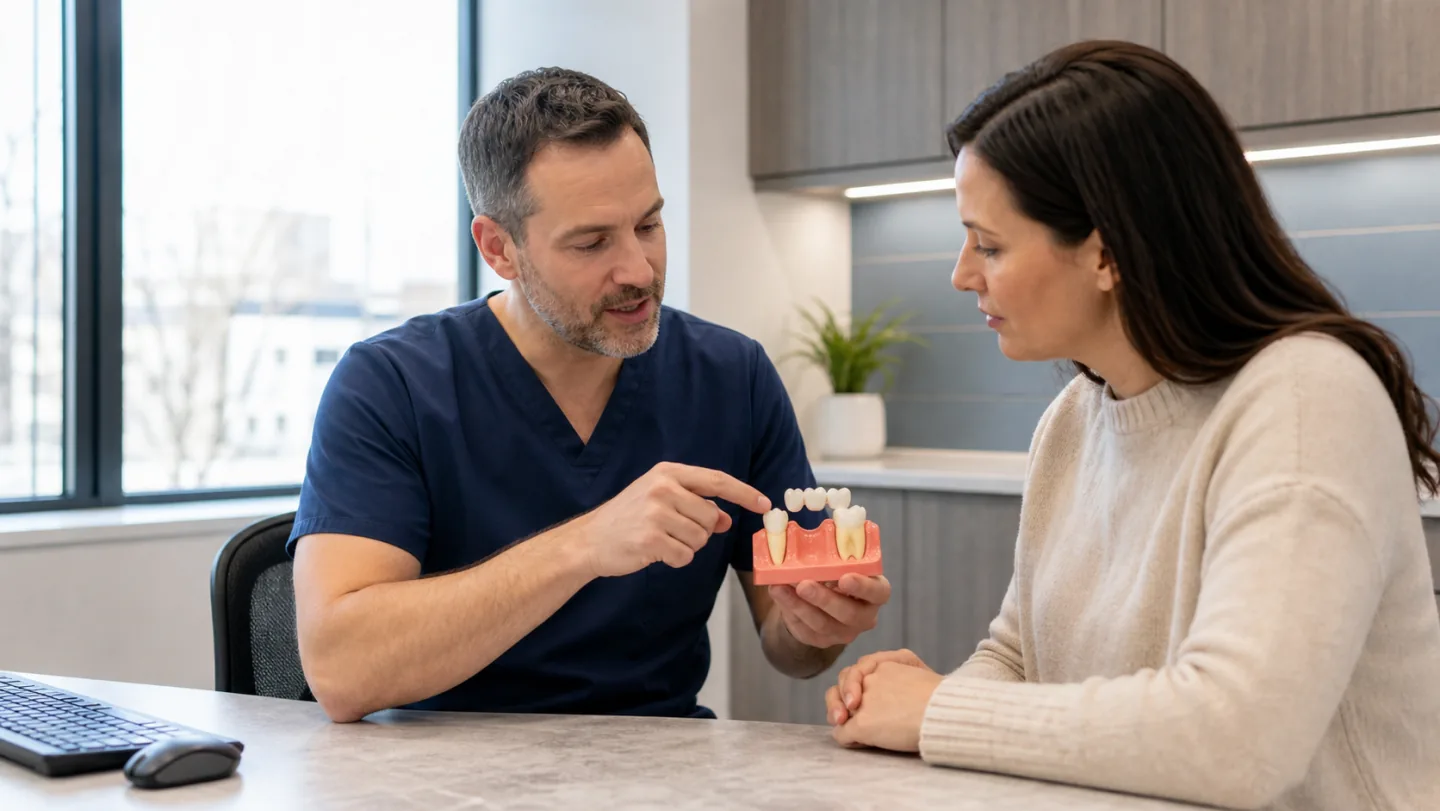
A dentist explaining how a fixed bridge can replace a missing tooth
Thinking about the long haul

Dental Bridges for Highland Pointe Residents

If you want to know what you would be signing up for years from now, that is a sensible way to weigh a bridge. No honest answer comes with a fixed number, but plenty can be said about what shapes the outcome.

Let's find a time

Request an appointment

We’ll call to confirm your appointment. For urgent care, please call us directly.

A longer view of treatment

What Shapes a Bridge Over Time, for Highland Pointe Patients

Nobody can promise you a set lifespan for a dental bridge. How it fares depends on the supporting teeth or implants, your bite, the material, the health of your gums, whether decay develops, and the maintenance it receives along the way.

Some of those factors get settled during planning, and others stay in your hands long after the fitting. For Highland Pointe residents, the assessment takes place at our clinic on McPhillips Street in Winnipeg, and it is a fair moment to ask how each factor looks in your particular mouth.

Explore dental bridges
Reclined teal dental chair with a monitor on the counter behind it at Winnipeg North Dental
A monitor on the counter behind a teal chair at Winnipeg North Dental.

No promised number

Anyone quoting an exact count of years is guessing, because several variables are in play at once.

Planning counts

Sound support and a design suited to your bite give a bridge a more reasonable footing from the start.

Upkeep counts too

Daily plaque removal and regular examinations help protect the natural teeth that hold everything up.

Decided now, tended later

Two sets of factors influence how long it serves you.

It can help to separate what gets chosen during planning from what depends on the years that follow.

Settled at the planning stage

These are the structural decisions, made after your dentist has examined the space and what surrounds it.

  • Whether the proposed anchors can carry chewing forces.
  • The length of the span being replaced.
  • How opposing teeth and sideways movements affect shape.
  • A material chosen with your bite in mind.

Tended year after year

These stay with you for as long as you have the bridge, and they can change as your mouth changes.

  • Plaque control beneath the bridge and along its edges.
  • The condition of your gums around each support.
  • Early attention to chips, rough spots or looseness.
  • Examinations that look for decay at the margins.

If a design looks fragile for your situation, ask directly what might wear or fail first, and how that would be handled.

Built with the future in mind

Where each stage supports durability.

Treatment moves through several stages, and every one contributes something to how sound the finished work will be.

Request your visit
  1. 01

    Test the foundation

    Roots, gums, alignment and existing restorations on potential anchors are all reviewed. For implants, the planning also weighs bone, general health and healing.

  2. 02

    Ready the supports

    Natural anchors receive whatever preparation the design requires. An implant that has already healed is assessed to see if it can take a restorative connection.

  3. 03

    Capture bite and shade

    Impressions or scans and bite records guide how the piece gets made. During this wait, a temporary may look after prepared teeth and your appearance.

  4. 04

    Confirm before securing

    Your dentist goes over the contacts, margins, bite, look and cleaning access, adjusting as needed, and only then attaches the final bridge.

Questions with a long horizon

Ask about year ten, not only week one.

Consider raising what the future might look like for you. What tends to require attention first? What would happen if one support developed a problem? Those answers are often more useful than a single estimate of years.

Long-term cost is part of the comparison too. Once options are on the table, you can ask for estimates and talk through what your coverage might apply to.

Jot down before you come

  • Any history of chipped or broken dental work.
  • How often you have managed regular dental visits lately.
  • Your medications and any relevant health conditions.
  • Whether you wake up with a sore jaw or worn-looking teeth.
Two white chairs at small tables by a window blind, with a blue bench alongside, at Winnipeg North Dental
White desk with black chairs and a snake plant near a window at Winnipeg North Dental

White chairs by a window and a white desk at Winnipeg North Dental.

Weighing a big decision

You are allowed to think it over.

A bridge is a considerable commitment, and wanting time before you answer is reasonable. Ask what you would like to know, then decide when you have what you need.

Ask about the trade-offs

Every tooth-replacement choice gives something and asks something, and hearing both sides is part of informed consent.

Take your time with it

Unless something is urgent, you can go home with what you heard and reflect before committing.

Mention what worries you

Whether it is the cost, the chair or the commitment, naming it helps keep the talk useful.

The years after the fitting

Small habits carry a lot of weight.

Once the bridge is secured, most of what protects it happens at your bathroom sink. The rest takes place at routine examinations, where your team can check what you cannot see.

01

Daily reach underneath

Regular floss stops at the joined units, so a threader, super floss, interdental brush or water flosser may be recommended. Ask to be shown how.

02

Routine eyes on it

Decay at anchor margins and shifts in gum health can develop quietly, which is why examinations remain so important.

03

Early word on changes

Contact us when the bridge moves, chips, feels rough or changes your bite. Waiting rarely makes these simpler.

Repeated food packing, bleeding, swelling or an ongoing bad taste deserve a call as well.

Talk with our team
Blue and grey siding around the Winnipeg North Dental entrance, with planters at the walkway

Winnipeg North Dental

Unit-5 2358 Mcphillips Street, Winnipeg, MB R2V 4J6
Get directions (opens in a new tab)
Highland Pointe and the long view

Discuss the Long-Term Picture at Our Clinic

Highland Pointe is in Winnipeg, and bridge care takes place at Winnipeg North Dental, Unit 5, 2358 McPhillips Street, Winnipeg, MB. Open the directions link when planning your visit.

A phone call or the form below can start things off. Your request does not lock in a time until the clinic has been in touch with you.

Questions about coverage?

Talk with our team before your visit or learn about CDCP.

A little clarity before your visit

Your questions, answered.

Helpful details about dental bridges in Highland Pointe.

Ask our team
Can you tell me how many years mine would last?

Not as a promise. Support, bite, cleaning, decay, gum health, material and maintenance all play a part, so your dentist can only discuss what looks favourable or concerning in your case.

What usually causes trouble with a bridge over time?

The natural supports are a common concern, since decay can begin at the margins and gum health can change. Heavy forces and worn or chipped surfaces can also come into it.

Does the material make much of a difference?

It can. Opposing teeth and the way your jaw moves side to side influence both the shape and the material selected, so ask why a particular one is being proposed for you.

Is a longer span more of a risk than a short one?

A longer space places different mechanical demands on the bridge, which makes the quality of the support increasingly important. Your examination shows how that applies to the gap you have.

Does a bridge ever need replacing?

It can, and that may be because of changes in a support, in your gums or in the bridge itself. Regular examinations give your team a chance to spot these changes and talk over what to do.

How does long-term upkeep compare with an implant?

A tooth-supported bridge relies on natural anchors that can decay, while an implant raises questions about bone and healing. Both need cleaning and regular reviews, so ask how they compare for you.

How do Highland Pointe residents ask these questions in person?

Request an assessment using the form on this page or by calling (204) 338-3003. It takes place at our McPhillips Street clinic in Winnipeg, and the team will reach out about timing.

Plan for the years ahead

Ask what a bridge would need from you over time.

Highland Pointe residents can request a bridge assessment at our Winnipeg clinic, and we’ll follow up with you about scheduling.

Patient testimonials

Kind words from our patients

★★★★★ 5.0 from 440+ reviews on Google

Close to home

Areas we serve

Convenient dental care on McPhillips Street for families across northwest Winnipeg and nearby communities.

Explore all service areas

A healthier smile is one visit away

Ready for dental care that feels genuinely comfortable?

✓ New patients welcome ✓ Direct insurance billing ✓ Multilingual team

How can we help?

Our dental team is here for you.

Ready to book or have a question? Choose the option that works best for you.

For urgent dental concerns, please call us directly.

Send us a message

Our team will reply during clinic hours.



