Skip to content
Winnipeg North Dental
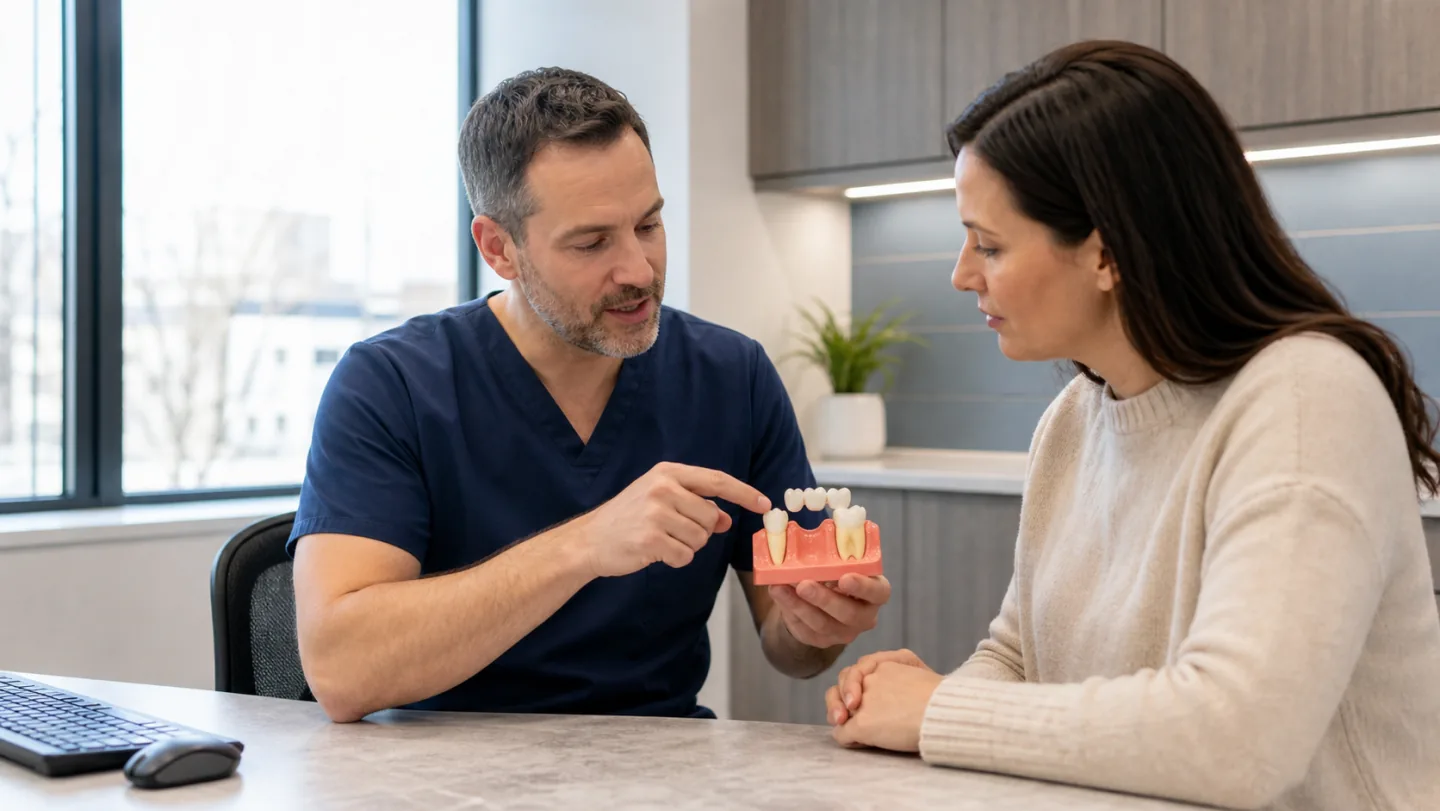
A dentist explaining how a fixed bridge can replace a missing tooth
A taste that keeps coming back

Dental Bridges for Elmwood Residents

You brush, you rinse, and an hour later that unpleasant taste near your bridge has returned. It can be awkward to bring up. It is also precisely the kind of change worth reporting.

Let's find a time

Request an appointment

We’ll call to confirm your appointment. For urgent care, please call us directly.

Awkward, and worth mentioning

An Unpleasant Taste or Smell Near a Bridge

A bridge is a connected structure with an underside you cannot see, and plaque or food can collect there without you knowing. A persistent bad taste does not reveal its own cause, though, so looking it up is unlikely to settle things.

For patients living in Elmwood, an area of Winnipeg, an examination at our McPhillips Street clinic is how the source gets looked for. Your dentist can check the gums, the margins and the supporting teeth, and tell you what the findings suggest.

Explore dental bridges
Winnipeg North Dental treatment room with a reclined teal dental chair on a wood-look floor
The blue-green patient chair, reclined, in one Winnipeg North Dental room.

Common enough to raise

Nobody needs to feel embarrassed about describing a smell or taste to a dental team.

More than one possibility

Trapped debris, irritated gums and decay at an anchor are among the things considered.

Cleaning matters here

A demonstration can reveal whether your current routine is truly reaching the underside.

Tracing the source

What gets looked at when a bridge smells or tastes off.

Your dentist cannot name the cause until the area is examined. These are the broad territories that the examination tends to cover.

Around and under the bridge

Attention goes first to places where debris may sit and where a seal could have changed.

  • Food packing beneath the artificial tooth or beside it.
  • Margins where a crown meets a natural anchor.
  • Any rough edge, chipped surface or sign of movement.
  • Whether cleaning tools can reach each side of the span.

The tissues and teeth that support it

A bridge depends on what lies below, so its foundation receives a careful look as well.

  • Bleeding or swelling along the gums.
  • Decay on an anchor tooth, where one is used.
  • Root health, using X-rays if they are clinically appropriate.
  • Implant surroundings, for a bridge supported that way.

Some findings call for simple changes at home, while others may mean repair or replacement. Your examination decides which direction applies, so try not to assume the worst beforehand.

What to expect from the visit

Getting from a vague worry to a clear explanation.

Your appointment is mostly about finding out. Any further treatment is something you would talk over after your dentist has shared what was found.

Request your visit
  1. 01

    Describe the pattern

    Say how long the taste has been there, whether particular foods trigger it, and whether you have spotted bleeding or tenderness.

  2. 02

    Examine the area

    Your dentist inspects the bridge, its margins and the gums, then checks how securely it sits and how it meets your opposing teeth.

  3. 03

    Explain what turned up

    You hear what appears to be involved and which options make sense, whether that is cleaning help, further treatment or simply monitoring.

  4. 04

    Decide on next steps

    If a new bridge is advised, support is prepared, design records are captured, a temporary may be placed, and the fit is checked prior to attachment.

Noticing the details

A few observations can narrow things down.

Before your visit, pay attention to when the taste shows up. You do not need a diary. A rough sense of what makes it stronger or weaker is already useful.

Keep to your normal cleaning routine beforehand and mention any changes you have tried recently. Fees for any further treatment can be discussed once a cause is clearer.

Worth having ready

  • The approximate age of the bridge, and where it was placed.
  • When you first noticed the taste or smell.
  • The cleaning tools you use around it now, if any.
  • Your medications, as well as any recent health changes.
Bright Winnipeg North Dental waiting area with window blinds, plants and a blue bench
White consultation desk with black office chairs at Winnipeg North Dental

A row of seats under tall blinds, plus the desk where consultations happen.

No judgment here

You do not have to apologize for your bridge.

Some people delay a visit because they suspect they have been cleaning badly. Bridges can be tricky to clean, even for careful people, and describing the problem plainly is the most helpful thing you can do.

Point to the spot

If the taste seems strongest on one side, show your dentist where before the exam begins.

Flag any tender area

Letting us know about sore gums beforehand helps the examination go more gently around them.

Ask to watch a demonstration

Seeing a cleaning tool used in your own mouth may be easier than following written instructions.

Keeping it from returning

Daily care for the part you cannot see.

Whatever the cause turns out to be, the area beneath a bridge will keep needing its own attention. Daily plaque removal there helps protect the gums and lowers the risk of decay around natural anchors.

01

Reach underneath every day

Regular floss will not pass down through joined units, so a threader, super floss, interdental brush or water flosser may be what gets you underneath.

02

Return if it lingers

A taste that fades and later comes back still counts, and so does new bleeding, swelling or packing food.

03

Book regular examinations

Trouble at the edge of an anchor crown can develop quietly, and a routine check-up gives someone the chance to spot it.

Swelling or pain that feels urgent means calling the clinic straight away, not filling out the form.

Talk with our team
Entrance to Winnipeg North Dental in a blue-grey building with large shaded windows

Winnipeg North Dental

Unit-5 2358 Mcphillips Street, Winnipeg, MB R2V 4J6
Get directions (opens in a new tab)
Where to have it checked

Bring That Bridge Concern to McPhillips Street

Elmwood residents with a bridge concern are examined at Winnipeg North Dental, Unit 5, 2358 McPhillips Street, Winnipeg, MB R2V 4J6, including any treatment that may be needed.

Tell us what you are noticing when you call or send the form. Your time is not booked until the clinic gets back to you to confirm.

Questions about coverage?

Talk with our team before your visit or learn about CDCP.

A little clarity before your visit

Your questions, answered.

Helpful details about dental bridges in Elmwood.

Ask our team
Why does my bridge have a bad taste or smell?

Several things can produce it, including trapped food, plaque, gum inflammation or decay at a supporting tooth. An examination is the way to find out which applies to you.

Does a bad taste mean my bridge has failed?

Not necessarily. Some causes turn out to be manageable with better access for cleaning, while others call for more work. Your dentist can tell you after looking.

Can mouthwash take care of it?

Rinsing may mask a taste for a while without reaching whatever is causing it. Have the area examined if the problem keeps returning.

Will the bridge have to come off for you to find out?

Not as a routine first step. Your dentist begins by examining the area and considers any further investigation based on what those early findings show.

Should I wait to see if it clears up on its own?

A persistent bad taste is one of the changes to tell us about, so there is good reason to call instead of waiting for weeks. Call right away if swelling appears.

How do Elmwood residents get a bridge checked?

Request a visit through this page or phone (204) 338-3003, mentioning the taste and the age of your bridge. The clinic will reply about arranging a time.

Swap the worry for an answer

Get that lingering taste examined.

Elmwood residents can request a bridge examination at our clinic on McPhillips Street, and we will respond to set up a time.

Patient testimonials

Kind words from our patients

★★★★★ 5.0 from 440+ reviews on Google

Close to home

Areas we serve

Convenient dental care on McPhillips Street for families across northwest Winnipeg and nearby communities.

Explore all service areas

A healthier smile is one visit away

Ready for dental care that feels genuinely comfortable?

✓ New patients welcome ✓ Direct insurance billing ✓ Multilingual team

How can we help?

Our dental team is here for you.

Ready to book or have a question? Choose the option that works best for you.

For urgent dental concerns, please call us directly.

Send us a message

Our team will reply during clinic hours.



