Skip to content
Winnipeg North Dental
A dentist carefully completing a tooth-coloured bonding treatment
Slightly crooked, or shaped that way?

Dental Bonding for Weston Residents

A tooth can look out of line because of where it sits or because of its outline. The two problems can look alike in the mirror, yet they point toward quite different kinds of treatment.

Let's find a time

Request an appointment

We’ll call to confirm your appointment. For urgent care, please call us directly.

Adding versus moving

Bonding or Alignment: A Comparison for Weston Residents

Maybe you’ve never had orthodontic work, and one lateral incisor has always sat a shade behind the others. It’s natural to wonder if a little resin could even things out without any need for trays or brackets. Sometimes a small visual improvement is possible. Sometimes it isn’t.

Here’s the essential difference. Composite changes the outline of a tooth, whereas orthodontics changes where the tooth and its root actually sit, along with how your bite comes together. At our clinic on McPhillips Street in Winnipeg, the dentist can examine which of these your concern really involves.

Explore dental bonding
Reception area with white desk, glass partition, artwork and wood flooring at Winnipeg North Dental
White desk, glass partition and artwork along a wood-floored entry.

Outline can be altered

Resin can refine an edge or fill out a contour, which sometimes softens the look of slight irregularity.

Position stays where it is

No amount of composite moves a root, so the actual placement of the tooth remains unchanged.

Too much width backfires

Trying to disguise position with bulk can leave a tooth looking oversized or harder to keep clean.

Resin and alignment, compared

What each approach is really doing.

Neither option is the right one for everybody. They simply solve different problems, and comparing them this way can help you recognize which question you’re asking.

When you add composite

The tooth stays in its current location while the visible shape gets changed to relate better to its neighbours.

  • Suited to small differences in outline or edge length.
  • Usually needs little or no removal of enamel.
  • Can often be finished in one visit.
  • Can chip, stain or wear, and may need upkeep.

When teeth are moved

Orthodontics treats the alignment itself, including root position and how upper and lower teeth relate to each other.

  • Addresses the cause when position is the issue.
  • Can include the bite relationship, not just appearance.
  • Involves a course of treatment rather than a single visit.
  • Doesn’t change a tooth’s natural shape or chipped edges.

The two aren’t always either-or. Where it suits the teeth, aligning first and refining a shape afterwards may come up in discussion.

How the choice gets made

Finding out what’s really going on.

An assessment looks past what you see from the front. Here’s how a visit may unfold, for people who could end up on either path.

Request your visit
  1. 01

    Study position and bite

    The dentist checks where the tooth sits, how it meets the opposite teeth, and whether its shape or its placement is causing the appearance you’ve noticed.

  2. 02

    Talk through both routes

    You’ll hear what resin could plausibly do, what moving the tooth would address instead, and what each would involve in terms of upkeep.

  3. 03

    If you choose bonding

    Shade comes first, followed by conditioning of the enamel. Composite is then added and contoured in layers, with a curing light hardening each one.

  4. 04

    Verify and finish

    Contact with the opposing teeth is checked, since a tooth out of line can have unusual contacts. Texture and polish complete the work.

Questions to sit with

Think about how much you want changed.

Are you bothered by the look of one tooth, or does your bite also concern you? Would you consider a longer course of treatment, or are you hoping for something simpler? Your answers will help to steer the conversation.

It’s fine not to know yet. Understanding your options may well change what you’d like to do.

What to mention at the exam

  • Whether you’ve had braces or aligners in the past.
  • Any difficulty cleaning around the tooth in question.
  • Your medical history and medications.
  • Whichever insurance or CDCP particulars you hold.
Desk with keyboard and black chairs in a bright room with window blinds at Winnipeg North Dental
Dental operatory with a wall-mounted monitor and light blue chair at Winnipeg North Dental

A desk with a keyboard and black chairs, then an operatory with a wall-mounted monitor.

No wrong answer

You can prefer the simpler path.

You don’t have to want perfect alignment. Plenty of people are content with teeth that aren’t textbook-straight, and some choose to leave things as they are. What’s important is that the choice is informed and yours.

Say what you’d tolerate

If trays or brackets aren’t something you’d consider, mention that early so the discussion stays relevant.

Flag bite discomfort

Soreness or a sense that teeth don’t meet comfortably is well worth raising, whatever you decide about appearance.

Ask to see the limit

It’s reasonable to ask how far resin could go on your tooth before the shape started to look unnatural.

Whichever way you go

Your choice and how it holds up.

After either route, the longer-term picture matters. A tooth sitting out of line can receive force differently, so it pays to keep an eye on the resin in that spot.

01

Uneven contact

A corner that takes more force may be prone to chipping. Report any new roughness rather than waiting for it to go further.

02

Crowded spots

Overlapping areas can be fiddly to clean, and both your natural enamel and composite margins depend on steady brushing and flossing.

03

Room to revisit

Should you decide on alignment treatment later on, tell the provider about your bonding, since shapes may need to be reconsidered.

Have a question about shifting teeth or your bonded edge? Call the clinic.

Talk with our team
Building exterior with dark grey siding, large windows and a Winnipeg North Dental sign

Winnipeg North Dental

Unit-5 2358 Mcphillips Street, Winnipeg, MB R2V 4J6
Get directions (opens in a new tab)
Getting both sides explained

McPhillips Street Assessments for Weston Residents

If you live in Weston, an area in Winnipeg, the assessment takes place at Winnipeg North Dental, Unit 5, 2358 McPhillips Street, Winnipeg. Use the directions link to work out how you’ll get there.

Phone (204) 338-3003 or fill out the form below to ask for a time. You’re booked only when you’ve heard back from the clinic with a confirmation.

Questions about coverage?

Talk with our team before your visit or learn about CDCP.

A little clarity before your visit

Your questions, answered.

Helpful details about dental bonding in Weston.

Ask our team
How do I get a slightly crooked tooth assessed from Weston?

Send a request with this page’s form or call (204) 338-3003. The examination would happen at Unit 5, 2358 McPhillips Street, Winnipeg, on a date the clinic arranges with you.

Can bonding make a crooked tooth look straight?

It can sometimes improve the look of a very slight irregularity by changing the outline, but the tooth doesn’t actually move. Whether the effect would seem natural in your case is something to discuss after an exam.

Would I need braces instead?

That depends on your teeth and bite. Orthodontics addresses root position and how teeth meet, which resin can’t do, so it’s often more appropriate when position is the true concern.

Is one rotated tooth enough of a reason to ask about this?

Yes. A single tooth is reason enough for a conversation. The dentist can look at how it sits and tell you which options are appropriate, including leaving it as it is.

Could bonding make the problem look worse?

It could if too much is asked of it. Excess width may lead to odd proportions, plaque traps or bite interference, which is why limits are discussed before anything is added.

Can I align my teeth first, then bond them?

That sequence is sometimes considered when the shape still needs refining after movement is complete. Ask how the timing might work for your teeth, as it depends on your treatment.

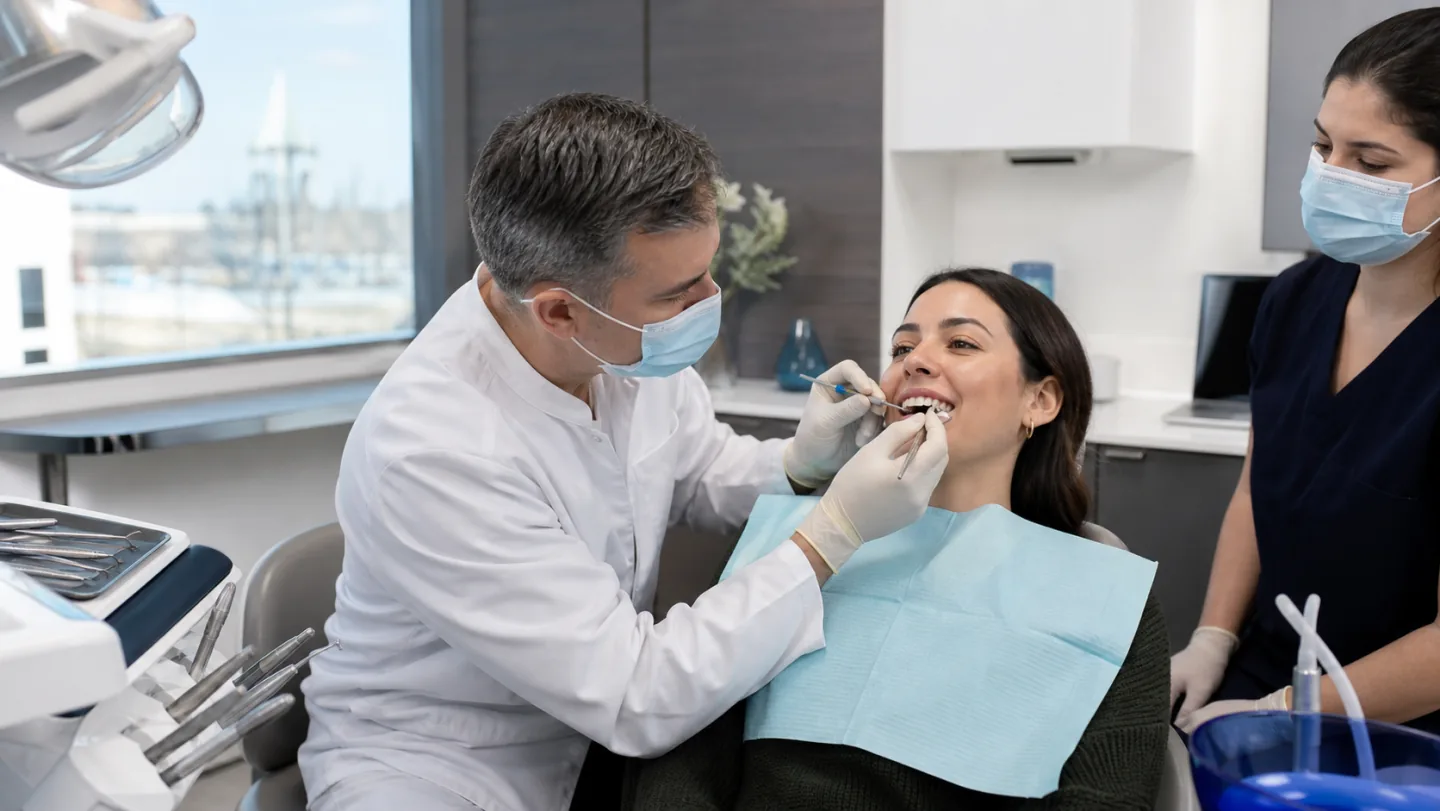
Shape or position?

Have the tooth looked at properly.

Weston residents are welcome to ask for an assessment at our clinic in Winnipeg. The clinic will contact you to discuss options for a visit.

Patient testimonials

Kind words from our patients

★★★★★ 5.0 from 440+ reviews on Google

Close to home

Areas we serve

Convenient dental care on McPhillips Street for families across northwest Winnipeg and nearby communities.

Explore all service areas

A healthier smile is one visit away

Ready for dental care that feels genuinely comfortable?

✓ New patients welcome ✓ Direct insurance billing ✓ Multilingual team

How can we help?

Our dental team is here for you.

Ready to book or have a question? Choose the option that works best for you.

For urgent dental concerns, please call us directly.

Send us a message

Our team will reply during clinic hours.



