Skip to content
Winnipeg North Dental
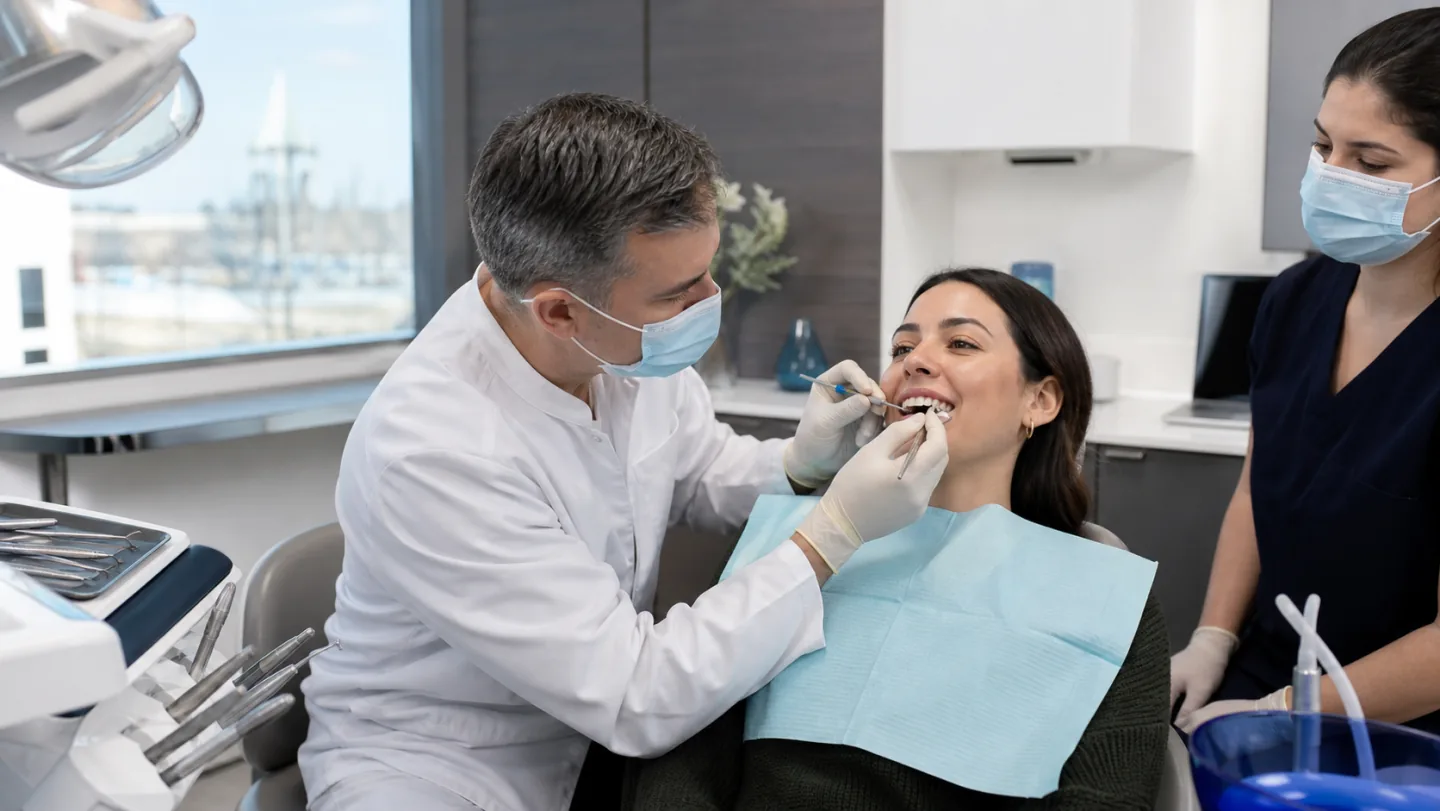
A dentist carefully completing a tooth-coloured bonding treatment
How resin becomes tooth

Dental Bonding for Robertson Residents

There’s no mould and no lab model here. The restoration is built by hand on your own tooth, a thin layer at a time, and this page walks through what’s going on as it takes shape.

Let's find a time

Request an appointment

We’ll call to confirm your appointment. For urgent care, please call us directly.

For the curious patient

How Bonding Is Built, Explained for Robertson Residents

If you like to understand a process before you sit down for it, direct bonding makes an interesting subject. Composite starts out soft, stays workable while it’s being positioned, and sets only when a curing light reaches it. The dentist sculpts it right there in your mouth.

A believable result calls for more than the correct colour. Where the edge sits, how the tooth pairs up with its neighbour, the way its surface catches light, and how it meets the opposite teeth all contribute. Those decisions get made chairside, at our clinic on McPhillips Street in Winnipeg.

Explore dental bonding
Light blue dental chair with an overhead arm and wood cabinets at Winnipeg North Dental
Light blue chair, overhead arm and wood cabinets in a treatment room.

Shaped at the chair

Modest changes can be sculpted directly, with nothing being sent away for fabrication.

Several opacities at work

Different resin shades can imitate how natural enamel and the tooth beneath it handle light.

Hardened on command

Each increment stays soft until a special light cures it, which gives time for careful placement.

The four things being controlled

What your dentist is balancing.

Dentists often think about direct resin in terms of colour, contour, texture and function. Grouping them into appearance and performance makes the work easier to follow.

How it will look

Your eye reads a tooth through more than its shade, so visual decisions go well beyond picking a match from a guide.

  • Shades and opacities chosen in relation to your tooth.
  • Length and edge position planned against its neighbour.
  • Line angles that influence how wide a tooth appears.
  • Surface texture that governs where highlights fall.

How it will work

A pretty addition is of little use if it takes a hit each time you bite, which is why function gets equal attention.

  • Contacts checked with the opposing teeth.
  • Thin sections kept clear of excess force where possible.
  • Proportions that don’t create a plaque trap.
  • Margins polished so they stay smooth to the tongue.

Not every concern suits this approach. When the change needed is large, or the bite can’t protect the resin, another treatment may make more sense.

Stage by stage

From a shade tab to a final polish.

The order matters here, and several of the steps exist for reasons that aren’t obvious from the chair. Here’s the thinking behind each of them.

Request your visit
  1. 01

    Colour comes first

    Teeth look lighter as they dry out, so the shades get selected early on, before isolation and open-mouth time can throw off the comparison.

  2. 02

    Create the bond

    The enamel is conditioned and kept isolated from moisture. Adhesive then gives the composite something to lock onto.

  3. 03

    Add in increments

    Controlled layers are placed to establish the planned length, angles and contour, with light used to harden the material as the work progresses.

  4. 04

    Bring out the surface

    Your bite gets checked and adjusted. Texture is then refined, and the margins and face of the tooth are polished until they reflect light more like enamel.

If you’re the type who asks

Bring your how and why questions.

You don’t need any technical vocabulary to ask about this work. A plain question such as why that shade or why that shape usually gets you a clearer understanding of the plan for your tooth.

Some clinical details depend on what the examination shows, including whether freezing is appropriate or if any preparation is required.

Questions and details to bring

  • What you’d like to change, and which tooth bothers you most.
  • Whether you’re thinking of whitening at any point.
  • What medicines you take, plus anything notable in your health.
  • Coverage details such as insurance or CDCP, if relevant.
Waiting area with white chairs, a blue bench, abstract artwork and window blinds at Winnipeg North Dental
Consultation room with a white desk and black chairs at Winnipeg North Dental

Abstract art above a blue bench in the waiting area, then a white desk in a consultation room.

Understanding helps

Follow along if you’d like to.

For some people, knowing what each sound and light means makes treatment feel far less strange. Others would rather just rest. Either preference is fine, and it’s worth saying which one suits you.

The blue light

That bright wand is the curing light, and it’s the thing that turns soft composite into a hard surface.

A hand mirror moment

If you’d like to see how the shape is progressing, ask whether there’s a good point for you to take a look.

Numbness isn’t automatic

Intact enamel often doesn’t need freezing, although it may be appropriate for a sensitive fracture or for removing decay.

Once the light switches off

Why the material behaves as it does.

Knowing what composite is made to do helps explain the usual advice afterwards. It’s a capable material, but it isn’t the same substance as enamel and doesn’t age in quite the same way.

01

It can absorb colour

Resin has the ability to take on stain from coffee, tea, red wine and tobacco, and it may lose some surface gloss over time.

02

It won’t bleach

Whitening products lighten natural enamel rather than cured composite, so any later change in your tooth colour could leave a mismatch.

03

It can take a patch

One practical advantage of direct resin is that a chipped area can often be repaired, provided what’s left of the bonding and tooth is sound.

Have a question about how your bonding is behaving? Call the clinic to ask.

Talk with our team
Storefront with dark doors, frosted windows and a Winnipeg North Dental sign showing the phone number

Winnipeg North Dental

Unit-5 2358 Mcphillips Street, Winnipeg, MB R2V 4J6
Get directions (opens in a new tab)
Where it’s sculpted

Bonding at Our Clinic for Robertson Residents

Robertson is an area in Winnipeg, and residents have this work completed at Winnipeg North Dental, Unit 5, 2358 McPhillips Street. Directions are one click away from this address block.

To start, use the form further down or ring (204) 338-3003. A submitted form is a request only, and the clinic will reach out to arrange a time.

Questions about coverage?

Talk with our team before your visit or learn about CDCP.

A little clarity before your visit

Your questions, answered.

Helpful details about dental bonding in Robertson.

Ask our team
Can someone from Robertson ask how their tooth would be built up?

Certainly. Send the form or phone (204) 338-3003 to request an assessment. It would take place at Unit 5, 2358 McPhillips Street, Winnipeg, and the plan for your tooth can be explained there.

What exactly is composite resin?

It’s a tooth-coloured filling material that stays mouldable until it’s light-cured. Because it’s applied directly, the dentist can sculpt and adjust its form during your appointment.

Why are there several layers instead of one?

Working in layers offers better control of the shape, and it allows shades and opacities to be combined. A natural tooth isn’t one flat colour, so a single uniform mass may not relate to it as well.

Why does my tooth need to be conditioned?

Composite doesn’t simply stick to a bare, wet tooth. Conditioning and isolating the enamel set up the surface so the adhesive can connect the resin firmly.

What does the polishing actually do?

It affects both looks and feel. A refined surface handles light more like enamel, and smooth margins are less inclined to catch plaque or feel rough to your tongue.

Why is my bite checked if this is a cosmetic repair?

New material changes how your teeth come together. If an added edge takes too much force, it could become uncomfortable or chip, so contact points are examined before you leave.

See the plan for your tooth

Find out how your repair would be built.

Curious Robertson residents are invited to request a look at the tooth in question, at our Winnipeg clinic. Someone from the clinic will follow up to work out the timing.

Patient testimonials

Kind words from our patients

★★★★★ 5.0 from 440+ reviews on Google

Close to home

Areas we serve

Convenient dental care on McPhillips Street for families across northwest Winnipeg and nearby communities.

Explore all service areas

A healthier smile is one visit away

Ready for dental care that feels genuinely comfortable?

✓ New patients welcome ✓ Direct insurance billing ✓ Multilingual team

How can we help?

Our dental team is here for you.

Ready to book or have a question? Choose the option that works best for you.

For urgent dental concerns, please call us directly.

Send us a message

Our team will reply during clinic hours.



