Skip to content
Winnipeg North Dental
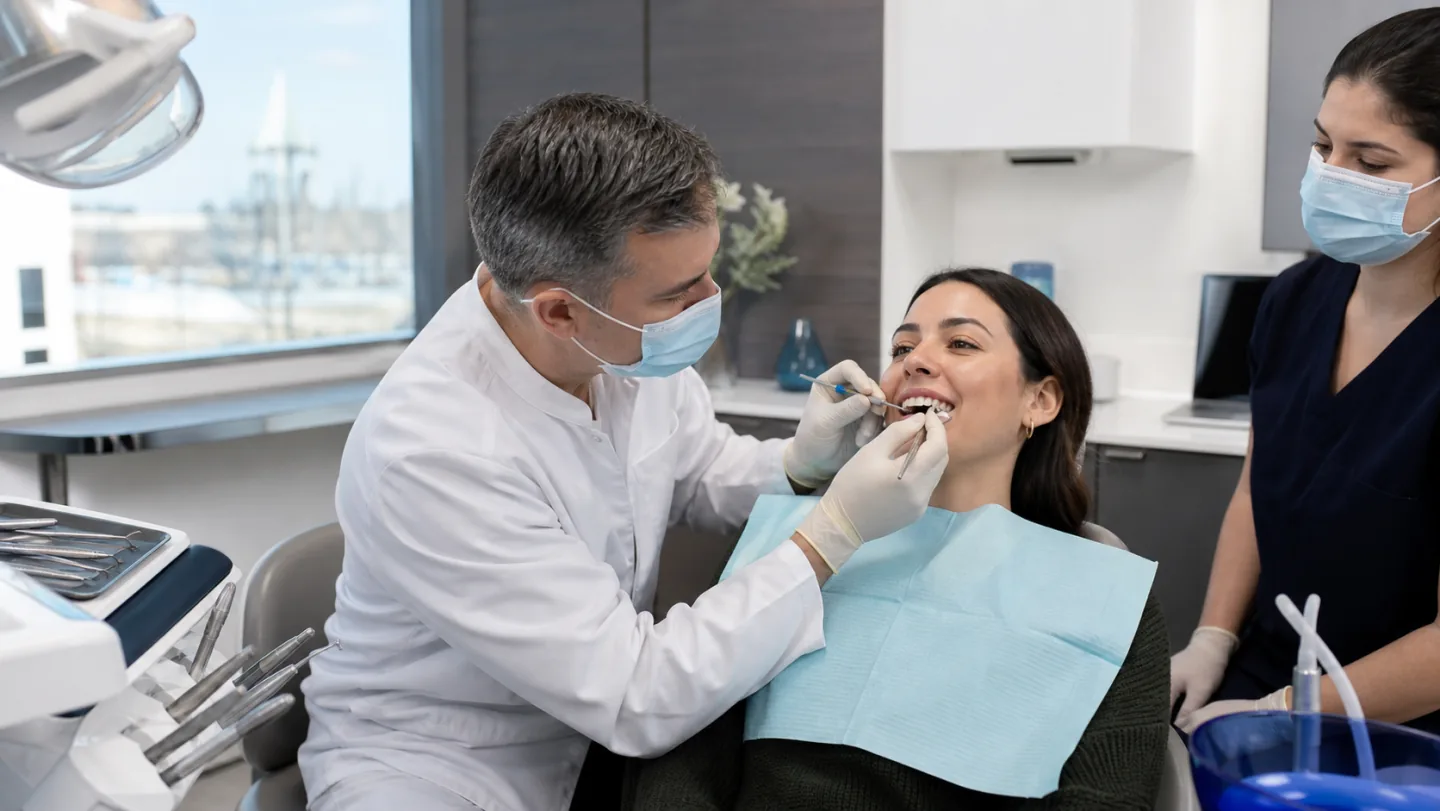
A dentist carefully completing a tooth-coloured bonding treatment
Cosmetic, or something more?

Dental Bonding for Inkster Gardens Residents

A mark or rough patch on a tooth doesn’t announce its own cause. Before anyone covers it up, it should be looked at. Here’s why that first look matters for bonding.

Let's find a time

Request an appointment

We’ll call to confirm your appointment. For urgent care, please call us directly.

Looking under the surface

Checking First for Inkster Gardens Residents

You spot a small mark near your front tooth’s edge, or your tongue keeps finding a rough patch. It might be an old stain or a harmless irregularity. It could also be something that needs treatment. Resin placed over an unexamined problem isn’t doing you any favours.

Bonding works most predictably on healthy enamel, which is why the assessment comes first. Inkster Gardens is in Winnipeg, and residents are seen at our McPhillips Street clinic. If the area does turn out to suit composite, you’ll hear how it can be covered or rebuilt, and if it doesn’t, you’ll hear what else is on the table.

Explore dental bonding
Quiet office-style consultation space with ergonomic black chairs at Winnipeg North Dental
Black ergonomic chairs facing a white table in a consultation room.

Diagnosis comes first

Your concern gets examined before any talk of shades or shaping, so that the right problem is being solved.

Sound tooth, sound repair

Any decay is removed before composite goes on, since adhesive needs a dependable surface to grip.

Sometimes it’s nothing

A small mark may need no treatment at all, and it’s useful to be told that plainly when it’s the case.

What the exam sorts out

Two very different kinds of spot.

From the outside, several conditions can look quite alike. The dentist’s job here is working out which situation you’re in and what would actually help.

May suit resin

When the tooth is structurally fine and the concern is limited to a small area, direct composite may be suitable.

  • A localized discoloured patch on otherwise sound enamel.
  • An old chip that has remained stable.
  • A worn corner with no related sensitivity.
  • An irregular surface confined to a small zone.

May need care first

Here a repair of appearance would be premature, as there’s a health matter to be dealt with or investigated before anything else.

  • Decay at or around the affected spot.
  • A fracture that causes sensitivity.
  • A tooth that has darkened as a whole.
  • An existing restoration that’s breaking down.

Please don’t use these lists for self-diagnosis. Only a clinical examination can tell which category your tooth belongs in.

What to expect, in sequence

First the question, then the treatment.

Your first visit is mainly about getting an answer. Should treatment be appropriate, it’s likely to proceed along these lines.

Request your visit
  1. 01

    Point out the area

    Show the dentist what you’ve noticed and describe how long it’s been there, whether it’s changed and whether it reacts to anything.

  2. 02

    Let it be examined

    The tooth is assessed, and X-rays are discussed if they’d add useful information. Afterward you’ll get an explanation of what’s been found.

  3. 03

    Treat what’s underneath

    Decay comes out before resin goes on, and freezing may be appropriate for that part. If there’s no decay, this step won’t apply.

  4. 04

    Restore the appearance

    Shades are selected, the prepared enamel receives adhesive, and layers of composite are shaped, cured, polished and tested against your bite.

Keeping track of the change

Take a photo now.

It’s surprisingly tough to remember what a small mark looked like six months earlier. A clear picture from today gives you something to compare with if the spot seems to be growing.

If a tooth is causing you pain, or you’re worried about an injury, please phone the clinic rather than filling in the online form.

What the dentist will want to know

  • When you first noticed the area in question.
  • Whether heat, cold or sweetness sets it off.
  • Dental work previously done on that tooth.
  • Your medications, and any insurance or CDCP details.
Examination chair with a monitor and glass-front cupboards in the background at Winnipeg North Dental
Bench, abstract painting and reception desk in the entry area at Winnipeg North Dental

A treatment room and the entry area at Winnipeg North Dental.

Asking without worrying

No concern is too small to mention.

It’s easy to feel silly about getting a tiny mark checked. Don’t. Asking about it early is a sensible thing to do, and finding out it’s harmless is a perfectly good outcome.

Ask to see it

If an X-ray or close look shows something, ask for it to be pointed out so you can follow the explanation.

Share what you’re afraid of

If you’re secretly worried it’s something serious, say that. It helps the dentist address what’s really on your mind.

Request the next step clearly

Before you leave, confirm whether the plan is to treat, to watch or to leave the area alone.

Once the spot is dealt with

Staying on top of it.

A bonded area still sits on a living tooth, and the natural surface around it needs just as much attention as before. Composite itself can also pick up stain or lose its polish.

01

Keep the edges plaque-free

Careful brushing and interdental cleaning help safeguard the join, where resin meets natural enamel.

02

Mention anything new

Fresh sensitivity, a dark line at the margin or a change in the feel of the surface all justify a call.

03

Keep your routine checks

Ask when to come back. Regular examinations are how small changes get noticed while they’re still minor.

If that same spot starts to change, call the clinic to have it looked at.

Talk with our team
Winnipeg North Dental storefront with window blinds, posters on the door and a sign above

Winnipeg North Dental

Unit-5 2358 Mcphillips Street, Winnipeg, MB R2V 4J6
Get directions (opens in a new tab)
Getting a proper look

Inkster Gardens Residents Can Have It Checked Here

Examinations and bonding for people from Inkster Gardens are done at Winnipeg North Dental, Unit 5, 2358 McPhillips Street, Winnipeg. A directions link is available to help you plan.

Non-urgent requests can go through the form, and a member of the team will follow up with a time. For anything urgent, call (204) 338-3003 instead.

Questions about coverage?

Talk with our team before your visit or learn about CDCP.

A little clarity before your visit

Your questions, answered.

Helpful details about dental bonding in Inkster Gardens.

Ask our team
Where can Inkster Gardens residents have a tooth spot looked at?

At Winnipeg North Dental, Unit 5, 2358 McPhillips Street, Winnipeg. Ask for a visit using this page, or call (204) 338-3003. The clinic will reply to settle on a time.

How do I know if a mark on my tooth is decay or just a stain?

You can’t always tell by looking. Colour alone isn’t reliable, and a dentist has to examine the tooth to find out. That’s one reason not to assume a mark is merely cosmetic.

Can bonding go over a cavity?

Resin shouldn’t be used to hide decay. The decayed part is removed first, and freezing may be appropriate for that. What’s used to restore the tooth afterward depends on the findings.

What’s the difference between bonding and a tooth-coloured filling?

Both use similar resin materials, but the purpose differs. A filling restores an area affected by decay, whereas cosmetic bonding is aimed at refining a tooth’s shape or appearance.

Can you cover a mark without touching the rest of my tooth?

A small discoloured area can sometimes be masked with resin, often with little or no enamel removal. A darker or more widespread colour change may call for another approach.

A tooth with a chip has started to hurt. Should I use the form?

Please call the clinic instead of sending a form, because pain deserves a conversation. Explain what happened and when it began, and you’ll be advised on the next step.

Better to know

Have that spot checked before you cover it.

Inkster Gardens residents can request an examination and bonding discussion at our Winnipeg clinic. Someone from the clinic will reply to you to arrange it.

Patient testimonials

Kind words from our patients

★★★★★ 5.0 from 440+ reviews on Google

Close to home

Areas we serve

Convenient dental care on McPhillips Street for families across northwest Winnipeg and nearby communities.

Explore all service areas

A healthier smile is one visit away

Ready for dental care that feels genuinely comfortable?

✓ New patients welcome ✓ Direct insurance billing ✓ Multilingual team

How can we help?

Our dental team is here for you.

Ready to book or have a question? Choose the option that works best for you.

For urgent dental concerns, please call us directly.

Send us a message

Our team will reply during clinic hours.



