
Wisdom teeth have a talent for becoming noticeable at inconvenient times. A dull ache develops behind the last molar during exams. The gum swells before a trip. Food keeps collecting in a spot that is almost impossible to brush. For other people, wisdom teeth arrive quietly and never cause a problem.
That difference is important. Having wisdom teeth does not automatically mean they must be removed, and being free of pain does not prove that they are healthy. Their position, access for cleaning, effect on nearby teeth, and changes over time all matter.
If you are wondering about wisdom teeth removal in Winnipeg, this guide explains how dentists assess third molars, when monitoring may be reasonable, what an extraction involves, and how to make recovery more comfortable.
What are wisdom teeth?
Wisdom teeth are the third set of permanent molars at the very back of the mouth. Most permanent teeth arrive during childhood, while third molars commonly develop and erupt later, often in the late teenage years or early adulthood. Timing varies, and some people never develop all four.
In a jaw with enough space, a wisdom tooth may come in upright, meet the opposing tooth, and become a functional part of the bite. In a crowded or differently shaped jaw, it may remain trapped in bone, emerge only partway through the gum, or lean toward the molar in front.
The term “impacted” means the tooth cannot erupt into a normal position because bone, gum, or another tooth blocks its path. Impaction itself does not describe whether there is active disease, but it can create conditions in which problems are more likely.
Common signs of a wisdom-tooth problem
Symptoms may come and go. You might notice:
- Soreness or pressure behind the last molar
- Red, swollen, or bleeding gum over a partly erupted tooth
- A bad taste or unpleasant breath from the area
- Difficulty opening the mouth fully
- Pain that seems to travel toward the ear or jaw
- Food repeatedly trapping under a gum flap
- Tender lymph nodes or swelling along the jaw
- Decay or sensitivity in the wisdom tooth or neighbouring molar
These signs are not specific to wisdom teeth. A cavity, gum problem, jaw-muscle strain, or another tooth can produce similar discomfort. An examination is the reliable way to identify the source.
Fever, spreading facial swelling, trouble swallowing, trouble breathing, or rapidly worsening illness needs urgent attention. Contact a dental office immediately, and seek emergency medical care when swelling affects breathing or swallowing.
Pericoronitis around a partly erupted tooth
When part of a wisdom tooth is visible but a flap of gum still covers the rest, bacteria and food can collect in the pocket. The resulting inflammation or infection is called pericoronitis. The gum may feel tender, swollen, and difficult to clean. An upper tooth can sometimes bite against the swollen tissue and make it more painful.
Treatment depends on severity and recurrence. A dentist may gently clean the area, discuss antimicrobial rinsing, manage the opposing bite, or prescribe medication when clinically appropriate. Antibiotics alone do not correct the sheltered space that allowed the problem to develop. Once the acute episode is controlled, the long-term question is whether the tooth can become cleanable or should be removed.
Do not dig beneath the gum with pins, fingernails, or other sharp objects. Gentle cleaning with the method recommended by a dental professional is safer.
How dentists assess wisdom teeth
The assessment includes more than counting teeth on an X-ray. Your dentist will examine how much of each tooth has erupted, the condition of the surrounding gum, whether decay is present, and how well the area can be cleaned. They will look for damage to the second molar, signs of infection, cyst-like changes, and the relationship to the bite.
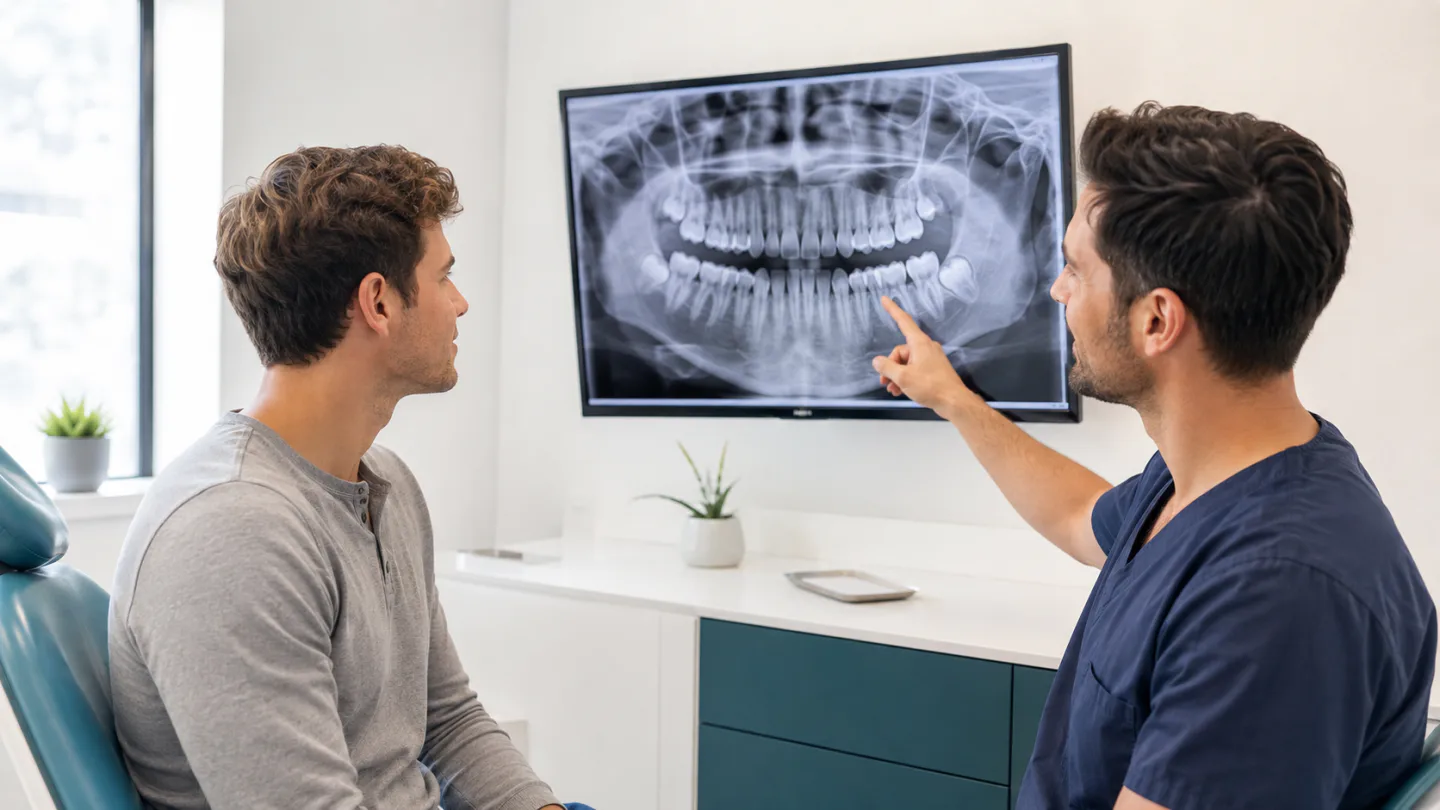
A panoramic dental image is commonly used because it shows all four wisdom-tooth areas, the jawbones, and nearby structures in one view. In selected cases, three-dimensional imaging may be recommended to clarify anatomy, particularly the relationship between lower wisdom-tooth roots and the nerve canal.
Age, health, medicines, smoking or vaping, previous infections, symptoms, root development, and surgical complexity all inform the discussion. There is no single X-ray angle that makes the decision for every person.
Do all wisdom teeth need to be removed?
No. A wisdom tooth that is fully erupted, healthy, functional, and easy to clean may be monitored like other teeth. A deeply impacted tooth without disease may also be observed in some circumstances. Monitoring means purposeful follow-up, not forgetting the tooth exists.
Removal is more likely to be recommended when there is:
- Recurrent pain or infection
- Decay that cannot be predictably restored
- Gum disease around the wisdom tooth or second molar
- Damage or resorption affecting a neighbouring tooth
- A cyst or another concerning change
- A fracture or other condition that makes the tooth non-restorable
- A position that is causing persistent, documented problems
Sometimes removal is considered before symptoms occur because current findings suggest a meaningful future risk and surgery is expected to become more difficult later. That is an individual risk-benefit discussion. Ask what is happening now, what might happen if the tooth stays, and how it would be monitored.
Can wisdom teeth crowd the front teeth?
People often notice lower front teeth becoming less straight around the same age that wisdom teeth develop. It is tempting to assume the third molars pushed the entire row forward. Dental crowding is more complex and can change throughout adulthood because of growth, bite forces, gum support, and natural tooth movement.
Removing wisdom teeth should not be presented as a guaranteed way to prevent lower front crowding. If alignment is your main concern, ask the dentist and orthodontic provider to explain the evidence and whether retainers or orthodontic care are more relevant to your situation.
Wisdom teeth may still need treatment for their own health; that is a separate question from promising a perfectly straight front row.
What happens during wisdom-tooth removal?
The exact procedure depends on whether the tooth is erupted, covered by gum, or surrounded by bone. After reviewing consent and health information, the area is numbed with local anesthetic. Additional sedation options may be available or a referral may be recommended depending on anxiety, complexity, health, and the setting.
For a fully erupted tooth, the dentist may loosen and remove it in a process similar to another extraction. For an impacted tooth, a small opening in the gum may be needed. Bone covering the tooth may be carefully removed, and the tooth may be divided into sections so it can come out through a smaller opening. Stitches may be placed afterward.
You should feel pressure and movement but not sharp pain. Tell the team if you feel pain so they can reassess the freezing. Sedation changes awareness and memory; it does not replace local anesthetic at the surgical site.
General dentist or oral surgeon?
Many wisdom teeth can be removed by general dentists. More complex cases may be referred to an oral and maxillofacial surgeon. Referral can be appropriate when teeth are deeply impacted, roots are close to important structures, health conditions add complexity, advanced sedation is requested, or the expected surgery falls outside the dentist’s usual scope.
A referral is not a sign that something has gone wrong. It is part of matching the procedure with the appropriate training, facility, and support. Ask who will perform the removal, which type of anesthesia is planned, and who to contact after hours if you have a concern.
Risks worth understanding
Every extraction has possible complications, although many people heal without serious difficulty. Risks can include bleeding, infection, delayed healing, dry socket, injury to a neighbouring tooth or restoration, sinus communication with an upper tooth, jaw stiffness, and altered sensation from irritation or injury to nearby nerves.
With lower wisdom teeth, nerves that supply feeling to the lip, chin, tongue, or gums may lie close to the roots. Temporary tingling or numbness can occur; permanent change is less common but important to discuss. Imaging helps estimate the relationship but cannot remove every risk.
Your own risk depends on anatomy and health. Consent should be a conversation in which you have time to ask about likelihood, alternatives, and what would happen if a complication developed.
Preparing for the appointment
Follow the specific instructions from the treating office, especially if sedation is planned. Eating and drinking rules vary by anesthetic method. Do not guess or rely on advice written for someone else.
Arrange a responsible adult escort if required. Plan for time away from work, school, driving, exercise, and caregiving duties. Fill prescriptions if directed, prepare soft foods, and have cold packs and clean gauze available. Tell the office about all medicines, supplements, allergies, pregnancy, sleep apnea, cannabis use, and previous reactions to anesthesia.
Wear comfortable clothing and remove oral jewellery. If you develop a cold, breathing problem, fever, or change in health before the procedure, call the office rather than deciding on your own that it does not matter.
The first day of recovery
A blood clot must form and remain in each socket. Bite on gauze as instructed and change it only as directed. Some oozing mixed with saliva is expected; heavy bleeding that does not slow with pressure needs a call to the treating office.
Rest with your head elevated. Use cold packs on the outside of the face for short intervals if recommended. Take prescribed or over-the-counter medication exactly as directed and do not exceed labelled doses. If you have medical conditions, allergies, take blood thinners, or are unsure which pain medicine is safe, ask the treating clinician or pharmacist.
Choose cool or lukewarm soft foods and drink carefully from a cup. Avoid smoking, vaping, alcohol, forceful rinsing, spitting, and drinking through a straw during the early healing period. These actions can disturb the clot and delay recovery.
Eating and cleaning after removal
Soft does not have to mean only ice cream. Yogurt, eggs, oatmeal that has cooled, mashed vegetables, cottage cheese, soup served lukewarm, smoothies eaten with a spoon, and tender pasta can provide more balanced nutrition. Avoid hard crumbs, seeds, popcorn, nuts, and foods that lodge easily until the sites are ready.
Keep the rest of the mouth clean. Brush gently and stay away from the sockets at first. Begin any salt-water rinsing or irrigation only when and how your dental team recommends; starting too soon or using too much pressure can disrupt healing.
Gradually return to normal food based on comfort and the clinician’s directions. Chewing soreness can last longer after a difficult impaction than after a simple erupted-tooth removal.
Swelling, bruising, and jaw stiffness
Swelling commonly increases over the first couple of days before it begins to settle. Bruising may appear later, and the jaw can feel stiff. The pattern varies with the number and difficulty of teeth removed.
Follow the office’s advice about switching from cold to gentle warmth, movement, and activity. Do not force the mouth open through sharp pain. Contact the office when swelling keeps getting worse beyond the expected period, returns after improving, is accompanied by fever or pus, or makes swallowing difficult.
Recovery is not a contest. Returning to hard training, heavy lifting, or a physically demanding job too early can restart bleeding and throbbing.
What is dry socket?
Dry socket occurs when the protective clot is lost or breaks down before the socket is covered with early healing tissue. It is more common after lower wisdom-tooth removal. Pain usually becomes stronger rather than weaker a few days after surgery and may radiate toward the ear or temple. A bad taste or odour may accompany it.
This is not something you should try to pack at home. A dentist can examine the socket, rule out other concerns, rinse it, and place a soothing dressing when appropriate. Smoking and vaping substantially interfere with healing and increase risk, which is one reason the avoidance instructions matter.
Costs and dental coverage in Winnipeg
Wisdom-tooth removal cost varies with the number of teeth, whether they are erupted or impacted, imaging, sedation, surgical time, and provider. Ask for a written estimate that separates these components.
Private dental benefits or the Canadian Dental Care Plan may contribute when criteria are met, but preauthorization, co-payments, frequency rules, and plan maximums can apply. A predetermination estimates plan payment; it is not a guarantee. Confirm both the expected clinical fee and the portion you may owe.
If pain or infection is active, tell the office. The timing of urgent assessment should be based on health, even if the definitive removal requires financial planning.
Planning a wisdom-tooth visit in Winnipeg
The best decision is neither “remove every wisdom tooth” nor “leave them until they hurt.” It is a plan based on position, disease, cleanability, anatomy, age, health, and reliable follow-up.
Winnipeg North Dental can examine wisdom-tooth symptoms, arrange appropriate imaging, provide tooth extraction care, and refer when a case needs specialist management. If you have pressure, swelling, a bad taste, or questions about a panoramic image, request an appointment or call (204) 338-3003. Early assessment gives you more room to plan than a painful weekend infection.