
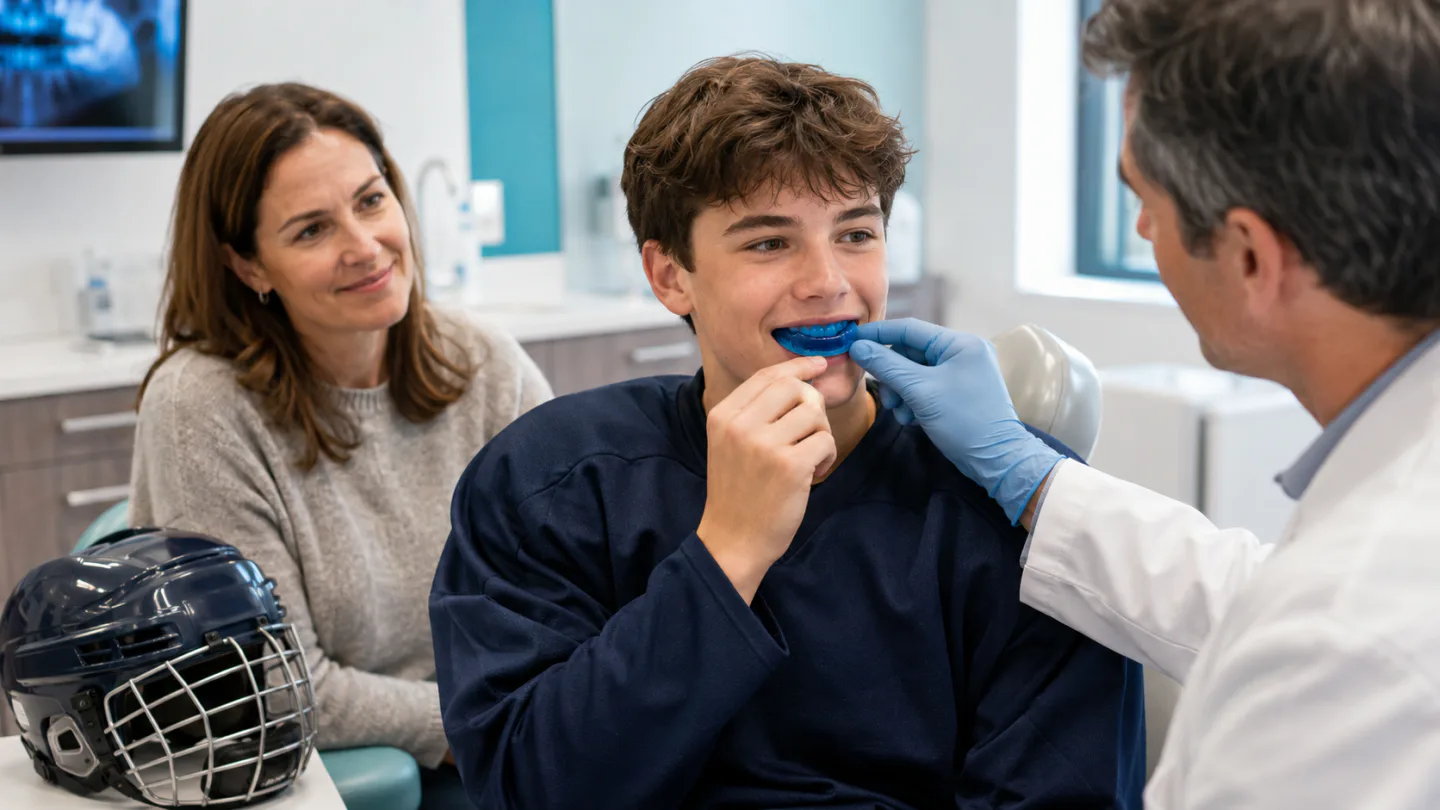
Winnipeg athletes know the routine: helmet, skates, pads, gloves, and a final check before heading onto the ice or field. A mouthguard can be one of the smallest pieces of equipment in the bag, yet it protects teeth and soft tissues that are difficult and expensive to repair after an impact.
Mouthguards are useful well beyond hockey. Basketball elbows, soccer collisions, martial-arts contact, baseballs, lacrosse sticks, skateboarding falls, and recreational activities can all injure the mouth. The most useful guard is not the most expensive one in theory; it is the one that fits, stays in place, allows breathing and communication, and is worn consistently.
If you are choosing a sports mouthguard in Winnipeg, this guide compares the main types, explains custom fitting, and covers what to do when an injury happens despite protection.
What a sports mouthguard protects
A mouthguard cushions and distributes force around the teeth. It creates a protective layer between upper and lower arches and can reduce cuts caused when lips and cheeks are driven against the teeth or braces.
It is intended to reduce the risk and severity of dental and oral injury, including:
- Chipped, cracked, or displaced teeth
- Teeth knocked completely out
- Cuts to lips, cheeks, and tongue
- Damage to crowns, veneers, and orthodontic appliances
- Force transmitted to supporting bone and jaw structures
No mouthguard makes a sport injury-proof. A hard direct impact can still damage teeth or jaw, and appropriate helmets and face protection remain essential. Mouthguards are one part of a broader safety system.
Mouthguards and concussion claims
Mouthguards are strongly associated with protecting teeth and oral tissues. You may also see products advertised as preventing concussions or improving strength and performance. Those claims should be treated cautiously.
A concussion is a brain injury caused by forces transmitted to the head and body. Proper sport rules, coaching, helmets where indicated, removal from play after a suspected concussion, and medical assessment are central. An athlete should never continue because a mouthguard supposedly makes concussion impossible.
Choose a guard for proven oral protection and fit. Do not pay a premium based only on dramatic neurological or performance promises.
Who should wear one?
Use is obvious in collision and contact sports, but injuries also occur in activities where falls, equipment, or accidental contact are possible. Consider a mouthguard for hockey, ringette, football, lacrosse, rugby, basketball, soccer, baseball, softball, martial arts, boxing, wrestling, field hockey, skateboarding, skiing, snowboarding, cycling, and other risk-prone activities.
League rules are the minimum, not a complete risk assessment. An adult recreational player can still take a puck to the mouth. A child practising a non-contact drill can still fall.
Ask the dentist about the specific sport, age, braces, dental work, history of injury, and how often the guard will be used.
The three main mouthguard types
Sports mouthguards generally fall into three groups: stock, boil-and-bite, and custom-made. Each offers a different balance of price, fit, retention, and durability.
A stock guard is sold in a standard shape and worn without meaningful adaptation. It is inexpensive and immediately available, but it can feel bulky and may require the athlete to clench to hold it in place. A loose guard interferes with speech and may be abandoned during play.
A boil-and-bite guard is softened in hot water and formed around the teeth. It can fit better than a stock model when instructions are followed carefully. Thin spots, distortion, and poor adaptation are common when it is overheated or bitten through during fitting.
A custom guard is made from a dental impression or scan and formed to the athlete’s teeth. It generally offers the most controlled fit and can be designed for the sport, age, and dental condition.
Benefits of a custom sports mouthguard
A custom guard is shaped to stay on the upper teeth without constant clenching. Better retention can make breathing, drinking, and giving short instructions easier. The dentist can adjust edges away from sensitive gums and create appropriate thickness in impact areas.
Customization is especially useful for people with unusual tooth positions, a strong gag reflex, extensive dental work, or a history of poorly fitting store-bought guards. Colour can make a guard easier to find, and identification may be added depending on the laboratory process.
The benefit depends on good design. A “custom” guard that is extremely thin or poorly extended may not provide the expected protection. Ask about material, layers, thickness, and how the sport influenced the prescription.
How the dental fitting works
The dentist first checks for active decay, loose teeth, gum problems, and appliances that affect fit. An impression or digital scan records the teeth and surrounding structures. The guard is fabricated on the model or digital design, often using pressure or vacuum forming and one or more layers of resilient material.
At delivery, the dentist checks retention, coverage, edges, bite, and comfort. The athlete should practise inserting and removing it without chewing on the material. Bring the guard back if it rubs, triggers gagging, falls during speech, or makes breathing unreasonably difficult.
Do not trim a custom appliance at home. A rough shortened edge can irritate tissue and reduce protection.
Mouthguards for children with growing mouths
Children’s teeth and jaws change quickly. Baby teeth loosen, permanent teeth erupt, and orthodontic plans begin. A guard that fitted at the start of one season may become tight or unstable before the next.
The dentist balances protection with expected changes. In an actively changing mouth, a boil-and-bite model may sometimes be a practical short-term choice. At other stages, a custom guard provides better comfort and use. There is no value in an expensive appliance that locks around an erupting tooth or no longer seats fully.
Check fit regularly and after dental treatment. Never force a tight guard into place. A child should be able to remove it independently in an emergency.
Playing sports with braces
Braces make mouth protection especially important because brackets can cut the lips and cheeks during impact. The guard needs room for tooth movement and enough clearance around the appliance. A standard close-fitting model may bind as orthodontic treatment progresses.
Use a mouthguard specifically designed for braces and follow advice from the dentist or orthodontist. Guards may need more frequent replacement or adjustment. Depending on the sport and bite, protection over both arches may be considered.
Bring the mouthguard to orthodontic and dental appointments. New brackets, hooks, elastics, or tooth movement can change comfort and fit.
What about retainers and removable aligners?
Do not wear a thin orthodontic retainer or clear aligner as a substitute for a sports mouthguard. These appliances are not designed to absorb impact and can break, dislodge, or cut tissue.
Your orthodontic provider will generally give instructions about removing aligners or retainers for contact activity and using a separate mouthguard. Store the appliance in its case rather than wrapping it in tissue or leaving it in a hot car.
Because treatment changes tooth position, a new sports guard may be needed during or after orthodontics. Coordinate timing before ordering one for a full season.
A sports guard is not a night guard
Sports mouthguards are made to cushion brief impacts. Night guards are designed for the repeated forces and wear patterns of clenching or grinding during sleep. Their materials, thickness, coverage, and bite relationships can differ.
Do not wear a soft sports guard every night unless specifically directed. Some people chew heavily on soft material, and an unsuitable design may worsen muscle fatigue or alter how teeth contact. Likewise, a hard night guard may not provide the resilient impact protection intended for sport.
If you need both, ask for two purpose-specific appliances.
Cleaning and storing the guard
Rinse the mouthguard with cool water after every use. Gently brush it with a soft toothbrush and mild soap or the cleaner recommended by the dentist. Toothpaste can be abrasive and may roughen the surface.
Let it dry and store it in a firm ventilated case. Keep the case clean as well. Avoid boiling water, dishwashers, direct sun, and hot vehicles; heat can distort the fit. Keep it away from pets, who are remarkably efficient at destroying dental appliances.
Inspect for tears, thin areas, rough edges, odour, or a change in fit. Bring it to regular dental visits so the dentist can assess both the guard and the teeth underneath.
When should a mouthguard be replaced?
Replace it when it no longer seats fully, falls out, has been chewed thin, is torn, or has edges that cannot be safely smoothed. It may also need replacement after significant dental work, tooth loss, eruption, orthodontic movement, or jaw growth.
Some adults can use a well-maintained custom guard for more than one season. Growing children and athletes who chew their appliances may need more frequent changes. A calendar rule is less useful than checking the actual condition and fit.
Write the athlete’s name and contact information on the case, not by carving the protective surface.
What to do when a tooth is injured
Stop play and assess the person first. A suspected concussion, loss of consciousness, significant facial injury, uncontrolled bleeding, or breathing problem requires appropriate emergency medical care.
For a chipped tooth, rinse gently, collect fragments, and contact a dentist. For a displaced tooth, avoid pushing it repeatedly and seek urgent care. If a permanent tooth is knocked out, pick it up by the crown, not the root. If dirty, rinse it briefly without scrubbing. Reinsert it gently if you can do so safely, or keep it moist in milk or an appropriate tooth-preservation solution, and get to a dentist immediately.
Do not reinsert a knocked-out baby tooth because this can damage the permanent tooth developing below. The child still needs prompt assessment.
Return to play after a dental injury
The athlete should not simply push the guard back over a loose, fractured, or repositioned tooth and return to play. Dental trauma can involve the root, bone, lip, and jaw even when the visible chip is small.
The dentist will assess stability, pain, bite, and need for protection. A temporary modification or new guard may be required after swelling settles or treatment is completed. Follow medical concussion protocols separately.
Report colour change, a gum bump, new sensitivity, or swelling in the weeks after injury. Trauma can damage the nerve even when the tooth looked stable on day one.
Mouthguard costs in Winnipeg
Stock and boil-and-bite guards have a lower purchase price. A custom mouthguard includes the examination or assessment, impression or scan, fabrication, fitting, and adjustment. Fees vary with design, material, layers, and laboratory process.
Some dental benefit plans contribute to custom athletic appliances, while others exclude them. Ask for the procedure description and estimate before treatment. Team programs or health-spending accounts may offer other support.
Cost matters, especially for a growing child who may need replacement. Discuss the stage of dental development so the level of customization and expected lifespan make practical sense.
Choosing a sports mouthguard in Winnipeg
A mouthguard cannot prevent every injury, but a stable and comfortable appliance is much more likely to be worn during the moment it is needed. Fit, retention, appropriate thickness, and sport-specific use matter more than slogans on the package.
Winnipeg North Dental can assess fit and discuss custom mouthguards alongside regular check-ups and cleanings. If you or your child is starting hockey, martial arts, basketball, or another injury-prone activity, request an appointment before the season. Bring any current guard so the dentist can see what works, what does not, and whether replacement is necessary.