
Advice to brush in the morning and before bed sounds simple until your morning begins at four in the afternoon. A rotating schedule can make familiar health routines surprisingly difficult to place. You may finish work as the rest of Winnipeg is starting its day, eat at unusual times and arrive home too tired to think beyond getting to sleep.
Dental care for shift workers in Winnipeg needs to fit that reality. The basic goals remain consistent, but the clock times may change. A useful routine follows waking, eating and your main sleep period rather than assuming that everyone lives on a nine-to-five timetable.
Working shifts does not mean dental problems are inevitable. It does mean that practical barriers deserve attention: missed breaks, constant sipping, supplies left at home and appointments booked when you would normally be asleep. Addressing those barriers can be more effective than repeatedly promising yourself that next week’s schedule will be easier.
Build around events that still happen
Start by identifying events that remain recognizable even when your hours change. You wake for your main day, leave for work, eat and prepare for your main sleep. Those events can become anchors for oral care when conventional labels such as morning and evening stop being useful.
The Canadian Dental Association’s preventive-care guidance recommends twice-daily brushing with fluoride toothpaste and daily flossing. Translate that into a plan for your waking cycle instead of trying to obey two fixed clock times that conflict with work.
For example, brushing before your main sleep period may happen after sunrise following a night shift. The other brushing session can fit at another consistent point while you are awake. Discuss unusual split-sleep schedules with your dental team if you are unsure how to organize the routine.
Write the plan in ordinary language: “Brush before I settle into bed” is clearer than an alarm labelled 10 p.m. that rings while you are working.
Protect the moment before sleep
The most vulnerable part of a routine is often the transition from arriving home to falling asleep. You sit down briefly, start looking at your phone and wake an hour later without having completed the things you intended to do. Fatigue can make a small task feel much larger.
Put brushing early in the sequence that leads to bed. Keep the supplies visible and ready rather than inside a bag you need to unpack. If you normally shower first, attach brushing to that event. If you eat after arriving home, plan the sequence around that meal and your dental team’s advice.
Avoid building a routine that depends on feeling motivated after a difficult shift. Reduce the number of decisions required. A charged brush, available toothpaste and a familiar interdental aid remove small obstacles before they become reasons to skip care.
If you miss a session, return to the routine at the next appropriate opportunity. Do not compensate with harsh scrubbing or decide the entire day has been wasted. Consistency develops through repeated recovery from ordinary disruptions.
Pack a small kit that earns its place
A work kit is useful only if you can access and use it. Before buying travel products, consider the actual facilities: a clean place to wash hands, a sink, storage and enough privacy or time. Some workplaces make brushing during a break practical; others do not.
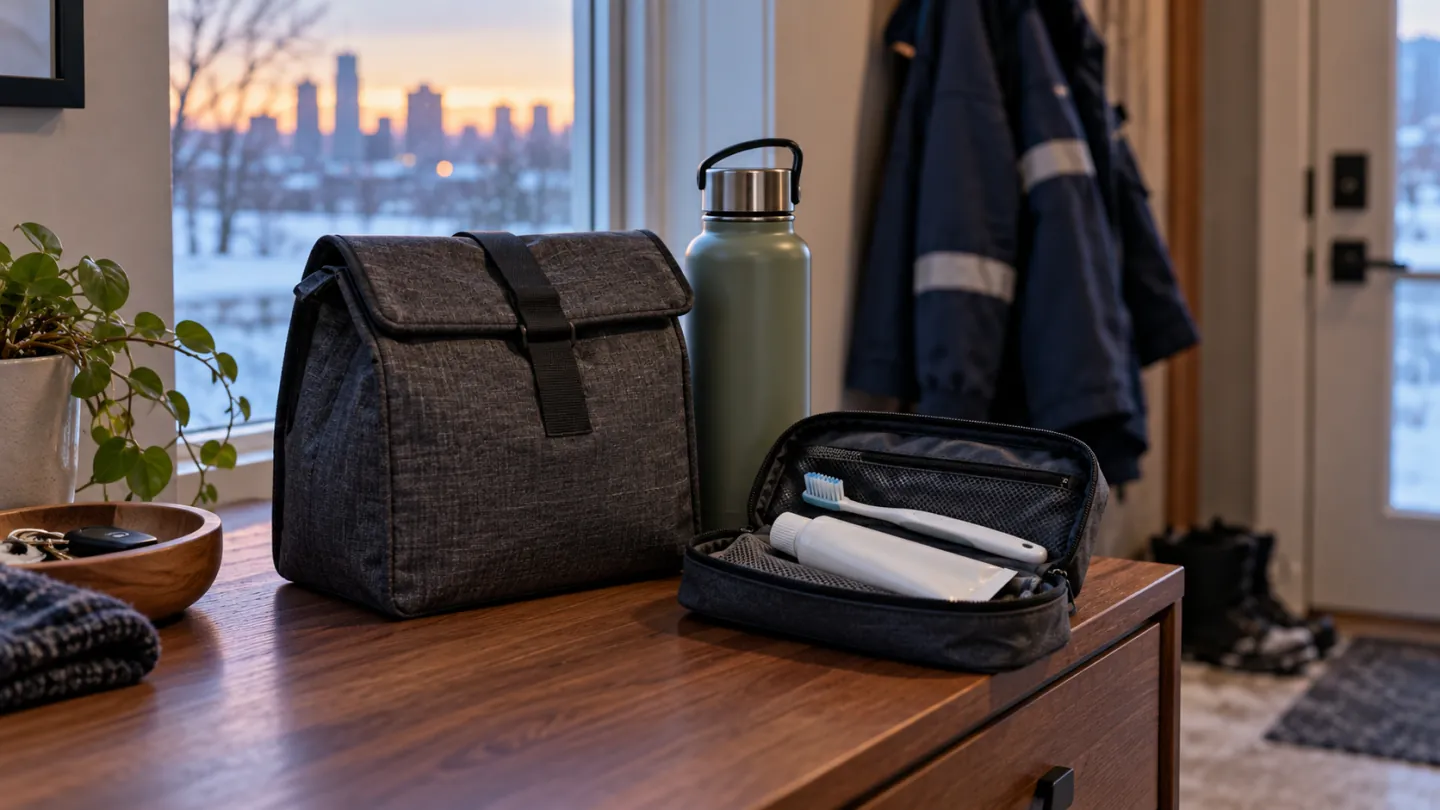
A basic kit might contain a soft toothbrush, fluoride toothpaste and the interdental tool you already know how to use. Keep it separate from work equipment and store the brush so it can dry appropriately after use. Check supplies when you repack your lunch rather than waiting until the tube is empty.
Do not make the kit unnecessarily elaborate. Several mouthwashes and unfamiliar tools add weight and decisions without necessarily improving the routine. If your dentist has prescribed a specific product, follow those instructions and keep it clearly labelled.
The kit is a backup and a convenience. It does not require brushing in an unsuitable setting or turning a short meal break into another stressful task. Use it where it genuinely helps.
Look closely at what keeps you company overnight
A drink can become a companion through a quiet or demanding shift. Coffee, energy drinks and sweetened beverages may be consumed gradually because the work does not allow a defined break. The habit is understandable, but the duration can be easy to overlook.
Record what goes into the bottle or mug and how long it lasts. Include sugar, syrups and repeated refills. If you are sipping an acidic or sweetened drink for hours, consider whether water can become the default between defined drink breaks.
This is not an instruction to manage fatigue with water. The Canadian Centre for Occupational Health and Safety discusses rotational shiftwork as a challenge involving sleep, schedules and recovery. If exhaustion is affecting safety or daily functioning, it needs an appropriate workplace or healthcare discussion.
Our coffee and tea article separates staining from sugar and acid considerations. Understanding those differences lets you adjust a beverage habit without assuming every cup creates the same dental concern.
Plan food for the break you actually get
A planned meal can become a series of bites between tasks when a shift is unpredictable. You may have little control over the timing, but a realistic food plan can still reduce the need to rely on whatever happens to be available.
Pack foods you can store safely and eat comfortably within the breaks your workplace allows. Include a backup for delays. If chewing pain is limiting your choices, arrange assessment rather than accepting a shrinking list of foods as a normal feature of shift work.
Where possible, make eating a defined break rather than keeping sweets beside the workstation all night. If that is impossible, explain the constraint at your dental appointment. Advice should account for the actual work setting and any medical need for frequent meals.
Our adult snacking guide offers ways to examine the pattern without creating restrictive food rules. The aim is adequate nutrition and a manageable dental routine, not skipping meals to satisfy an idealized schedule.
Rotating days need a transition plan
A routine that works during three night shifts may become awkward on days off. Instead of treating every schedule change as a fresh start, decide which anchors remain the same and which need to move. Your main sleep period is usually more useful than the date on the calendar.
Look at the next few days before the rotation changes. Identify when you expect to sleep, when you will eat and when supplies will be available. Keep the plan short enough that it can survive an unexpected overtime request or family responsibility.
If you use reminders, name the action and the context. “Brush before daytime sleep” may be more useful than an unexplained alert. Disable reminders that have become irrelevant so they do not turn into background noise you automatically dismiss.
You do not need a detailed tracking system unless you find one helpful. A note on the bathroom mirror or a kit placed beside your sleep supplies may accomplish more than an app requiring extra attention.
Make appointments compatible with recovery
Booking the first available appointment is not always the most practical choice after an overnight shift. Consider whether you will be rested enough to travel safely, discuss treatment and remember instructions. Tell reception about your working hours when arranging care.
Ask how long the visit is expected to take and whether treatment might affect eating, speaking or returning to work. If a procedure involves sedation, follow the clinic’s specific instructions about an escort, transportation and restrictions. Do not assume a familiar commute makes driving appropriate afterward.
For routine visits, bring your schedule when possible and choose a time that is sustainable for follow-up. An appointment you can reliably attend is more useful than repeatedly cancelling a slot that overlaps with sleep.
This article does not imply that every Winnipeg clinic offers appointments at every hour. Confirm actual availability directly. Explaining your constraints early gives the team a better chance to identify a suitable option within its schedule.
Dryness, clenching and soreness deserve specifics
If you wake with a dry mouth or a tired jaw, do not automatically attribute it to working nights. Describe the symptom, its timing and any changes in medicines or sleep. The dental team may need to consider several possible contributors.
For jaw discomfort, notice whether you hold your teeth together while concentrating, drive with a tense jaw or chew gum for long periods. Those observations are useful, but they do not establish a diagnosis. Our teeth-grinding guide explains why an appliance recommendation should follow an assessment.
Persistent dryness also needs attention. Bring an up-to-date medication list and mention whether the problem affects eating, speaking or sleeping. Do not stop a prescribed medicine because you suspect a connection.
If you have loud snoring, witnessed breathing pauses or marked daytime sleepiness, discuss those symptoms with a medical professional. A dental routine cannot resolve every sleep-related concern, and a generic mouthguard should not be assumed to treat it.
Keep instructions available when you are tired
After treatment, ask for written instructions and a clear contact route for questions. Fatigue makes it easy to forget whether a restriction lasts until numbness wears off, for the rest of the day or longer. Clarify rather than guessing.
Tell the dentist about the tasks in your next shift. Heavy lifting, prolonged speaking, driving and safety-sensitive work may matter depending on the procedure and medicines involved. The team needs that context to give appropriate advice.
If medication is recommended, ask a pharmacist how it fits your health history, other medicines and work requirements. Follow the label and individualized directions. Do not use a colleague’s prescription or leftover antibiotics to get through a shift.
Keep the clinic’s number somewhere easy to find. For urgent symptoms, call and describe the problem rather than assuming you must wait until your next day off. Severe swelling with breathing or swallowing difficulty requires emergency medical attention.
Review what failed without blaming yourself
When a routine breaks down, identify the obstacle precisely. Was the brush at home? Was there no meal break? Did you fall asleep before reaching the bathroom? Did an appointment conflict with recovery time? Each answer suggests a different practical adjustment.
Try changing one part for the next rotation. Move the supplies, prepare the kit earlier or book at a different point in your waking day. A workable system is built through small corrections, especially when the schedule itself is demanding.
For dental care for shift workers in Winnipeg, request a visit at Winnipeg North Dental and explain your hours when booking. Bring the routine you actually follow, including the parts that are difficult. The goal is care that remains possible during a real workweek, with clear priorities and support when your schedule changes.