
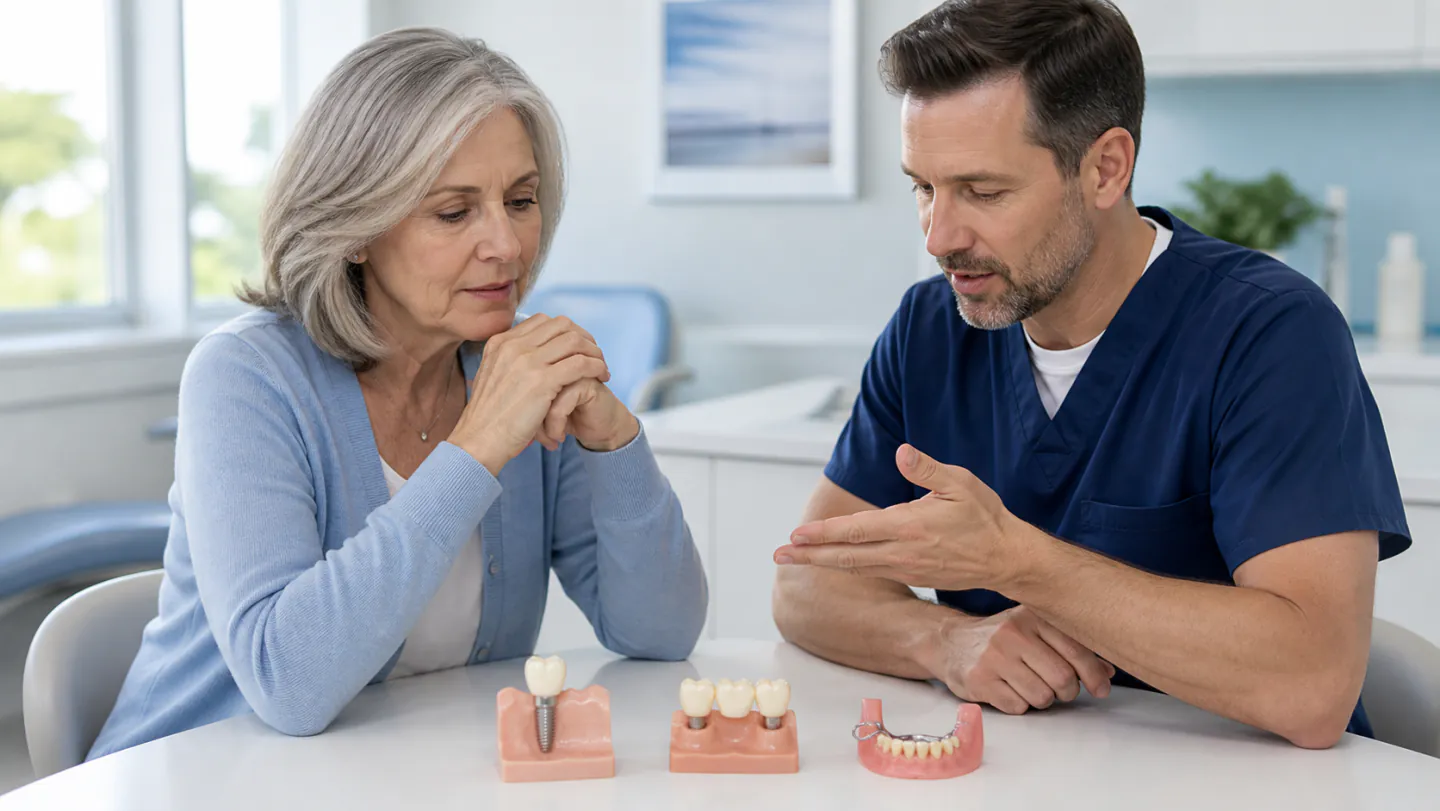
A missing tooth can affect people in very different ways. A front gap may change how freely you smile. A missing back tooth may make you chew on one side. Some spaces cause little day-to-day trouble, while others allow food to trap or neighbouring teeth to lean.
There is no automatic rule that every missing tooth must be replaced, and there is no single replacement that is best for everyone. A fixed bridge, removable partial denture, and dental implant solve the same visible problem in different ways. Each asks something different of the teeth, gums, bone, time, daily cleaning, and budget.
If you are comparing missing tooth replacement in Winnipeg, this guide will help you understand the main choices and prepare for a useful consultation. The right plan begins with the whole mouth, not a product.
What can happen after a tooth is lost?
The effects depend on the tooth and bite. Neighbouring teeth may gradually tilt or drift toward a space. An opposing tooth can move farther into the gap when it no longer has normal contact. Food may collect, and chewing pressure may shift to fewer teeth.
The bone that supported the missing root also changes because it no longer receives the same stimulation. This shrinkage is usually greatest in the earlier period after loss and can affect future implant or denture planning.
Not every change is rapid or harmful. A wisdom tooth space usually does not need replacement. A stable gap with healthy neighbouring teeth may be monitored. The dentist should explain what is likely in your specific bite rather than using fear to rush a decision.
Questions that shape the choice
Before comparing restorations, the dentist assesses:
- Which tooth or teeth are missing
- How long the space has been present
- Health and position of neighbouring teeth
- Amount and shape of available bone
- Gum health
- Bite forces and grinding
- Smile and speech concerns
- Remaining teeth and existing dental work
- Medical history and healing factors
- Cleaning ability, timing, and budget
Your priorities matter too. Some people strongly prefer a fixed tooth. Others want the least surgery, the fastest option, or the most affordable first step. A treatment is successful only if it is healthy and realistic for the person who must live with it.
Option one: a fixed dental bridge
A traditional dental bridge uses teeth beside the gap to support an artificial replacement tooth. The supporting teeth receive crowns that are joined to the replacement, creating one fixed restoration.
A bridge can feel stable and does not require implant surgery. Treatment is often completed faster than an implant and may be particularly reasonable when the neighbouring teeth already need crowns.
The tradeoff is that supporting teeth must be prepared and then carry additional load. If they are completely healthy and untouched, removing tooth structure deserves careful consideration. Decay, nerve problems, or fracture in one supporting tooth can affect the entire bridge.
Other bridge designs exist for selected situations, including resin-bonded bridges that attach more conservatively. Tooth position, bite, and span determine whether those designs are suitable.
What bridge treatment involves
For a conventional bridge, the support teeth are numbed and shaped. A scan or impression records the area, and a temporary bridge may protect the teeth while the final restoration is made.
At the placement visit, the dentist checks the edges, contact, bite, appearance, and your ability to clean beneath the replacement tooth. The bridge is then cemented or bonded.
A bridge does not come out for daily cleaning. Floss cannot pass down between the joined units, so you need a floss threader, interdental brush, water flosser, or another recommended tool under the artificial tooth. Cleaning this area is essential to protect the support teeth and gums.
Option two: a removable partial denture
A partial denture replaces one or more missing teeth and is removed by the patient. It usually rests on the gums and uses remaining teeth for support or retention. Frameworks and materials vary.
The main advantages are that several spaces can be replaced with one appliance, surgery is not required, and the initial fee is often lower than multiple implants or a fixed bridge. A partial may also serve as an interim option while the mouth heals or a longer plan is considered.
It can feel bulkier than a fixed restoration. Clasps may show, movement can occur during eating, and the supporting teeth and gums must adapt. Fit depends on the design and condition of the whole arch, not only on the empty space.
Getting used to a partial denture
New dentures require practice. Speech may feel different, saliva may increase, and chewing should begin with manageable food on both sides. Sore spots are common during early adjustment, but the appliance should not be ground or bent at home.
Remove and clean the partial daily using instructions for its material. Brush remaining teeth carefully, especially around clasped areas. Unless your provider directs otherwise, remove the appliance at night so the tissues can rest.
The mouth changes over time, and the partial can wear or lose fit. Regular assessment allows adjustments, repairs, or relining before movement damages teeth or creates persistent sores.
Option three: a dental implant
A dental implant is placed in the jawbone to replace a missing root. After it becomes stable in the bone, it can support a crown for one missing tooth. Implants can also support bridges or improve denture retention.
For a single space, an implant can replace the tooth without preparing its neighbours. It can feel and function like a fixed tooth and transfers force through the bone.
Implant treatment involves surgery, healing, and enough healthy bone and gum to support a maintainable result. It generally takes longer and may cost more initially than a conventional bridge or partial denture. An implant is not immune to gum disease, bone loss, wear, or mechanical complications.
Who may not be ready for an implant?
The dentist reviews bone, gum health, bite, space, and medical history. Implant timing or suitability may be affected by:
- Active gum disease or untreated decay
- Inadequate bone volume
- Smoking or vaping
- Uncontrolled health conditions
- Medications that affect healing or bone
- Heavy grinding
- Growth that is not complete
- Difficulty maintaining daily cleaning
These factors do not always mean a permanent “no.” Gum treatment, bone grafting, habit changes, medical coordination, or a different restoration design may improve the plan. Some people remain better served by a bridge or denture.
Implant treatment takes stages
Planning may involve a three-dimensional scan to show bone and nearby structures. The implant is then placed and allowed time to heal. In selected cases, a temporary tooth may be used, but “same-day teeth” does not mean the implant has completed biological healing.
After stability is confirmed, records are taken for the crown. The dentist checks shape, contact, bite, and cleaning access. Ongoing maintenance includes brushing, cleaning around the implant, and professional monitoring.
Ask for the estimated timeline and what you will wear during healing. Front-tooth appearance, extraction timing, bone needs, and laboratory stages can change the schedule.
Is doing nothing an option?
Sometimes. Leaving a space may be reasonable when it does not affect appearance or function, the bite is stable, and replacement would create more risk than benefit. This decision should include monitoring.
Doing nothing is less suitable when the space causes chewing problems, food trapping, tooth movement, or a visible concern that affects quality of life. A temporary decision can also become harder later if teeth drift or bone shrinks.
Ask what the dentist expects over one year and over several years. If you choose to wait, find out what changes would make replacement more urgent and whether a simple retainer could help maintain space in selected situations.
What about an immediate temporary tooth?
After extraction, a temporary removable tooth, temporary bridge, or other short-term option may be possible. The right choice depends on location, bite, healing, and the final plan.
Temporary restorations are designed mainly for appearance and limited function. They may need adjustment as swelling and gums change. Do not assume you can bite normally with a temporary front tooth.
Discuss this before extraction, especially for a visible tooth. Planning early gives the dental team time to make records and coordinate the temporary. An emergency removal may limit the options available the same day.
Bone grafting and timing
When a tooth is removed, a bone-preservation procedure may be discussed to support the shape of the site. It does not guarantee that a future implant will be possible, and not every extraction requires grafting.
If an implant is a possibility, bring it up before removal. The reason for extraction, infection, bone walls, gum type, and implant timing influence the approach.
Some implants are placed at the extraction appointment. Others are placed after early or complete healing. “Immediate” can shorten the overall process in suitable cases but is not automatically better. Stability and long-term maintainability matter more than speed.
Appearance and speech
Front teeth affect smile, lip support, and some speech sounds. The shape of the gum between teeth is also important. After loss, the gum may flatten or shrink, making a replacement tooth look longer or creating a dark space.
A bridge or implant crown can provide a fixed appearance, while a partial denture can replace lost gum volume as well as teeth. Sometimes the removable option produces a better appearance when a large amount of tissue is missing.
Ask how the restoration will meet the gum, whether a temporary preview is possible, and what limitations exist. Photographs online rarely show the underside, cleaning access, or tissue changes behind a result.
Comparing daily care
Every option needs maintenance:
- Bridge: clean beneath the replacement and around both support teeth.
- Partial denture: remove and clean the appliance; protect remaining teeth and gums.
- Implant: clean around the implant crown and monitor gum and bone health.
- Open space: keep neighbouring teeth clean and monitor movement and function.
Choose a method you can realistically perform. Limited hand movement, vision, caregiving needs, and routine all matter. A beautifully designed restoration that cannot be cleaned is not a good long-term solution.
How long do tooth replacements last?
No option carries a lifetime guarantee. A bridge can develop decay at a support tooth or suffer fracture. A partial can wear, loosen, or need tooth additions. An implant restoration can experience gum and bone problems, screw loosening, or material wear.
Longevity depends on design, support, bite, cleaning, health, habits, and follow-up. Ask what usually requires maintenance and which part can be repaired independently. For example, an implant may remain stable while its crown needs replacement.
Planning for future care produces a more honest comparison than asking which option lasts forever.
Costs and coverage in Winnipeg
A removable partial denture often has the lowest initial fee. A bridge cost reflects the number of joined units and supporting teeth. Implant treatment may include extraction, imaging, grafting, implant placement, components, and the final crown as separate stages.
Private insurance and the Canadian Dental Care Plan may contribute according to service rules, frequencies, missing-tooth clauses, preauthorization, and fee schedules. Implant coverage is often different from bridge or denture coverage.
Request itemized estimates for each complete option, not only the first appointment. Ask about likely maintenance, timing, temporary teeth, and what happens if the plan changes. The insurer makes the final coverage decision; clinical suitability should come from the dental assessment.
Questions to ask at a missing-tooth consultation
- What changes are already happening around the space?
- Is leaving it open reasonable?
- Are the neighbouring teeth healthy enough to support a bridge?
- Do I have enough bone and gum for an implant?
- Would a partial denture replace other weak or missing teeth too?
- How long will each option take?
- What will I wear during healing?
- How do I clean each choice?
- What are the likely future repairs and complete costs?
Replacing a missing tooth in Winnipeg
A replacement should restore something that matters to you—chewing, appearance, speech, stability, or comfort—without creating an unmanageable burden. The best choice is the one that fits your mouth and your life after the appointment is over.
Winnipeg North Dental provides bridges, dentures, and dental implants. Request a consultation to compare the realistic options for your space in clear, patient-friendly terms.