
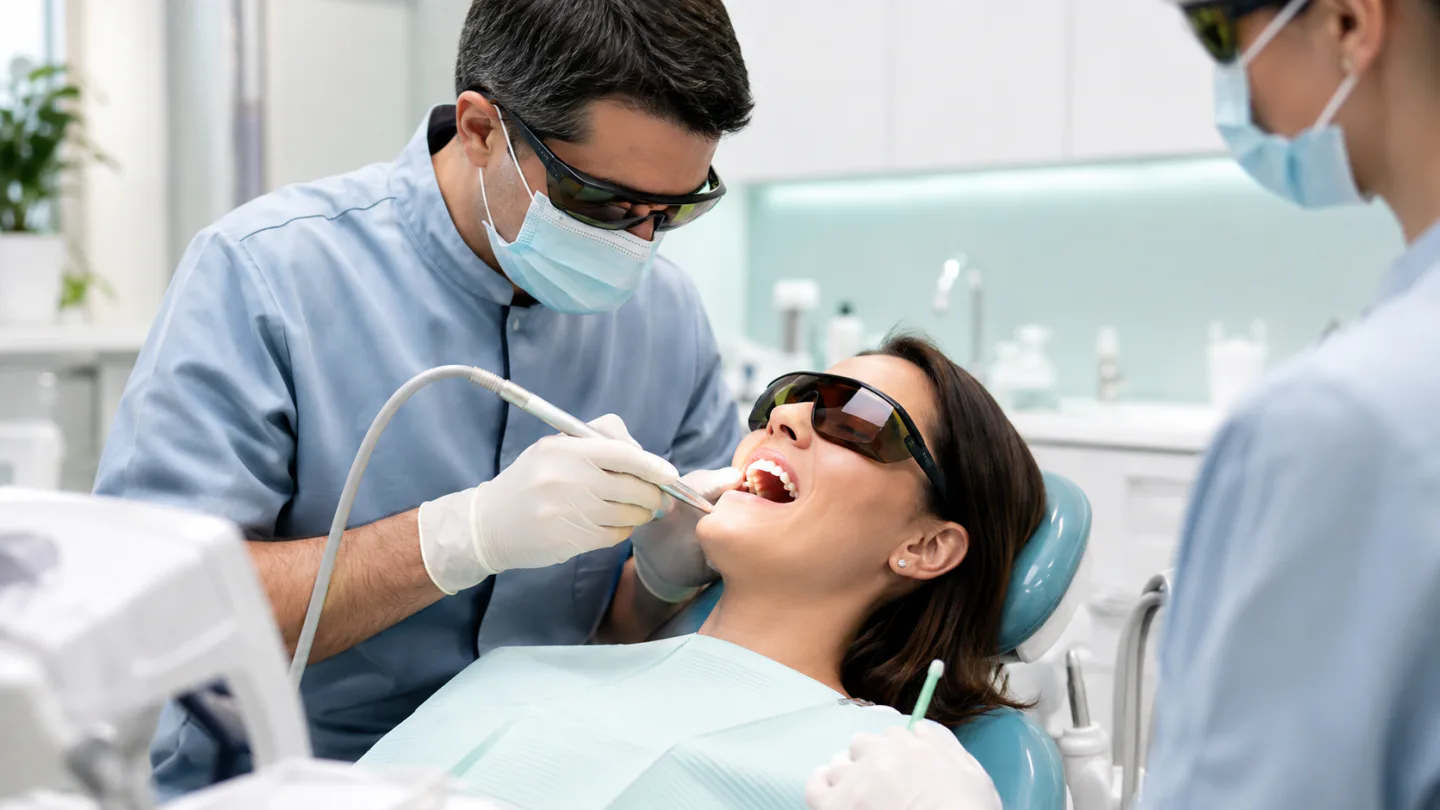
The word “laser” makes almost any treatment sound faster, gentler, and more advanced. In dentistry, lasers are genuinely useful tools for selected procedures. They can remove or reshape soft tissue with precision, control bleeding, and support treatment in areas where a conventional instrument may be less convenient.
They are not magic wands. A laser cannot replace every drill, cure gum disease by itself, or make diagnosis and local anesthetic irrelevant. Different lasers interact with tissue in different ways, and a device suited to gum contouring may not be intended for enamel or bone.
If you are researching laser dentistry in Winnipeg, this guide explains what dental lasers do, which procedures may use them, how the appointment can feel, and what questions help separate a useful technology from an oversized promise.
What is a dental laser?
A laser produces a concentrated beam of light at a specific wavelength. Dental tissues and pigments absorb wavelengths differently. That interaction allows an appropriately selected laser to cut, vaporize, coagulate, disinfect, or modify tissue in a controlled area.
Soft-tissue lasers are designed mainly for gums and other oral soft tissues. Hard-tissue lasers can interact with enamel, dentin, and sometimes bone, depending on the device and settings. Some systems have narrower uses, such as activating a whitening product or supporting bacterial reduction.
The laser is only one part of treatment. The clinician’s diagnosis, training, protective measures, parameter selection, and conventional skills determine how safely and effectively it is used.
Common soft-tissue uses
Lasers are often most visible in soft-tissue dentistry. Possible uses include:
- Reshaping excess or uneven gum tissue
- Exposing more tooth for a restoration or impression
- Removing a small tissue growth for examination
- Releasing a restrictive frenum in selected cases
- Managing inflamed tissue around a restoration
- Controlling bleeding during a procedure
- Treating certain ulcer or cold-sore symptoms with specific protocols
- Assisting selected periodontal procedures
Not every practice uses lasers for all of these purposes, and not every patient is a candidate. When tissue is removed because of an unexplained growth, it may still need to be submitted to a pathology laboratory. Vaporizing a lesion without a diagnosis can eliminate the sample needed to understand it.
Gum contouring and smile design
Some people show uneven gum levels or feel that their teeth look short because excess tissue covers part of the enamel. A laser can remove and shape superficial gum in suitable cases, often with good control of bleeding.
The key question is what lies beneath. The position of the bone, natural tooth shape, gum thickness, lip movement, and biological attachment around the tooth determine how much tissue can be changed safely. Removing gum without respecting these structures can lead to rebound, chronic inflammation, or sensitivity.
Aesthetic gum contouring should begin with measurements and a plan for the entire smile, not freehand removal based on a close-up photograph. In some cases, conventional periodontal surgery is more appropriate because bone also needs adjustment.
Lasers in gum-disease treatment
Periodontal disease is caused by a complex interaction among bacterial plaque, inflammation, risk factors, and the supporting tissues around teeth. The foundation of treatment remains accurate diagnosis, plaque control, removal of deposits from root surfaces, and ongoing maintenance. Smoking, diabetes control, and home care also affect results.
Lasers may be used as an adjunct in selected periodontal procedures to remove diseased tissue, reduce bleeding, or interact with bacteria. They should not be advertised as a guaranteed cure or a replacement for thorough root-surface debridement and follow-up.
Ask whether laser use changes the expected result compared with conventional care, what evidence supports that specific protocol, and whether there is an added fee. “Kills bacteria” is not enough explanation; many dental treatments reduce bacteria temporarily, while long-term stability depends on disrupting plaque repeatedly.
Can a laser replace the dental drill?
Some hard-tissue lasers can remove selected areas of tooth decay or prepare enamel and dentin. Patients may experience less vibration and a different sound than with a traditional handpiece. In small accessible cavities, that can be appealing.
Limitations remain. A laser may work more slowly in certain materials, cannot remove many existing metal or ceramic restorations, and may not create every preparation shape efficiently. A conventional handpiece may still be needed to refine the tooth, adjust a filling, or remove an old restoration.
Whether freezing is required depends on depth, tooth sensitivity, and the procedure—not merely the presence of a laser. Avoid any promise of “no needles for everyone.”
Lasers and root canal treatment
Root canal therapy relies on mechanical cleaning, irrigation, shaping, and sealing of the root canal system. Lasers or light-activated methods may be used to enhance irrigation or reduce microorganisms in selected protocols.
They do not remove the need to locate canals, use fine instruments, irrigate safely, and fill the system. Roots contain fins, curves, and branching spaces that no single beam simply sterilizes.
If a laser is proposed during root canal care, ask what step it supports and whether the treatment can be completed predictably without it. Technology should make the procedure clearer, not the explanation more mysterious.
Frenectomy and tongue-tie discussions
A frenum is a band of tissue connecting the lip, cheek, or tongue to surrounding structures. A laser can release a restrictive frenum with precise soft-tissue control and limited bleeding in selected cases.
The difficult part is deciding whether release will actually improve function. Feeding, speech, gum recession, orthodontic stability, pain, and tongue mobility are complex. Appearance alone does not establish a functional tongue-tie, and cutting tissue is not a universal solution for breastfeeding or speech concerns.
Assessment may involve a dentist, physician, lactation consultant, speech-language pathologist, or other appropriate professional. Aftercare and exercises should be evidence-informed and explained before treatment. Ask what functional limitation is being treated and how improvement will be measured.
Biopsies and tissue removal
Lasers can remove small soft-tissue lesions and help control bleeding. When the nature of a lesion is uncertain, preserving an undamaged tissue margin for pathology is crucial. Heat can alter cells at the edge of a specimen if technique or device selection is inappropriate.
The clinician should decide whether excision in a general dental setting is suitable or whether referral to an oral surgeon, oral medicine specialist, or other provider is safer. Lesions that are large, pigmented, fixed, ulcerated, rapidly growing, or otherwise concerning need deliberate diagnostic planning.
Never accept “the laser removed it, so it cannot be serious” as a substitute for diagnosis and follow-up.
Cold sores and canker sores
Some laser protocols are used to reduce pain or duration when applied early to recurrent cold sores or aphthous ulcers. Results and protocols vary, and treatment does not eliminate the underlying virus responsible for cold sores or guarantee that an ulcer will not recur.
The clinician must first distinguish among a cold sore, canker sore, traumatic ulcer, infection, and a persistent lesion that needs biopsy. Repeated treatment of the wrong diagnosis can delay appropriate care.
A sore lasting about two weeks, changing, recurring unusually, or accompanied by broader symptoms should be assessed rather than repeatedly “lasered away.”
Lasers in teeth whitening
Marketing often uses “laser whitening” to describe in-office bleaching performed with a bright light. The active whitening work is generally done by peroxide gel. A light or laser may activate or heat a system according to its design, but it does not make every product safer or the result permanent.
Whitening outcome depends on the cause of discolouration, natural tooth response, product concentration, contact time, and existing fillings or crowns. Light use can contribute to temporary dehydration, making teeth look brighter immediately before some colour rebounds.
Ask which system is used, what the energy source contributes, how gums are protected, and how sensitivity is managed. A dental examination remains more important than the drama of the equipment.
What does laser treatment feel like?
Experience varies by wavelength, settings, tissue, and procedure. Patients may hear a soft popping sound, notice a warm sensation, or smell an odour as tissue is treated. Suction and water may be used. Protective eyewear designed for the specific wavelength is required for everyone in the treatment area.
Some superficial procedures require little anesthetic; deeper or more extensive treatment still needs local freezing. A laser can seal small blood vessels as it works, so bleeding may be less than with a scalpel in selected soft-tissue procedures.
Less bleeding does not mean no wound. The treated area still needs time to heal, and discomfort, swelling, or a pale surface layer can occur.
Healing after a soft-tissue laser procedure
Follow the instructions for that procedure. General advice may include keeping the mouth clean, choosing soft non-spicy food, avoiding tobacco and alcohol, and using prescribed rinses or pain medicine appropriately. Do not peel or scrub the healing surface.
Call the office for bleeding that does not settle, increasing swelling, fever, pus, worsening pain, or an allergic or medication concern. The appearance can change during healing, so a scheduled review is important when tissue was reshaped or removed.
If a specimen was submitted, make sure you receive the pathology result. Do not assume “no news” means the report was normal.
Benefits of laser dentistry
Depending on the case, benefits may include precise tissue removal, excellent visibility through bleeding control, less need for sutures, reduced vibration, and a comfortable recovery. A laser can also reach and shape small soft-tissue areas efficiently.
These advantages are procedure-specific. A patient receiving superficial gum contouring may experience them differently from someone having periodontal surgery. The comparison should be with the realistic conventional alternative for the same diagnosis.
The best technology is the one that improves care in trained hands. A scalpel, electrosurgery unit, hand instrument, or conventional drill may be more efficient or appropriate for another step.
Limits and possible risks
Lasers can cause burns or damage nearby tissue when the wrong wavelength, setting, angle, or exposure is used. Eye injury is a risk without proper wavelength-specific protection. Heat may affect teeth or bone. Aerosol and plume must be managed appropriately.
The equipment is expensive, which can influence fees. Training varies, and owning a device does not automatically confer expertise in every advertised procedure. Some claims extend far beyond the evidence.
Ask about the clinician’s experience with your specific treatment, alternative methods, expected benefit, risks, recovery, and total fee. A thoughtful provider should be comfortable explaining when the laser will not be used.
Laser dentistry for children
Reduced vibration, controlled bleeding, and shorter steps can be helpful for selected pediatric procedures. A laser does not guarantee cooperation or eliminate the need for age-appropriate communication, behaviour guidance, or anesthesia.
Children still need a correct diagnosis and safe protection. Their teeth, roots, jaws, and ability to report sensation differ from adults. The dentist should explain why a laser is preferable for this child and this treatment rather than presenting it as automatically gentler.
Parents should receive the same information about alternatives, risks, aftercare, and expected healing that they would for conventional treatment.
Costs and dental benefits
Fees are generally based on the procedure performed, though laser use may add cost in some settings. A benefit plan may cover a gingival procedure, filling, or biopsy according to its rules without separately paying for the device used.
Ask for the diagnostic and procedure name, not just a “laser package.” Confirm deductibles, percentages, annual maximums, and whether preauthorization is advisable. Cosmetic gum contouring is commonly excluded from standard dental coverage.
A higher fee can be reasonable when technology materially improves a complex procedure, but it should come with a clear clinical explanation.
Considering laser dentistry in Winnipeg
Dental lasers are precise tools with valuable uses, especially in soft tissue. Their greatest strength is not that they replace traditional dentistry; it is that they give a trained clinician another way to perform a carefully selected procedure.
Winnipeg North Dental offers laser dentistry where it is appropriate and can explain conventional alternatives. If you have been advised to consider laser gum treatment, contouring, or another procedure, request an appointment and bring your questions. The decision should be based on diagnosis and expected benefit, not the glow of the word “laser.”