
If dental X-rays, impressions, or a toothbrush near your back teeth make you gag, you may worry about an appointment long before it begins. Some people feel embarrassed; others have been told to relax when they were already trying hard. A strong gag response deserves a practical conversation, not blame.
Managing a gag reflex during dental visits in Winnipeg starts with describing what triggers it and planning the appointment around that information. There is no single technique that works for everyone. The dental team needs to consider the procedure, your health, your previous experiences, and what adjustments can be made safely.
Tell the office when booking rather than waiting until an instrument is in your mouth. An early discussion gives the team time to explain options and decide whether the planned visit needs a different pace, equipment, or clinical setting. You do not need to demonstrate how severe the problem is before being taken seriously.
Explain what happens, not just that you gag
A few specific details can make the discussion more useful. Does gagging start when something touches the back of your mouth, when you lie back, when water collects, or even when you anticipate a particular procedure? Is it worse with certain tastes, textures, or a blocked nose?
Describe the response and its effect on care. You might be able to tolerate an examination but struggle with X-ray sensors, or brush most teeth while avoiding the inner surfaces of back molars. Explain whether earlier appointments were stopped and whether any adjustment helped.
You do not need to decide whether the cause is physical or psychological. Both the sensation and the anticipation can matter, and the clinician should assess the situation rather than assume one explanation. Bring relevant medical history, including reflux, swallowing concerns, respiratory problems, and medication. A new or changing symptom deserves discussion even if you have always considered yourself someone with a sensitive gag reflex.
Understand the limits of quick-fix advice
The gag reflex has a protective role, but an exaggerated response can interfere with dental care. Advice online often promises that a pressure point, product, or distraction will switch it off. Such claims can sound appealing when you are worried about getting through treatment.
A Cochrane review of gagging management in dental patients found very uncertain evidence for the interventions assessed and could not establish a reliably effective approach from the included trials. That review was published in 2019; it is a reason to be cautious about universal promises, not a statement that individualized care cannot help.
Ask the dentist what they recommend for your procedure and why. If a strategy is proposed, discuss what will happen if it does not work. Having a backup plan can be reassuring because the appointment no longer depends on you succeeding at one trick. Avoid purchasing products or attempting invasive exercises simply because someone online describes them as effortless.
Agree on a pause signal before treatment
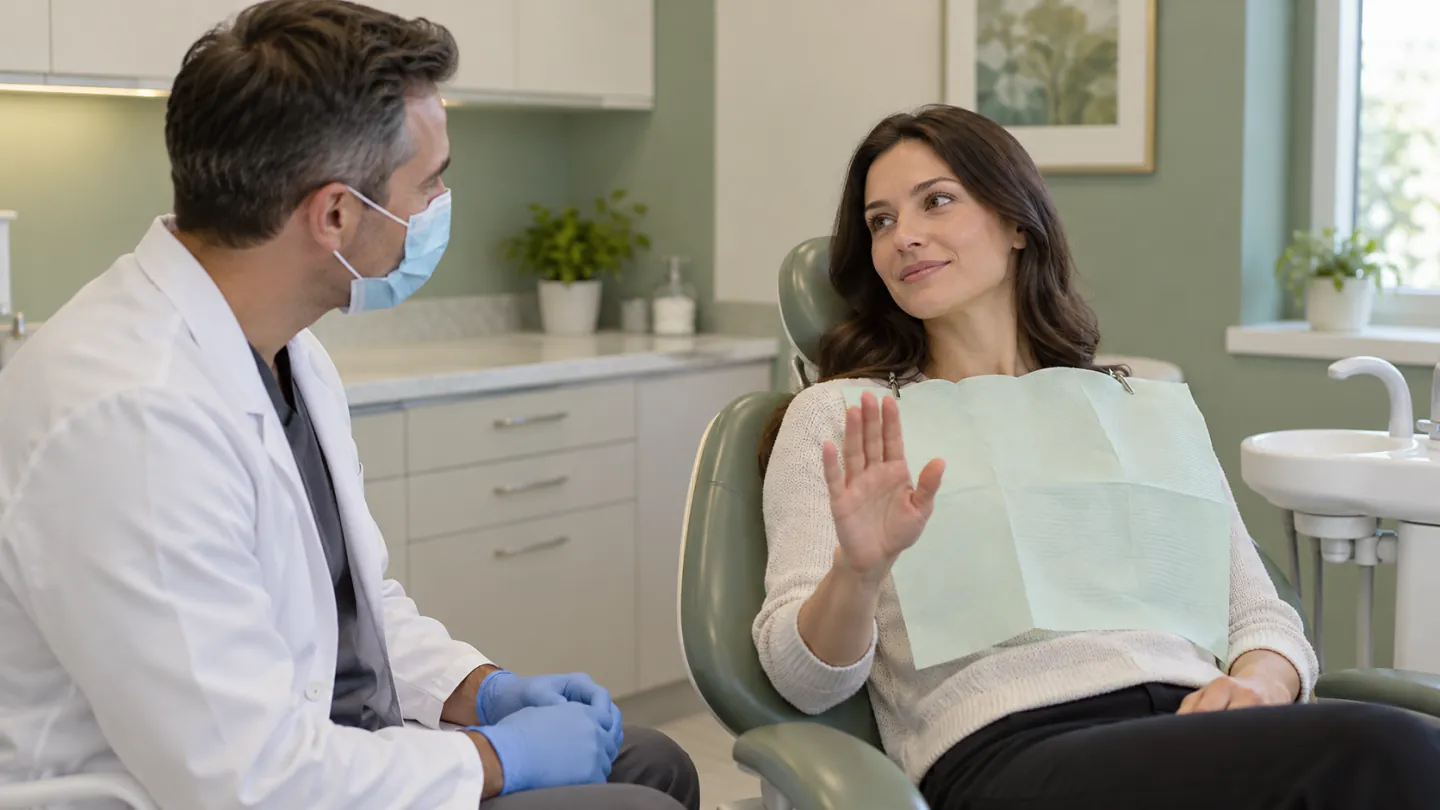
Choose a clear signal that does not require speaking with instruments in your mouth. Raising a hand is one possibility. Confirm that the clinician has seen the signal and understands what you want it to mean.
Ask how the team will pause safely during the specific procedure. In some situations, an instrument needs to be withdrawn carefully before you move. Knowing the sequence can prevent a sudden movement prompted by panic. You should not have to guess whether you are allowed to interrupt.
Also discuss whether you prefer a warning before each step or less detailed narration. Some people feel calmer when they know exactly what is coming; others find a long description increases anticipation. Tell the team your preference and revise it if needed. A useful communication plan is one you can actually use when uncomfortable, rather than an agreement that sounds good only while sitting in the waiting room.
Ask about position, pacing, and fluid management
Explain whether lying back makes the sensation harder to manage. The clinician can discuss how position may be adjusted while preserving access and safety for the work being done. Not every procedure can be completed in the same position, so ask what is feasible for this visit.
Mention if you are concerned about water or saliva collecting. Ask how suction and breaks will be handled and whether the work can be divided into shorter sections. Do not assume that you must tolerate a long uninterrupted stretch simply because that was your experience elsewhere.
If nasal breathing is difficult because of congestion or a medical condition, tell the team. Do not use medication or sprays solely to get through the appointment without checking that they are appropriate for you. The aim is to share information that affects comfort and planning, not to conceal symptoms so the appointment can proceed exactly as originally scheduled.
Make anxiety support specific
If worry increases the gag response, ask about strategies to reduce that part of the experience. A quieter discussion before treatment, a predictable sequence, a pause, or a familiar relaxation method may be useful to discuss. These supports should not imply that the physical response is imaginary.
NHS England’s dental anxiety guidance discusses communication and techniques such as controlled breathing for anxiety management. Those methods address anxiety; they are not a guaranteed cure for gagging. Practise only an approach that feels comfortable and that the clinical team considers appropriate.
If you have had a distressing dental experience, you can share the details you think are relevant without being pressured to disclose more than you want. Our guide to dental anxiety in Winnipeg offers ways to prepare for that conversation. The goal is a workable treatment relationship in which your concerns are understood and your feedback changes the plan.
Discuss imaging and impressions before they are attempted
If a previous sensor or impression tray caused severe gagging, tell the dentist which step was difficult. Ask whether a different size, position, sequence, or method is clinically appropriate and available. A change that works for one purpose may not provide the information needed for another.
For example, do not assume an external X-ray can replace every image taken inside the mouth, or that a digital scan removes all potential triggers. Ask what information the clinician needs and what the alternatives would change. Our dental X-ray guide explains why different images may be recommended.
Before starting, agree on how many attempts are reasonable and when to reassess. Repeating the same unsuccessful step without discussion can make anticipation worse. If the planned records cannot be obtained comfortably, the clinician should explain the effect on diagnosis or treatment and help identify a sensible next step rather than leaving you to decide alone whether to abandon care.
Consider sedation through an individual assessment
Sedation may be discussed for some patients, but it is not automatically the first choice or suitable for everyone. The decision depends on your medical history, the proposed treatment, the available setting, and the clinician’s assessment. Ask what form is being considered and what problem it is intended to address.
Do not take a friend’s sedative, combine alcohol with medicines, or use a numbing spray on your throat to try to suppress gagging before a visit. These choices can affect safety and may interfere with the treatment plan. Tell the dentist about any medication or substance you have taken.
If sedation is recommended, get the preparation, eating, escort, and transport instructions in writing. Confirm what services the office provides and whether referral is needed. For a Winnipeg appointment, arrange the required ride and support before the day of treatment. The right plan is a coordinated clinical decision, not an experiment carried out in the waiting room.
Adapt home care without repeatedly provoking the reflex
Tell the dental team if gagging prevents you from cleaning certain surfaces. Ask them to watch your technique and discuss a smaller brush head, a different toothpaste texture or flavour, or another suitable adjustment. The aim is to clean the teeth effectively with a routine you can tolerate.
Avoid repeatedly pushing a brush farther back to see whether you can overcome the sensation. Do not place small loose objects in your mouth as a distraction or attempt throat-desensitizing exercises without professional guidance. If a clinician recommends a structured programme, ask them to demonstrate it and explain when to stop.
Keep tooth cleaning and tongue cleaning separate in your mind. If brushing the tongue is the main trigger, discuss whether that optional step is appropriate instead of allowing it to derail the entire toothbrushing routine. Report persistent nausea, vomiting, pain, or swallowing difficulty to the appropriate healthcare provider rather than assuming every symptom has the same dental explanation.
Plan the first visit around achievable information
If you have avoided care for a long time, ask whether the first visit can focus on discussion and assessment, with treatment planned afterward when appropriate. Tell the office about pain or other urgent symptoms so those needs are considered alongside comfort.
Bring a short note listing triggers, helpful adjustments, and questions. This can be easier than trying to explain everything while anxious. If you want a support person present, ask about arrangements beforehand. Allow enough travel time that a delayed bus or difficult parking does not leave you rushing into a conversation that needs a calm start.
A productive first visit may establish what you can tolerate, identify immediate dental needs, and create a sequence for the remaining work. It does not have to prove that you can complete every procedure in one sitting. Ask the clinician what has been learned and how that changes the next appointment.
Keep a record of what helps
After the visit, note which adjustments made a difference and which did not. Ask for successful approaches to be recorded in your dental chart. Include practical details such as a helpful position, the agreed signal, and whether shorter sections were easier to manage.
If an appointment remains difficult, discuss the next option rather than concluding that dental care is impossible. Further assessment, a revised approach, or referral may be appropriate. The aim is safe care that takes your response seriously and builds on actual experience.
To plan a dental visit in Winnipeg when gagging is a concern, request an appointment and mention it in the booking information. Explain whether it affects brushing, imaging, impressions, or previous treatment. That early detail gives the team a starting point for a more thoughtful and manageable appointment.