
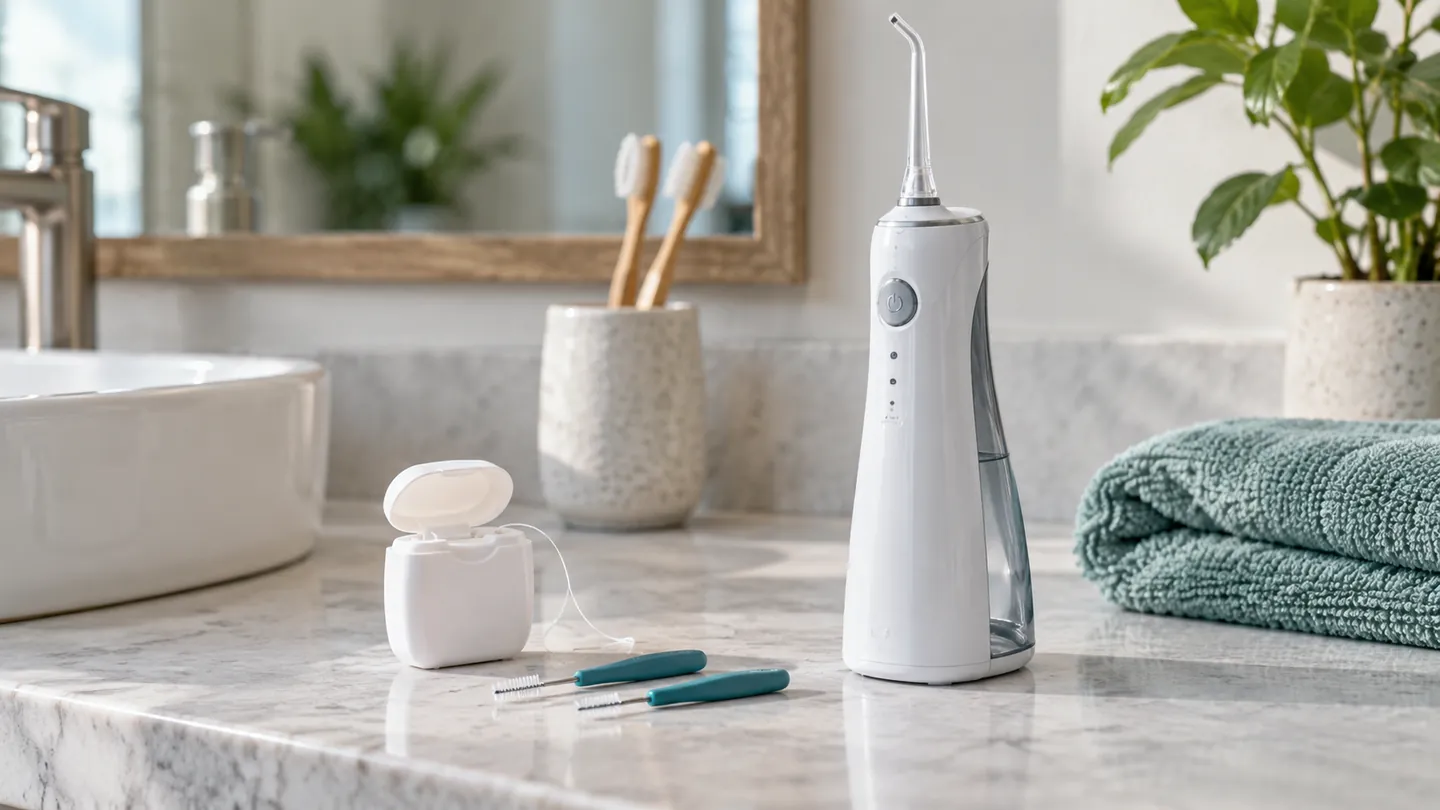
The oral-care aisle can make a simple question surprisingly complicated. There is waxed floss, dental tape, a row of tiny brushes in different sizes, disposable holders, and water flossers with enough settings to resemble an appliance showroom. You may leave with a new product and still be unsure how to clean the one area that always catches food.
For people comparing flossing and water flossers in Winnipeg, the best starting point is the shape of the spaces in their own mouth. Tight contacts, wider gaps, braces, bridges, implants, and limited hand movement create different challenges. The right tool is the one that reaches the intended surfaces and can be used consistently with a suitable technique.
This guide is about making that choice practical. It is not a ranking of brands or a promise that one device replaces every other part of oral care. You still need toothbrushing and professional assessment, and the dental team may recommend different aids for different areas.
Why brushing leaves another job to do
A toothbrush cleans the accessible surfaces of teeth, but the spaces between teeth need deliberate attention. The American Dental Association’s flossing guidance recommends daily cleaning between teeth and describes several types of aids that can be used.
The useful question is not whether you identify as someone who flosses. It is whether the method you use reaches the areas that need cleaning. Passing a strand quickly through a contact without cleaning along the neighbouring tooth surfaces may not accomplish what you intended.
At a dental visit, ask the hygienist to show you the difficult areas in your own mouth. You may discover that most spaces are straightforward and only two or three need a different technique. That is easier to solve than assuming the entire routine needs to be replaced.
Traditional floss: control matters more than speed
Floss can work well where teeth contact closely. Guide it gently through the contact rather than snapping it into the gum, then adapt it around the side of each tooth as instructed. The Canadian Dental Association’s oral health basics provides a foundation for brushing and flossing technique.
If the strand shreds at the same spot repeatedly, tell the dental team. A rough restoration, a tight area, or another issue may need to be assessed. Do not assume you should simply pull harder or avoid the space permanently.
Try the technique in front of a mirror when you are not rushing. People often focus on getting floss between the teeth and forget that the purpose is controlled cleaning against the surfaces. A demonstration followed by your own attempt is more helpful than a reminder to floss better.
Holders can make access easier
Some people struggle with finger floss because of limited hand movement, a strong gag reflex, or difficulty reaching the back teeth. A suitable holder may make the task more manageable. The choice should still allow you to clean both sides of the space without forcing the tool against the gums.
If you help a child or another adult, ask for a demonstration adapted to that role. Position, visibility, and consent matter. The person receiving help should be comfortable and able to signal when they need a pause.
Do not interpret difficulty with one method as a personal failure. Oral care is a physical task, and tools can be adapted. Tell the hygienist exactly where your hands get stuck or where the aid is uncomfortable. That information is more useful than quietly buying another product with similar limitations.
Interdental brushes need the right size
A small interdental brush can be useful in spaces where it fits appropriately. It should not be forced through a tight contact. The CDA’s prevention material notes that interdental cleaners may be helpful in circumstances such as wider spaces or orthodontic care.
Size matters, and different parts of the mouth may need different sizes. Ask the hygienist to identify which brush fits each area and demonstrate the angle. A brush that is too large can be uncomfortable; one that is too small may not contact the intended surfaces effectively.
Keep the instructions simple enough to remember. If you need two sizes, ask the team to mark which areas use each one. Replace damaged aids according to the product instructions and professional advice. Do not keep using a bent wire or a brush that has become difficult to control.
Where a water flosser can help
A water flosser directs a stream of water to assist cleaning between teeth and around certain dental work. The ADA’s water flosser guide describes it as an option, including for people who find conventional floss difficult to use.
Before buying, ask whether it addresses your specific challenge. Is the problem a bridge, braces, limited dexterity, or simply a habit that never became consistent? A device may help with access, but it cannot compensate for being left unused in the cupboard.
Follow the manufacturer’s instructions and the dental team’s advice about pressure, tips, and technique. Start with a comfortable setting rather than assuming maximum pressure is best. If you have recent surgery or an actively painful area, ask the treating clinician before directing a stream at it.
Decide with your bathroom and routine in mind
Product comparisons often focus on features while overlooking the reason people stop using a device. Does it fit beside the sink? Can you fill and empty it comfortably? Is the handle easy to grip? Will charging or replacement tips become an obstacle?
A person sharing a small bathroom may prefer a different setup from someone with ample counter space. Someone travelling regularly may value portability. Someone with reduced hand strength may need a handle and reservoir that are easy to manage without spilling.
These are useful questions to consider before spending money. Ask the hygienist what matters clinically, then choose within your budget. There is no need to pay for multiple specialised settings if a simpler tool meets the demonstrated need. The most expensive option is not automatically the most sustainable one.
Bleeding is information, not a reason to guess
Bleeding during cleaning may relate to inflammation, technique, or another issue that needs assessment. Tell the dental team where it occurs, how often, and whether it has changed. If bleeding persists, do not assume it is normal just because the area does not hurt.
At the same time, avoid repeatedly scrubbing the spot to test whether it still bleeds. Gentle, effective care and professional guidance are more useful than alternating between aggressive cleaning and complete avoidance. If a particular aid causes sharp pain, stop that action and ask for advice.
Our gum disease guide explains why symptoms need context. Swelling, pus, a persistent unpleasant taste, loose teeth, or significant pain should be reported promptly. A new tool is not a substitute for examining a possible dental or periodontal problem.
Bridges, implants, and fixed retainers need specific demonstrations
Dental work can create surfaces that ordinary floss cannot reach by simply moving down between two teeth. A bridge may need cleaning underneath, and a fixed retainer may require a way to pass around the wire. Ask for a demonstration of the exact route.
Around implants, the restoration design and available access matter. Do not improvise with sharp objects or force an aid under a component. Our dental implant care guide explains why maintenance should be planned for the individual restoration.
If you cannot reproduce the technique at home, bring the aids to your next visit and show the hygienist what happens. A small change in grip or tool choice may solve the problem. If the restoration itself prevents reasonable cleaning, that deserves evaluation rather than endless purchases of increasingly complicated devices.
Build the habit around an event you already do
Instead of promising to remember at a particular time, connect interdental cleaning to a reliable event. It might happen before evening brushing, after putting contact lenses away, or before your main sleep period if you work nights. Choose a moment when you have enough attention to use the tool safely.
Keep the supplies visible and easy to reach while protecting them from contamination. If the preferred tool is buried behind several bottles, the routine becomes easier to skip. A simple storage arrangement can matter more than another reminder on your phone.
If you miss a day, resume the normal routine rather than trying to compensate with force or extra-long cleaning. Consistency develops through repetition. An occasional lapse is a reason to restart, not evidence that the whole effort has failed.
Mouthwash does not remove the need for mechanical cleaning
A rinse may have a particular role when recommended, but it should not become a way to avoid a difficult cleaning area. Ask what the rinse is intended to do, how long to use it, and whether it is compatible with your other products.
Likewise, a fresh taste is not a reliable measure of whether plaque has been removed. It is possible to feel minty and still have a space that is never cleaned effectively. Judge the routine by technique, comfort, and the findings at follow-up rather than flavour alone.
If persistent bad breath is the reason you are shopping for products, mention it at the examination. Our bad breath guide explains why the cause may need attention beyond another mouth rinse or a stronger toothpaste.
Check whether the plan is working
At the next cleaning, ask which areas have improved and which still need help. The feedback should be specific enough to act on. A broad instruction to do more is less useful than learning that one back tooth needs a different angle or that an aid is not fitting a particular space.
Bring your questions, the tools you use, and any practical limitations. If the routine takes so long that you rarely complete it, say so. The dental team can help simplify it while preserving the parts that matter for your mouth.
For guidance on flossing and water flossers in Winnipeg, request a visit at Winnipeg North Dental. The aim is a routine you understand, can perform comfortably, and will actually continue. Choosing a product is only the beginning; learning how it fits your teeth is what makes the choice useful.