
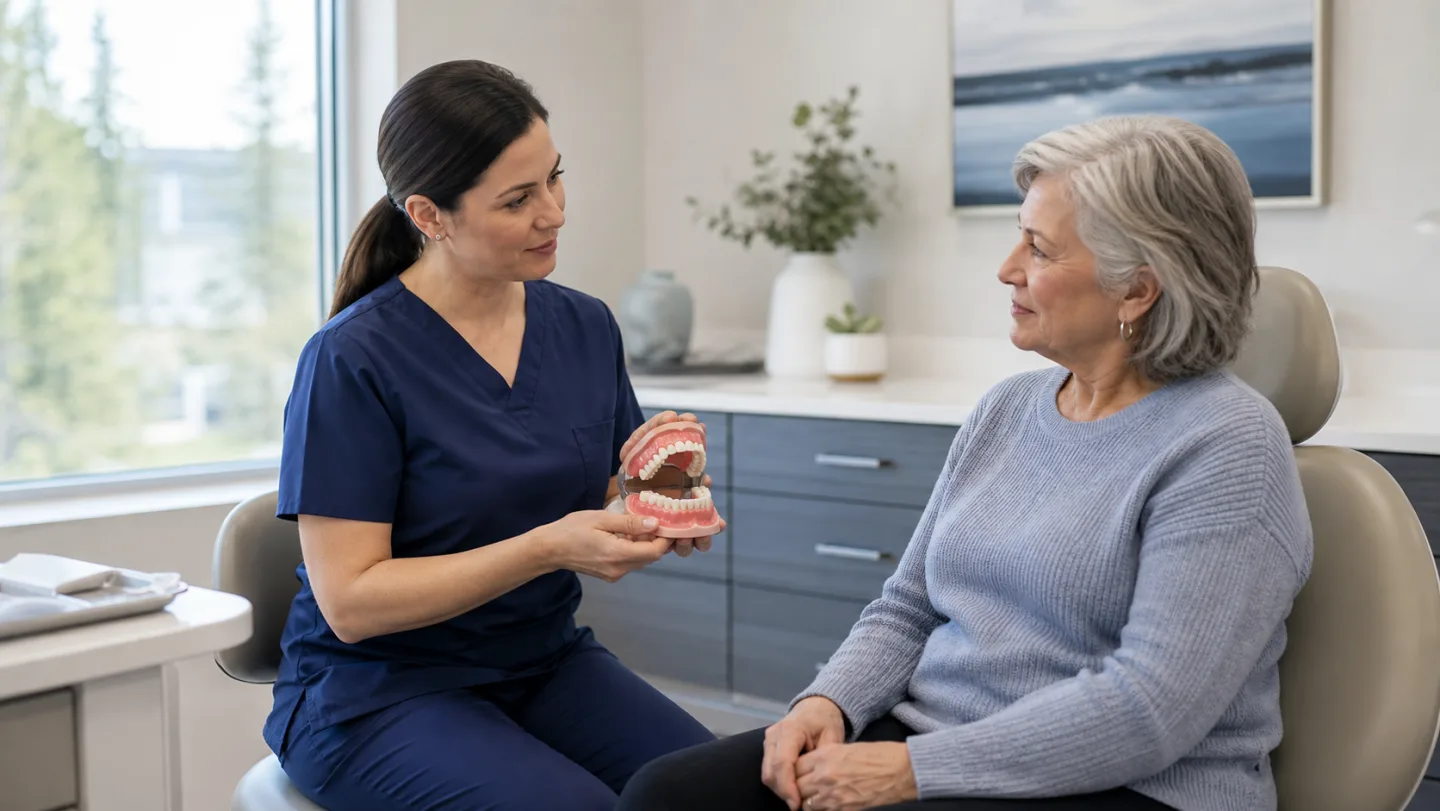
A denture should help you eat, speak, and smile with more confidence. When it feels loose, traps food, creates sore spots, or makes you avoid certain meals, it can affect daily life in ways other people never see.
Traditional dentures remain a practical solution for many people. Snap-in dentures add dental implants for extra retention. One is not automatically “old-fashioned,” and the other is not automatically the right upgrade. Bone, health, remaining teeth, cleaning ability, expectations, and budget all shape the decision.
If you are comparing dentures and snap-in dentures in Winnipeg, this guide explains how each option works and what questions to ask before treatment.
What is a traditional denture?
A denture is a removable replacement for missing teeth and surrounding gum tissue. It rests on the gums and is designed to restore appearance and function.
The two main categories are:
- Complete dentures, which replace all teeth in the upper or lower arch
- Partial dentures, which replace some missing teeth and use remaining teeth for support or retention
Complete upper dentures often gain retention from suction across the palate and the shape of the supporting tissues. Lower dentures have less surface area and must share space with the tongue and moving muscles, which can make stability more challenging.
A traditional denture is not attached to implants. It must be removed for cleaning and is generally removed at night to give tissues a rest, following your provider’s instructions.
What is a snap-in denture?
A snap-in denture is a removable overdenture that connects to dental implants through attachments. You may also hear the terms implant-supported denture, implant-retained denture, or removable implant overdenture.
Small attachments on the underside of the denture connect to components on the implants. The denture “snaps” into place for improved retention and is removed by the patient for daily cleaning.
The implants act as anchors. They can reduce movement and improve confidence, particularly for a lower complete denture. The denture still rests partly on gum tissue in many designs, so fit and tissue support continue to matter.
Snap-in dentures are different from a fixed full-arch bridge. A fixed prosthesis is secured to implants and removed by a dental professional rather than by the patient. Each design has different implant requirements, cleaning routines, costs, and maintenance.
The biggest difference: retention
Traditional dentures rely on anatomy, fit, saliva, muscle control, and sometimes adhesive. A well-made denture can work very well, but the jaw continues to change after teeth are lost. Over time, a denture may become less stable and need adjustment, relining, or replacement.
Snap-in dentures use implant attachments to resist lifting and shifting. Many patients value that extra confidence while speaking or eating. Retention does not mean the denture can never move or that every food will feel exactly like it did with natural teeth.
The amount of improvement depends on:
- Number and location of implants
- Implant stability and bone support
- Denture design
- Condition of the gum and ridge
- Bite forces
- Attachment wear
- Patient coordination and expectations
Ask what kind of movement the proposed design is intended to reduce. “More stable” should be explained in the context of your mouth.
Who may do well with a traditional denture?
Traditional dentures can be appropriate when:
- Surgery is not desired or medically suitable
- Bone conditions make implants more complex
- Cost needs to remain lower
- A patient needs a removable option that can be modified
- Remaining teeth support a partial denture
- Current anatomy can provide acceptable retention
- Treatment time needs to be shorter
Some people adapt well and wear conventional dentures comfortably for years. Others struggle most with a lower denture because the tongue and floor of the mouth are constantly moving.
The quality of the denture matters. Tooth position, border shape, bite, impression accuracy, and follow-up adjustments all affect function. A traditional denture should not be dismissed as “just false teeth.” It is a custom prosthesis.
Who may be a candidate for snap-in dentures?
Implant-supported dentures may be considered for a person who wants improved retention and has suitable health and anatomy for implant placement.
The assessment considers:
- General health and healing
- Available jawbone
- Gum health
- Smoking or vaping
- Diabetes and other medical conditions
- Medications affecting bone or healing
- Ability to clean around implants
- Jaw relationships and available space
- Current denture design
- Expectations for removability and stability
If the jawbone is limited, grafting or an alternative implant approach may be discussed. In some cases, a smaller number of implants can retain an overdenture. The number is individualized; it should not be chosen from an advertisement.
Patients need enough dexterity to remove, clean, and reinsert the denture or dependable support from a caregiver. A removable design only works well when daily hygiene is realistic.
What treatment involves for a traditional denture
The process varies depending on whether teeth are already missing or need extraction.
A conventional denture is made after extraction sites and tissues have healed. This often provides a more stable starting shape but means another temporary solution may be needed during healing.
An immediate denture is prepared before teeth are removed and inserted at the extraction appointment. It prevents a period without teeth, but the gums and bone change during healing. Relines and adjustments are commonly needed, and a new denture may eventually be recommended.
Appointments can include:
- Examination and discussion of goals
- Impressions or digital records
- Bite and jaw relationship records
- Selection and trial of tooth position and appearance
- Denture delivery
- Follow-up adjustments
Small sore spots after delivery are common because a new denture contacts tissues in unfamiliar ways. Do not try to grind the denture yourself. Mark when and where it hurts, and contact the clinic for adjustment.
What treatment involves for snap-in dentures
Snap-in denture treatment combines implant surgery with denture care.
The process may include:
- Examination, X-rays, and three-dimensional imaging
- Assessment of existing teeth and dentures
- Extraction or bone preparation when required
- Implant placement
- Healing while the implants integrate
- Attachment of components
- Creation or modification of the denture
- Bite, fit, and retention checks
- Maintenance appointments
Some patients can use a temporary denture during healing. It may need modification so it does not place harmful pressure on the surgical sites. The final attachments are often connected after the implants have integrated, although timing varies.
Do not assume “snap-in” means one appointment. Implant healing and restorative steps take time.
Eating with traditional and snap-in dentures
Any new denture requires practice. Start with manageable foods, smaller pieces, and even chewing on both sides when instructed. Very hard or sticky foods can destabilize a denture or damage components.
Snap-in dentures often improve confidence by reducing movement, but chewing force and food choices still need adjustment. The denture teeth are not natural enamel, and the prosthesis needs protection.
If eating remains difficult, the problem may involve more than retention. Tooth position, bite, sore tissue, dry mouth, or denture extension can contribute. An attachment cannot compensate for every design issue.
Tell the provider what you cannot eat and why. “My denture is uncomfortable” is useful, but “the lower denture lifts when I chew on the left” gives more specific information.
Speech and appearance
Dentures affect the space used by the tongue and lips. Speech may sound different at first, particularly with certain sounds. Reading aloud can help adaptation. Persistent speech issues should be discussed because tooth position or thickness may need review.
Appearance is planned through tooth shape, shade, size, position, and the amount of gum material shown. Bring photographs of your natural smile if they are available and meaningful to you.
Snap-in retention can reduce worry about movement during conversation, but the visible appearance comes from the denture design itself. Implants are the anchors, not the cosmetic part.
Cleaning traditional dentures
The Canadian Dental Association recommends cleaning complete and partial dentures every day. Plaque and tartar can build on dentures and contribute to stains, odour, gum irritation, and disease in remaining teeth.
General steps include:
- Remove and rinse the denture over a sink partly filled with water or over a towel
- Use a denture brush or soft brush
- Clean with denture cleaner or mild soap as advised
- Avoid regular toothpaste, which may be too abrasive
- Clean the gums, tongue, palate, and remaining teeth
- Remove the denture at night as instructed
- Store it safely according to professional directions
Handle it carefully. Dentures can break when dropped.
Adhesive should not be used to hide a seriously poor fit. If you need increasing amounts, book an assessment.
Cleaning snap-in dentures and implants
Snap-in dentures need all the care of traditional dentures plus cleaning around implant attachments.
Remove the denture daily. Brush the underside and attachment housings carefully. Clean around implant components at the gumline using the tools recommended by your dental team. Plaque left around implants can contribute to inflammation and bone loss.
The attachment inserts inside the denture wear over time and may lose retention. They are replaceable maintenance components, not a sign that the entire treatment failed.
Attend professional maintenance so the team can check:
- Gum health around implants
- Implant stability
- Attachment wear
- Denture fit and cracks
- Bite changes
- Ability to clean effectively
An implant cannot get a cavity, but the tissues around it require lifelong care.
Bone changes and long-term fit
Jawbone naturally changes after teeth are removed. Traditional dentures may become loose as the ridge shrinks. Relining adds material to improve adaptation to the current shape. Rebasing or replacing the denture may be needed when changes are larger.
Implants can help preserve bone in the immediate areas where they are integrated, but they do not freeze the entire jaw in time. A snap-in denture can still require relining or replacement as tissues, bite, materials, and facial support change.
Schedule an assessment if you notice rocking, sore spots, cracks, reduced attachment retention, difficulty chewing, or a change in appearance.
Cost factors in Winnipeg
Traditional denture costs depend on complete or partial design, materials, complexity, extractions, immediate versus conventional timing, laboratory work, and follow-up.
Snap-in denture costs may also include:
- Implant consultation and imaging
- Extractions
- Bone grafting
- Implant placement
- Temporary denture modification
- Abutments and attachments
- New overdenture or conversion of an existing denture
- Maintenance and replacement inserts
Ask for a staged estimate. Clarify which fees relate to surgery, which relate to the denture, and which future maintenance costs are likely.
Private insurance coverage varies. The 2026 Canadian Dental Care Plan includes eligible removable dentures under its rules but lists implants and implant-related procedures as exclusions. A conventional denture portion may be eligible while implant components are not. Confirm current coverage and any preauthorization before treatment.
Traditional denture, snap-in denture, or fixed teeth?
Use these questions to guide the discussion:
- How stable is a well-made traditional denture likely to be with my anatomy?
- What problem would implants solve in my case?
- How many implants are recommended and why?
- Will the final teeth be removable by me?
- Can my current denture be converted?
- Will I need grafting?
- What can I wear while healing?
- How do I clean the attachments?
- What maintenance parts wear out?
- What is included in the estimate?
Your priorities matter. One person values the lowest surgical burden. Another wants maximum lower-denture retention. Another needs a design a caregiver can clean. There is no single answer for all three.
Denture care in north Winnipeg
Winnipeg North Dental provides traditional dentures, snap-in dentures, dental implants, and fixed full-arch options for suitable patients.
If your current denture feels loose or you are replacing missing teeth for the first time, request a consultation. Bring your existing denture, even if you dislike it. It gives the dentist useful information about fit, bite, tooth position, and what you want to change.
The best denture conversation is not about choosing the most advanced label. It is about choosing a design you can use, clean, maintain, and feel comfortable wearing in your real life.