
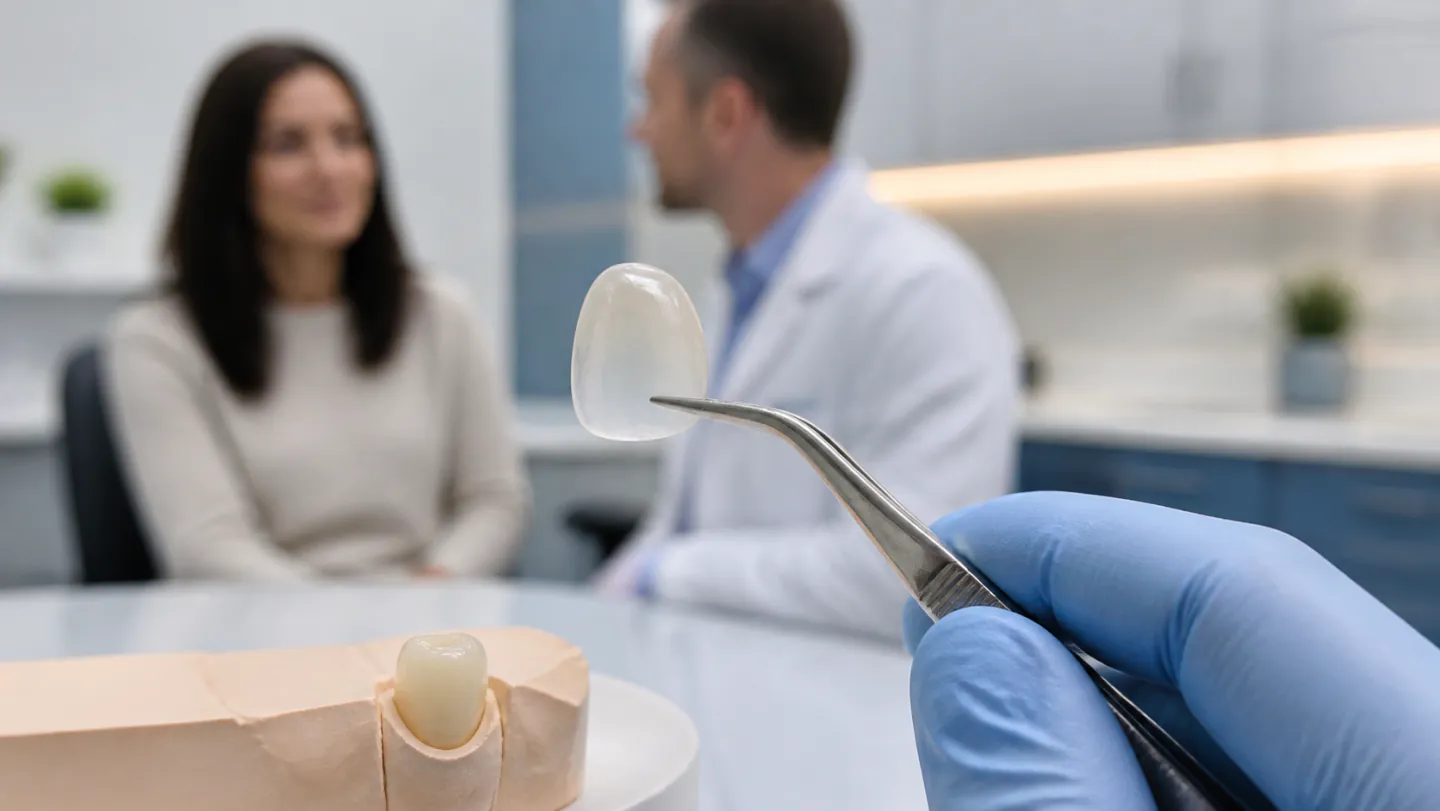
Veneers can change the colour, shape, length, or spacing of visible teeth. Online photographs often make the process look instant: one smile goes in, another comes out. What those images do not show is the planning, tooth preparation, bite assessment, and long-term care behind the result.
A veneer is not simply a white cover added to any tooth. It is a custom restoration that becomes part of your smile and must work with your gums, neighbouring teeth, and bite. Some patients are excellent candidates. Others can reach their goal with whitening, bonding, orthodontics, or no treatment at all.
If you are researching dental veneers in Winnipeg, this guide will help you ask better questions. It explains what veneers can realistically do, what cannot be reversed, and how a careful plan differs from choosing a smile from a catalogue.
What is a dental veneer?
A veneer is a thin restoration placed over the front and, in many cases, part of the sides or biting edge of a tooth. Veneers are commonly made from ceramic material or composite resin.
Ceramic veneers are usually designed outside the mouth from scans or impressions and then bonded to prepared teeth. Composite veneers may be shaped directly on the teeth during an appointment or made indirectly, depending on the plan.
The purpose is usually cosmetic, although a veneer may also rebuild a worn or chipped area. It does not replace the root or strengthen every type of damaged tooth. A tooth with a very large filling, deep crack, or significant loss of structure may need a crown instead. An unhealthy tooth may need treatment before any cosmetic work begins.
What smile concerns can veneers change?
Veneers may be considered for:
- Teeth with colour that does not respond well to whitening
- Small gaps between selected teeth
- Chipped or worn edges
- Uneven tooth length or shape
- Minor surface defects
- Some mildly rotated or irregular teeth
- Existing front restorations that need broader replacement
The word “minor” is important. Veneers can create the appearance of better alignment in selected situations, but they do not move roots or correct a larger bite problem. Trying to hide significant crowding with thicker restorations can produce bulky teeth that are difficult to clean.
A cosmetic consultation should begin with your concern in your own words. “I dislike this one dark tooth” leads to a different plan than “I want every tooth to look identical.”
What veneers cannot fix on their own
Veneers do not treat active decay, gum disease, infection, or an unstable bite. They also do not stop grinding. Covering a problem without managing its cause can shorten the life of the result.
They may be a poor choice when:
- There is not enough healthy enamel for reliable bonding
- Teeth are heavily broken down or contain very large fillings
- Gum inflammation or decay is active
- Grinding forces are not controlled
- The bite strikes the planned veneers heavily
- Tooth position would require excessive preparation
- Expectations depend on perfect symmetry or a guaranteed lifetime
Sometimes orthodontic treatment can move teeth into healthier positions before limited cosmetic work. Sometimes whitening and small areas of dental bonding create enough change with less tooth preparation. The most conservative option that reliably meets the goal deserves consideration.
Porcelain veneers and composite veneers
Porcelain or ceramic veneers are custom made and can offer strong colour stability, surface polish, and natural light reflection. They often involve at least two clinical visits and laboratory work. If damaged, repair may be possible in some situations, but replacement is often the more predictable solution.
Composite veneers use tooth-coloured resin. They can frequently be built directly on the tooth and may require less preparation. They are generally easier to repair, but can stain, wear, or lose polish sooner than ceramic.
One material is not automatically right for every smile. The choice depends on the amount of change, available enamel, bite, habits, maintenance expectations, timing, and budget. Ask to see how the proposed material behaves at the edge of the tooth and what future repair would involve.
Do veneers require shaving the teeth?
Many veneers require some enamel preparation to create room, establish a clear edge, and prevent the tooth from looking bulky. The amount varies. Some cases can be prepared very conservatively; others need more reduction because of tooth position, colour, existing fillings, or the planned shape.
“No-prep” veneers are marketed as completely reversible, but that description can be misleading. Even when little enamel is removed, the teeth may be cleaned, etched, bonded, and altered. Added thickness can also affect the gumline and bite. A no-preparation approach works only when the tooth position and desired result allow material to be added without over-contouring.
Ask your dentist to show where the tooth will be reduced and why. Once enamel is removed for a veneer, the tooth will generally continue to need a restoration in the future.
Planning the smile before treatment
Good veneer treatment begins before a drill touches a tooth. The dentist evaluates tooth health, gum levels, smile line, lip movement, tooth proportions, and bite. Photographs, scans, models, and X-rays may be used when appropriate.
You should discuss:
- Which features you want to change
- Which features you want to keep
- How bright or natural you want the shade
- Whether small variations are desirable
- How much tooth display you have when speaking and smiling
- Whether orthodontics or whitening should happen first
- How many teeth need treatment to create a balanced transition
A preview or trial design may help. Wax-ups, digital images, and temporary mock-ups have limits, but they can reveal whether the proposed length and shape suit your face and speech. They should guide a conversation, not function as a guaranteed photograph of the final result.
What happens during veneer treatment?
At the preparation visit, the teeth are numbed if needed. Existing decay or unsuitable restorations are addressed, and the planned amount of enamel is shaped. A scan or impression records the teeth and bite. Shade information and photographs help the laboratory match the design.
Temporary veneers may be placed when significant preparation has been completed. They protect the teeth and let you experience the approximate shape. Temporaries are not as strong or polished as the final ceramic, so follow eating and cleaning instructions carefully.
At the final visit, each veneer is tried in. The dentist checks the edges, contacts, shade, shape, and bite before bonding. You should have an opportunity to view the result under normal lighting. Once approved, the teeth and veneers are prepared with material-specific steps, bonded, polished, and checked again.
Will veneers look natural?
Natural teeth are not flat blocks of one colour. They reflect and transmit light, often have subtle texture, and vary slightly from tooth to tooth. A natural-looking veneer takes those features into account.
The result depends on the material, thickness, underlying tooth colour, laboratory work, and design. A very bright opaque shade may hide darkness but look less lifelike. A highly translucent veneer may look natural but allow a deeply discoloured foundation to show.
The number of veneers also affects the transition. Treating one tooth requires careful matching. Treating several provides more control but involves more teeth. Neither approach should be chosen only because a package price promotes a particular number.
Do veneers hurt?
Local anesthetic can make preparation comfortable. You may feel vibration and pressure but should tell the team if you feel sharp pain. Afterward, some teeth can be temporarily sensitive to temperature, particularly when enamel has been prepared.
The gums may feel tender near the edges for a short time. Temporary veneers can feel different in speech and biting while you adapt. The final bite should be checked carefully, especially if veneers extend over the biting edges.
Call the office for increasing pain, swelling, a veneer that moves, or a bite that feels heavy. Lingering or spontaneous pain may indicate that the tooth’s nerve needs assessment. Do not assume every discomfort is a normal part of cosmetic treatment.
Risks and limitations to understand
Veneers are successful for many patients, but they involve tradeoffs:
- Enamel removal is generally irreversible.
- A veneer can chip, crack, debond, or wear.
- The natural tooth can still develop decay.
- Gum levels may change over time and expose an edge.
- Whitening will not change the veneer’s shade.
- A tooth may later need root canal treatment.
- Matching a single veneer perfectly can be difficult.
- Repairs may look or age differently from the original ceramic.
Grinding, nail biting, chewing ice, and using teeth as tools increase risk. A night guard may be recommended after treatment. The guard protects against some forces but does not make veneers indestructible.
How long do veneers last?
There is no set lifespan. Veneers may serve for many years when the teeth are healthy, bonding conditions are favourable, and bite forces are controlled. Others need earlier repair or replacement.
Longevity depends on the material, design, amount of enamel, daily care, gum health, grinding, diet, and unexpected injury. The quality of the foundation matters just as much as the visible surface.
Plan for maintenance from the beginning. A veneer is not a one-time purchase that permanently ends dental treatment for that tooth. Ask what replacement might involve and how future costs should factor into your decision.
Caring for veneers
Brush twice daily with fluoride toothpaste and clean between the teeth every day. Use a non-damaging toothpaste and a soft brush; aggressive polishing products can affect surfaces and margins.
Do not bite hard items with veneered front teeth. Cut very firm foods into manageable pieces and chew normally with appropriate teeth. Wear a sports mouthguard for activities with facial-injury risk and use a prescribed night guard as directed.
Regular examinations allow the dentist to check the edges, gums, bite, and underlying tooth. Professional cleaning should be adapted to the restorative materials. Tell a new hygienist or dentist which teeth have veneers.
Alternatives to veneers
Depending on your goal, alternatives may include:
- Professional whitening for general colour change
- Composite bonding for small chips, gaps, or shape differences
- Orthodontic treatment to move teeth rather than cover their position
- Tooth reshaping for very limited edge changes
- A crown for a heavily damaged tooth
- Replacement of one failing filling
- Accepting a healthy variation that does not need treatment
The Canadian Dental Association encourages patients to discuss cosmetic procedures with a dentist who can evaluate the whole mouth. A good plan should compare reasonable choices and their effect on healthy tooth structure.
Veneer costs and coverage in Winnipeg
Fees depend on the number of teeth, material, laboratory work, complexity, temporary restorations, and whether other care is needed first. Treating gum disease, cavities, or bite problems adds separate cost but may be essential to a stable result.
Veneers placed mainly to change appearance are generally considered cosmetic and are commonly excluded from private dental benefits and the Canadian Dental Care Plan. A veneer used to repair damage may be assessed differently by a plan, but coverage is never guaranteed.
Request a written estimate and ask what it includes. Also budget for a night guard, follow-up, maintenance, and eventual repair or replacement. A low initial quote is not a complete comparison if planning, materials, or aftercare differ.
Questions to ask at a veneer consultation
- Are my teeth and gums healthy enough for veneers?
- Could whitening, bonding, or orthodontics meet my goal with less preparation?
- How much enamel would be removed from each tooth?
- Can I preview the proposed shape?
- Why do you recommend this material and number of veneers?
- How will my bite be protected?
- What result is uncertain or difficult in my case?
- What happens if a veneer chips or needs replacement?
- What is included in the estimate?
You should feel comfortable taking time to decide. Cosmetic treatment is usually elective, so there is rarely a reason to agree before your questions are answered.
Considering dental veneers in Winnipeg
Veneers can create a meaningful smile change, but the best result is not simply the whitest or most uniform. It is a result that fits your face, protects healthy tooth, works with your bite, and can be maintained.
Winnipeg North Dental provides dental veneers and conservative cosmetic alternatives. If you want to explore a change, request a consultation to discuss your priorities, review the health of your teeth, and compare options without technical language or pressure.