
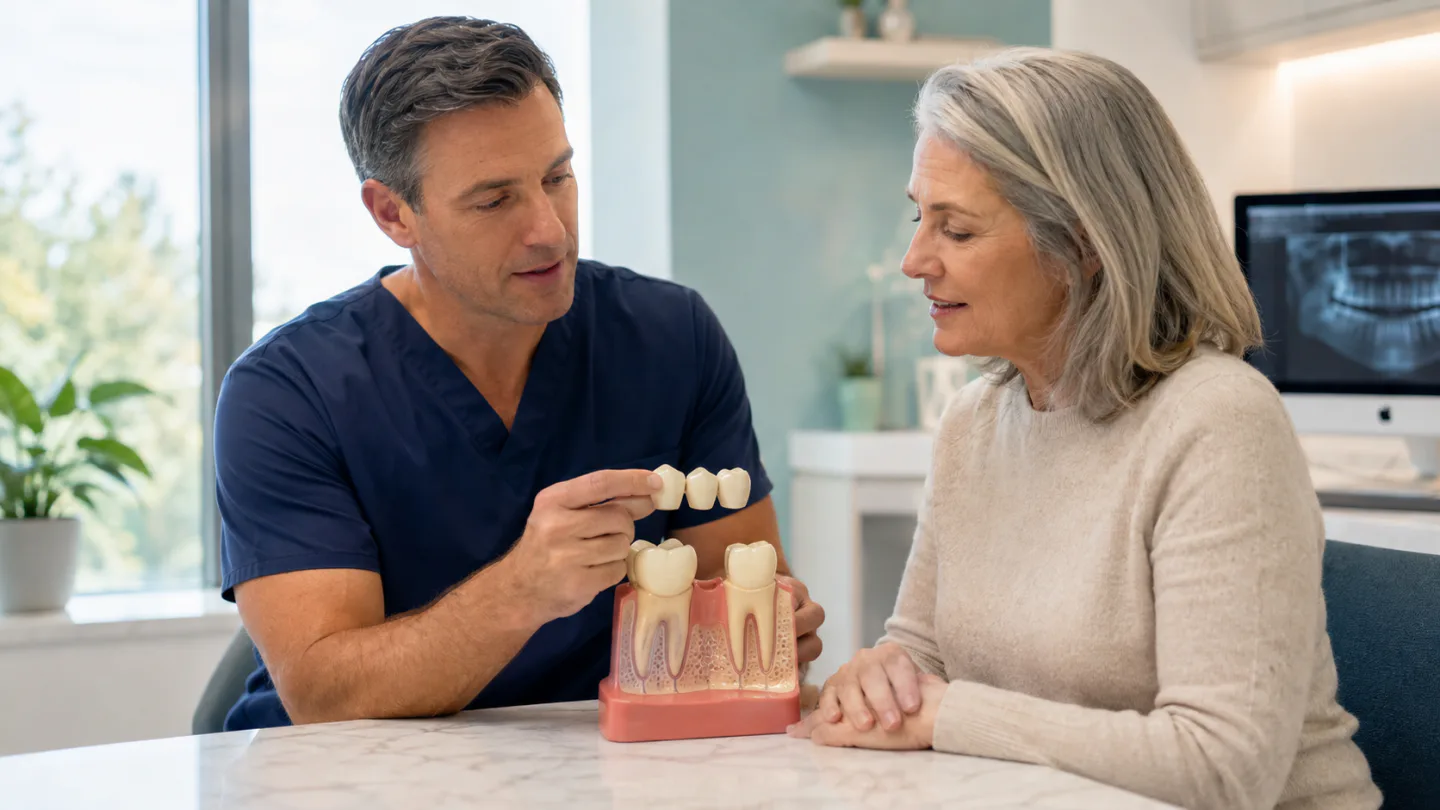
When one tooth is missing, the space can affect far more than the photograph of your smile. Food may pack into the gap. Speech can feel different. The tongue keeps finding the space, and chewing shifts to the other side. Over time, neighbouring and opposing teeth may move in ways that complicate the bite.
A dental bridge is one way to replace a missing tooth without wearing a removable appliance. It stays in the mouth and uses neighbouring teeth or dental implants for support. That convenience comes with trade-offs: the supporting structures must be suitable, the space under the artificial tooth needs deliberate cleaning, and some bridge designs require shaping otherwise healthy teeth.
If you are comparing dental bridges in Winnipeg, this guide explains the main types, how treatment works, how bridges differ from implants and partial dentures, and what helps one last.
What is a dental bridge?
A bridge is a fixed dental restoration that spans a space where one or more teeth are absent. The replacement tooth in the gap is called a pontic. The parts that hold it are the retainers, which may be crowns on natural teeth, bonded wings, or components attached to implants.
Unlike a removable partial denture, a fixed bridge is not taken out for sleep or cleaning. It is cemented or screwed in place and is intended to function as part of the bite.
The word “fixed” does not mean permanent for life. Bridges can wear, chip, loosen, or develop problems in the supporting teeth and gums. With thoughtful planning and daily care, many serve for years; future maintenance should still be part of the decision.
Why replace a missing tooth?
Not every space must be restored immediately. A tooth absent at the very back may have little effect on appearance or function, while a missing front tooth can have an immediate social and speech impact. The decision is personal and clinical.
Possible reasons to replace a tooth include:
- Restoring chewing contact
- Improving speech or appearance
- Reducing repeated food trapping
- Supporting a stable bite
- Preventing selected neighbouring teeth from drifting or tipping
- Sharing force more evenly across the mouth
- Restoring confidence when smiling
Before recommending a bridge, the dentist should also ask why the tooth was lost. Active decay, gum disease, grinding, or a traumatic bite must be managed or the same forces may threaten the replacement.
Traditional tooth-supported bridges
A traditional bridge commonly replaces a tooth by placing crowns on the teeth on both sides of the gap. The crowns and pontic are joined as one restoration. This design can feel secure and may be a practical choice when the neighbouring teeth already have large fillings or need crowns for their own reasons.
Its main trade-off is that both support teeth must be shaped to make room for the crowns. If they are untouched and healthy, removing enamel and dentin is a significant commitment. Supporting teeth also carry the load of the missing tooth and must be strong enough for that role.
Traditional bridges can replace more than one adjacent tooth, but longer spans flex more and place greater demands on the supports. Bite, tooth position, root support, and material strength determine whether a proposed span is reasonable.
Resin-bonded or Maryland bridges
A resin-bonded bridge uses one or more thin wings attached to the back of neighbouring teeth. Because much less tooth structure may need to be removed, this design can be appealing for a single missing front tooth, especially in a younger patient or when preserving intact teeth is a priority.
The design is not suitable for every bite or location. Heavy contacts, limited bonding surface, tooth movement, and habits such as grinding can cause a wing to loosen. A debonded bridge may sometimes be recemented, but repeated failure means the plan needs review.
Resin-bonded bridges should not be described as simply temporary or simply permanent. Their success depends on careful case selection, preparation design, material, bite, and patient habits.
Cantilever bridges
A cantilever bridge is supported on only one side of the missing tooth. It may be considered where anatomy or space makes two-sided support impossible, but the lever effect creates additional force on the supporting tooth and cement.
Modern use is selective. A small replacement tooth in an area of lighter load is very different from a back-tooth span exposed to heavy chewing. Ask why a cantilever design is being proposed, how the bite will be controlled, and what alternative support is available.
Implant-supported bridges
When several teeth are missing, a bridge can be attached to dental implants rather than natural teeth. The implants act as anchors in the jawbone. This approach avoids preparing neighbouring natural teeth and can replace a span with fewer implants than one implant for every missing tooth.
Implant treatment requires surgery, healing time, sufficient bone, healthy tissues, and ongoing maintenance. Smoking, uncontrolled health conditions, active gum disease, and grinding can affect risk. Three-dimensional planning may be needed to evaluate bone and anatomy.
An implant-supported bridge is not immune to problems. The restoration can chip or loosen, and inflammation can develop around implants when plaque is not controlled. Cleaning access needs to be designed into the bridge from the beginning.
Is a bridge right for the space?
The dentist assesses the gap, supporting teeth, gums, bone, bite, smile line, and your priorities. Dental X-rays help show roots, bone support, decay, and previous root canal treatment. Impressions or digital scans capture space and tooth shape.
A natural-tooth bridge may be a poor choice when support teeth are mobile, badly decayed, too small, or affected by advanced gum disease. It may also be questionable when the span is long or force is unusually heavy. An implant may not be appropriate when surgery or healing risk is unacceptable. A partial denture may be difficult when the remaining teeth do not provide useful support.
Good planning is about finding the best compromise for this mouth, not declaring one replacement universally superior.
The bridge treatment process
For a traditional bridge, the area is numbed and the supporting teeth are shaped for crowns. The dentist then takes a digital scan or physical impression and records the bite and shade. A temporary bridge protects the prepared teeth while the laboratory makes the final restoration.
At the fitting appointment, the temporary is removed and the dentist checks the bridge’s margins, contacts, appearance, and bite. Adjustments may be made before it is cemented. The patient should be shown how to clean beneath the pontic before leaving.
The process can involve additional steps if a tooth needs gum treatment, root canal therapy, a foundation filling, or extraction-site healing. Implant-supported bridges require surgical planning and a healing phase before the final restoration is attached.
Living with a temporary bridge
A temporary protects prepared teeth and helps maintain their position, but it is not as strong or precisely fitted as the final bridge. Avoid sticky foods that can lift it and very hard foods that may fracture it. Chew thoughtfully on the other side when possible.
Keep the area clean using the technique the dental team demonstrates. When flossing near a temporary, you may be told to pull floss out sideways rather than lifting it back through the contact; follow the specific instruction you receive.
If the temporary loosens, call the office. Do not leave prepared teeth uncovered or glue the bridge at home. Tooth movement can make the final restoration difficult to seat, and household adhesives can damage tissue and complicate treatment.
Materials used for dental bridges
Bridges may be made from zirconia, other ceramics, porcelain fused to metal, metal alloys, resin-based materials, or a combination. Material choice depends on location, span, appearance, available thickness, opposing teeth, and the laboratory design.
Tooth-coloured ceramics can create an attractive result, but not every ceramic behaves the same under a long or heavy span. Metal-based designs may allow different dimensions and have a long clinical history, though metal or an opaque layer can affect appearance near the gum.
Rather than asking only for “the best material,” ask why the proposed material fits your bite, whether it can be repaired, and what kind of wear it may create against the opposing teeth.
How a bridge should feel
A new bridge may feel unfamiliar for a few days as the tongue and chewing pattern adapt. It should not create sharp pain, a bite that hits dramatically before the other teeth, or a space that constantly traps large amounts of food.
Contact the office if the bridge moves, the bite remains uncomfortable, the gum becomes increasingly swollen, or sensitivity is strong or persistent. Small bite adjustments are often easier before soreness develops in the tooth or jaw muscles.
Do not assume every sensation is “normal because it is new.” The dental team would rather check a concern than have you compensate by avoiding the area for months.
Cleaning under a dental bridge
Regular floss cannot pass down between the joined crowns and pontic. Plaque still gathers along the gumline and under the replacement tooth, so a different route is needed.
Options may include:
- Floss with a stiffened threader end
- A separate floss threader
- Small interdental brushes in appropriately sized spaces
- A water flosser as an additional aid
- Specialized bridge floss with a thicker cleaning section
The tool must fit without cutting the gum or damaging the restoration. A hygienist can demonstrate the angle and help you practise. Brush the outer, inner, and chewing surfaces twice daily with fluoride toothpaste, paying particular attention to the crown margins.
A water flosser can be helpful, but it does not make professional monitoring unnecessary. Your home routine should be chosen based on the actual bridge design and dexterity.
What can go wrong with a bridge?
The artificial tooth itself cannot develop a cavity, but the natural teeth under supporting crowns can. Decay often begins at a crown margin where plaque remains. Gum inflammation and bone loss can weaken support. Porcelain may chip, cement may fail, and a root-canal-treated support tooth may fracture.
Clenching and grinding add repeated load. If a bridge breaks because the bite force was never addressed, simply remaking the same design may repeat the problem. A night guard, bite adjustment, different material, or different replacement approach may be considered.
Signs that need assessment include a loose feeling, new bad taste, bleeding around a support, food trapping, pain on biting, a visible dark edge, or floss catching and shredding. Problems are usually easier to manage before the bridge becomes mobile or a support tooth breaks.
Bridge, implant, or partial denture?
A bridge is usually faster than implant treatment and avoids implant surgery. It may make particular sense when adjacent teeth already need crowns. Its drawbacks include preparing support teeth and joining them together for cleaning and future treatment.
A single implant replaces the missing root without cutting neighbouring teeth. It requires surgery, adequate bone, healing, and its own long-term tissue care. Treatment often takes longer and may cost more initially.
A removable partial denture can replace several teeth, may be less invasive, and can often be modified if another tooth is lost. It is taken out for cleaning and may feel bulkier or move more than a fixed option.
Doing nothing is also an option in selected spaces, but the dentist should explain likely changes. Compare longevity, maintenance, effect on other teeth, total timeline, and likely future repairs—not only today’s fee.
Dental bridge costs in Winnipeg
The cost of a dental bridge in Winnipeg varies with the number of units, type of support, material, laboratory work, preparatory treatment, and complexity. A “three-unit bridge” replaces one tooth with a crown on each side, so the fee reflects three joined units rather than one artificial tooth.
Dental plans may contribute but can apply a deductible, percentage, annual maximum, missing-tooth clause, replacement interval, or alternate-benefit rule. A plan might base payment on a partial denture even if you choose a fixed bridge. A predetermination can clarify the estimate but is not a guarantee of payment.
Ask for the full plan in writing, including work needed on support teeth, temporary restoration, and maintenance. If several options are appropriate, compare both the expected patient portion and the biological trade-offs.
Planning a dental bridge in Winnipeg
A successful bridge begins with healthy support and a design you can maintain. It should restore function without creating a cleaning problem you were never shown how to manage.
Winnipeg North Dental offers dental bridge treatment and can compare fixed bridges with dental implants and removable options. If you have a missing tooth or an older bridge that feels loose, request an appointment for an examination and personalized discussion. The right plan should make sense for your bite, health, budget, and long-term care—not just fill the space on an X-ray.