
It happens halfway through lunch: a brief sharp pain when you bite, followed by several perfectly comfortable mouthfuls. You try the same side again and cannot reproduce it. By the time you decide to call a dentist, the tooth feels normal, and you wonder whether the appointment is still necessary.
Intermittent biting pain deserves attention even when it is difficult to pinpoint. A cracked tooth is one possible explanation, but it is not the only one. A filling, a bite change, decay, inflammation around a tooth or another condition may produce discomfort that sounds similar in a short description.
If you are experiencing pain when biting in Winnipeg, the useful next step is an assessment rather than repeated experiments with hard food. The pattern you have noticed can guide the examination. It cannot, on its own, determine whether a tooth needs a small adjustment, a restoration, root canal treatment or something else.
The moment of pain is useful information
Pay attention to whether discomfort occurs as you press down, as you release the bite or afterward. Note whether it happens with particular foods, whether temperature also triggers it and whether you can identify one tooth or only a general area.
The American Association of Endodontists describes cracked-tooth symptoms as potentially intermittent, including pain during chewing or when biting pressure is released. Because symptoms may come and go, locating the affected tooth can take careful assessment.
Do not deliberately keep provoking the pain to collect evidence. A short record of ordinary episodes is enough. Write down when the problem began and whether anything changed around that time, such as recent dental work, an injury or biting something unexpectedly hard.
When booking, say that you have pain on biting rather than requesting only a routine cleaning. The clinic can then arrange an appointment suited to examining the symptom and advise you about timing.
A crack is not always visible in the mirror
People often expect a cracked tooth to look obviously broken. Some fractures do, but others are small, hidden by a restoration or located where you cannot see them. Conversely, a visible line on the enamel is not automatically a deep structural problem.
The distinction matters because appearance alone can create both false reassurance and unnecessary alarm. You might miss a significant problem because the tooth looks intact, or worry about a harmless superficial line because an enlarged phone photograph makes it dramatic.
Do not scrape a line with a pin or try to separate two areas with a tool. That cannot measure its depth and may damage tissue or the tooth. Bring the concern to the examination and let the clinician inspect it under appropriate conditions.
If an actual fragment has broken off, keep it safely and tell the office. Our chipped and broken tooth guide covers visible fractures, while this article focuses on the less obvious situation in which chewing produces a recurring symptom.
Expect more than one kind of examination
The dentist may compare the suspect tooth with neighbouring teeth, examine restorations, assess the bite, inspect the gums and use selected tests to reproduce or understand the symptom. The sequence depends on what your history and the initial examination suggest.
Cleveland Clinic’s cracked-tooth information describes methods such as controlled bite testing, light examination, gum measurements and imaging. These tests provide different pieces of information rather than one universal yes-or-no answer.
Tell the clinician promptly if a test is uncomfortable. You do not need to endure repeated pain silently to make the examination more convincing. Clear feedback about the location and character of the sensation is helpful.
Ask what each finding contributes. For example, does it help identify the tooth, assess the nerve tissue, evaluate support around the root or estimate how much sound structure remains? Understanding the purpose makes an uncertain examination easier to follow.
An X-ray may answer a different question
Dental images are valuable, but a small crack may not appear as an obvious line. The direction of the fracture, surrounding materials and the type of imaging can affect what is visible. Images may instead show decay, previous treatment or changes in tissues around the root.
The European Society of Endodontology’s position statement on longitudinal cracks describes the diagnostic difficulty of early cracked teeth and the need to interpret clinical findings together. A normal-looking image does not, by itself, settle every question about intermittent biting pain.
If additional imaging is suggested, ask what uncertainty it is intended to resolve and how the result could change treatment. More imaging is not automatically better, and it should be justified by the clinical question.
Our dental X-ray guide explains the broader role of imaging. It can help you prepare for a conversation about why a particular view is useful without expecting it to reveal every detail of a fracture.
The condition inside the tooth matters too
Assessing a suspected crack involves more than its visible length. The dentist also needs to consider the pulp, the living tissue inside the tooth, and the tissues around the root. Temperature responses, spontaneous pain and other findings can influence that assessment.
A recommendation for root canal treatment should be explained in terms of the diagnosis, not simply the presence of a line. Likewise, the absence of constant pain does not prove the pulp is healthy. Ask what evidence supports the recommendation and what remains uncertain.
In some cases, referral to an endodontist may help with diagnosis or treatment. That does not automatically mean the tooth is hopeless or that every specialist visit leads to a procedure. It may be a way to obtain a more focused assessment before making a major decision.
Bring relevant previous records when requested and explain any earlier treatment on the tooth. A history of repeated restorations, an old injury or previous root canal treatment can change the questions the clinician needs to answer.
Treatment depends on what can be preserved
A small damaged area and a tooth split into separate segments are different problems. The amount of remaining tooth, location of the fracture, gum and bone support, pulp condition and ability to restore the tooth all affect the options.
The NHS overview of chipped, broken and cracked teeth describes possible repairs including fillings, crowns and root canal treatment when indicated. Some teeth cannot be predictably restored and may need extraction. The appropriate choice requires examination.
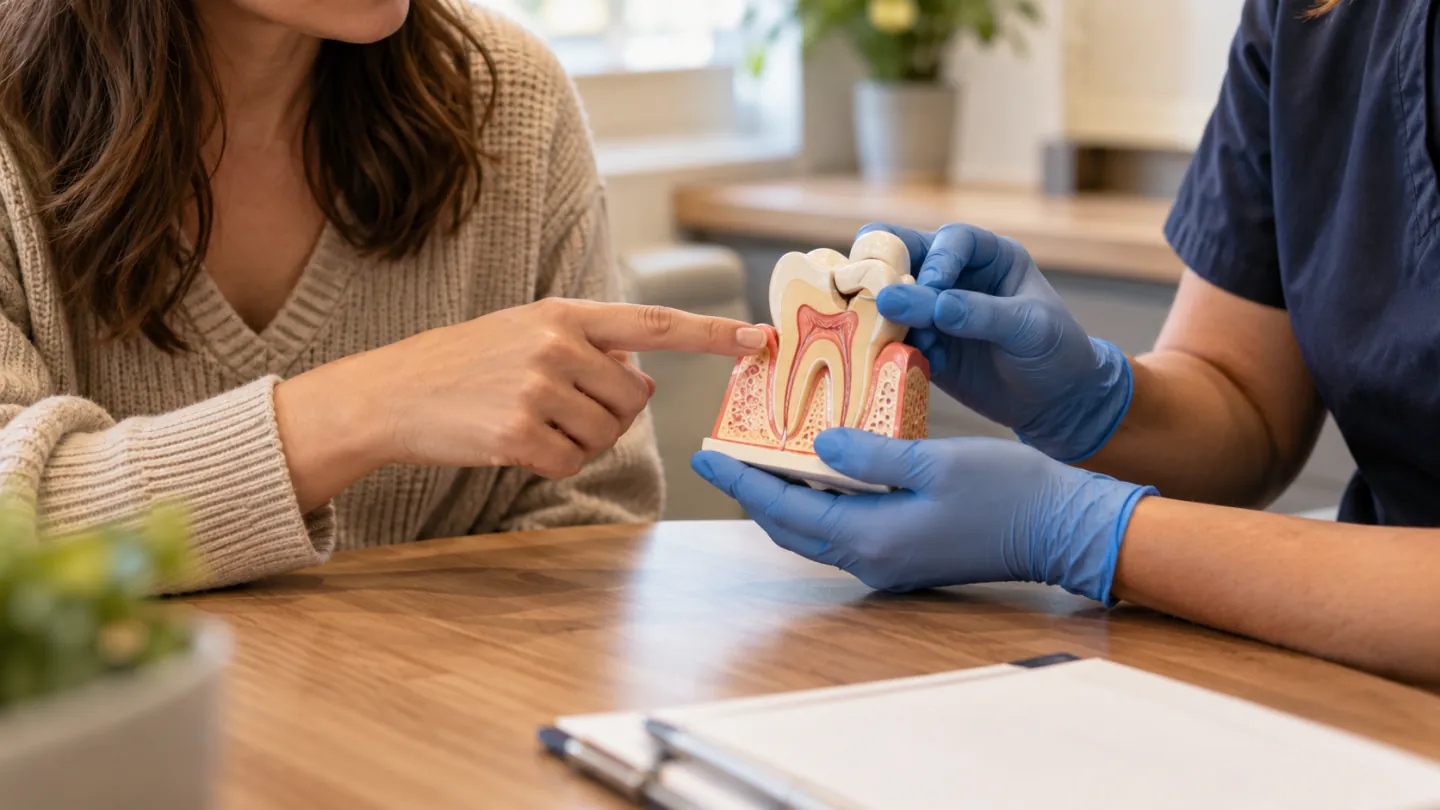
Ask the dentist to show you the area, using photographs or a model if helpful. You should understand what the proposed restoration protects and why a simpler option may or may not be suitable.
If several steps are proposed, request the full sequence: immediate protection, any treatment inside the tooth, the final restoration and review. Knowing the whole plan prevents the first appointment from being mistaken for completion of care.
A crown is protection, not a guarantee
Covering a weakened tooth may be part of treatment, but it does not make the tooth identical to one that never cracked. The AAE notes that tooth fractures do not heal like broken bones and that a crown cannot guarantee that every crack will stop progressing.
That uncertainty should be discussed before treatment, especially when the long-term outlook is difficult to predict. Ask which findings make the prognosis favourable or guarded and what symptoms would change the plan after restoration.
Do not interpret an honest discussion of uncertainty as a recommendation to do nothing. It is part of informed decision-making. A tooth may still be worth treating even when no clinician can promise an exact lifespan.
Our crown guide explains how crowns are planned and maintained. For a suspected crack, the additional issue is whether the underlying structure can support a durable result and how that will be monitored.
Protect the tooth while waiting for advice
Avoid deliberately biting hard objects or repeatedly testing the sore tooth. Choose foods that you can eat comfortably and contact the clinic for individualized guidance. Do not use the tooth to open packaging, crack shells or hold objects.
Keep the mouth clean with gentle brushing and suitable interdental care. Do not place aspirin or household chemicals directly against the tooth or gum. If you need pain relief, ask a pharmacist or clinician what is appropriate for your health history and other medicines, and follow the directions.
Tell the office if symptoms change while you are waiting. Increasing pain, swelling, fever or a new break can affect urgency. Severe swelling with difficulty breathing or swallowing needs emergency medical care rather than waiting for a routine dental slot.
If you are leaving Winnipeg soon, mention the travel date when calling. The team can assess the concern and discuss realistic timing instead of having you assume the tooth can wait until you return.
Discuss costs as a sequence
The cost of evaluating biting pain is not necessarily the cost of completing treatment. An examination, imaging, temporary protection, specialist assessment and a final restoration may be separate stages. Ask for an estimate that identifies the proposed stages and the uncertainty between them.
If benefits are involved, ask how estimates or predeterminations will be submitted and what portion you may need to pay. Coverage cannot determine whether a tooth is restorable, and a benefit estimate is not a clinical guarantee.
If the financial commitment is difficult, say so before treatment begins. Ask about suitable alternatives, the consequences of postponing and whether staging is clinically reasonable. Our insurance guide explains terms that may arise in that conversation.
For a major decision with unresolved questions, it is reasonable to request clarification or another opinion. Keep the focus on the findings and treatment tradeoffs rather than seeking a promise that no one can responsibly make.
Make follow-up part of the decision
After treatment, report whether the original biting pain changes and whether new symptoms develop. Follow instructions about the restoration, chewing and any recommended review. Improvement is useful information, but the tooth still needs ongoing care.
Discuss habits that may place repeated load on teeth, including clenching, grinding or chewing hard objects. If an appliance is recommended, ask what it is intended to protect and how its fit will be reviewed. It should follow an assessment rather than be purchased as a cure for every biting symptom.
For pain when biting in Winnipeg, request an appointment at Winnipeg North Dental. A clear symptom history and careful examination can turn an intermittent, frustrating problem into a more understandable set of options, with the limits and next steps explained before you decide.