
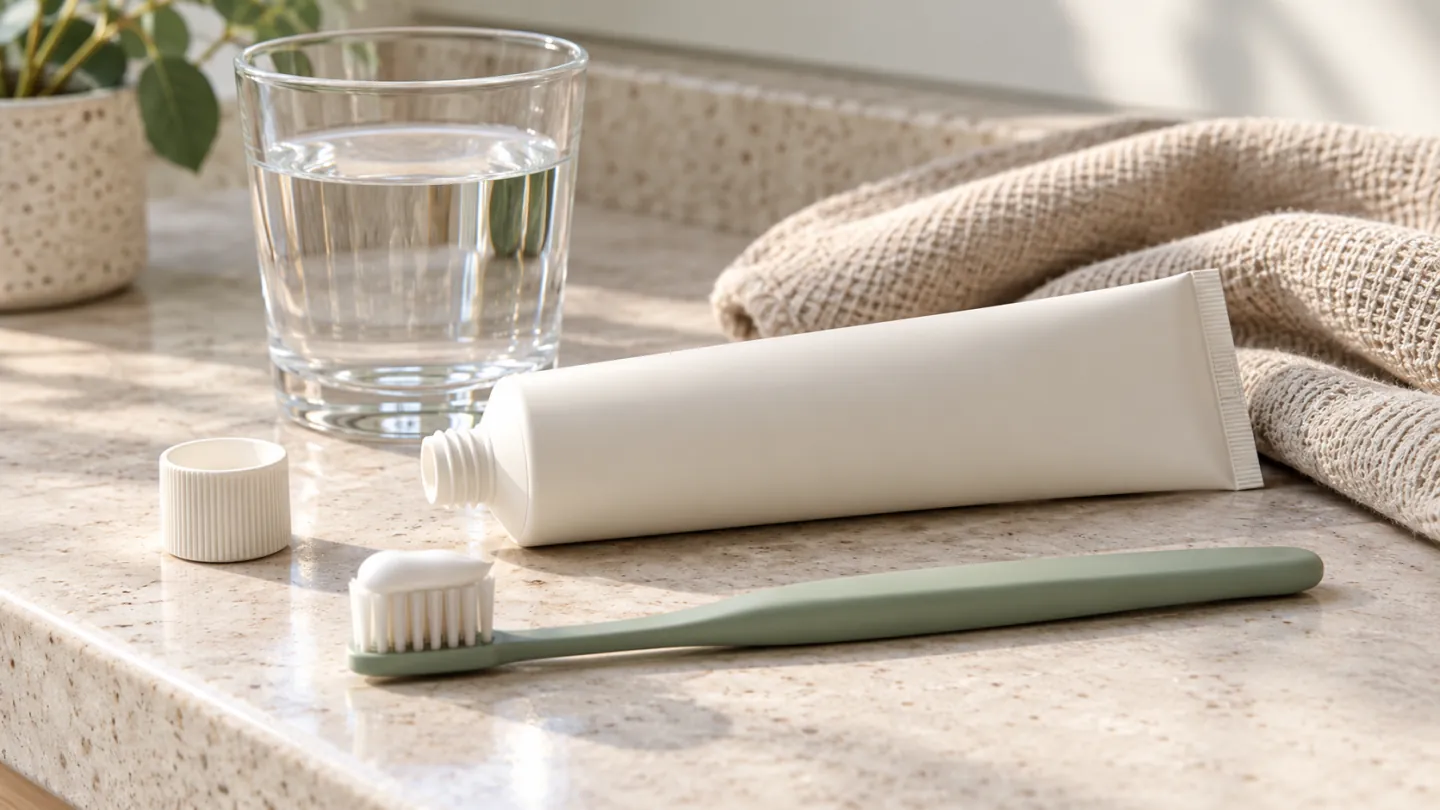
You finish a tube of toothpaste, go to replace it and discover that the familiar packaging has changed. The shelf now offers enamel defence, intense whitening, gum protection, charcoal, sensitivity relief and several kinds of mint. It is easy to leave with the product that has the largest discount or the most reassuring promise.
Choosing toothpaste in Winnipeg becomes simpler when you separate three questions. What protection does your mouth need? Which product can provide it? And will you actually tolerate using that product every day? The answer may be an ordinary fluoride toothpaste, a formula chosen for a specific symptom, or a product recommended after a dental examination.
This guide is about making that decision without turning your bathroom cupboard into a collection of unfinished experiments. Toothpaste has a useful role, but its packaging cannot diagnose a cavity, explain a sore gum or tell you why one tooth has suddenly become sensitive.
Begin with the active purpose
The most prominent words on a box are not always the most useful. Turn the package around and look for the active ingredients, intended use, age directions and warnings. A product’s flavour, colour and foam are separate from its cavity-prevention role.
The American Dental Association’s toothpaste overview explains that formulas contain ingredients with different jobs, including mild abrasives, moisture-retaining agents and detergents. Fluoride supports cavity prevention, while some products contain additional ingredients for sensitivity or gum-related concerns.
You do not need to become a chemist. Start by confirming whether the toothpaste contains fluoride and whether the directions fit the intended user. If a dentist has recommended a specific ingredient or strength, write that information down before shopping. Similar-looking boxes within the same product line may have different purposes.
When you cannot find the exact product, ask a pharmacist or your dental team to help compare the active details. Substituting based only on a brand name or a matching colour can miss the reason the product was recommended.
Fluoride is relevant after childhood
Adults sometimes assume that cavity prevention matters mainly for children. Their priorities shift toward fresh breath or removing stains, and they stop checking for fluoride. Yet having adult teeth, fillings or a long period without a cavity does not make decay impossible.
The National Institute of Dental and Craniofacial Research’s tooth decay information describes decay as a process in which bacterial acids cause mineral loss. Fluoride can help protect teeth and support reversal of early mineral changes before a cavity develops. A formed hole is a different problem and may need restorative care.
That distinction is useful when a package uses the word repair. Supporting a tooth surface is not the same as replacing a missing piece of enamel or filling an established cavity. If your dentist is watching an early lesion, ask what change is being monitored and when it will be reassessed.
Do not replace an examination with repeated purchases of increasingly elaborate toothpaste. A product can support a prevention plan, but you still need to know what the plan is trying to accomplish.
Sensitivity formulas need a sensible trial
A cold drink that briefly catches several teeth is a different story from one tooth that aches long after the drink is gone. Both may be described as sensitivity, but they should not automatically lead to the same purchase. Note the location, trigger and duration before deciding that toothpaste is the answer.
The ADA’s information on sensitive teeth lists several possible causes, including exposed roots, worn enamel, decay and damaged teeth or fillings. Desensitizing toothpaste is one possible treatment, and it may require repeated use before relief develops.
If a dentist recommends a trial, follow the product directions and clarify when to report back. Switching formulas every few days makes it harder to know whether one helped. Keeping a short note about triggers can be more useful than checking your teeth repeatedly with ice water.
Seek assessment for new, persistent or worsening symptoms, especially pain on biting, spontaneous pain or a clearly localized problem. Our tooth sensitivity guide explains the examination questions in more detail. A toothpaste label cannot distinguish a surface sensitivity problem from a tooth that needs treatment.
Whitening claims require realistic expectations
Whitening toothpaste can sound like a convenient alternative to professional whitening, but the word whitening covers different effects. Surface stain removal and changing the underlying shade of a tooth are not interchangeable goals. Before buying, consider what you are actually trying to change.
If the concern is a general build-up of coffee or tea stain, a cleaning appointment may help identify what is removable. If one tooth is darker than its neighbours, the reason needs attention before cosmetic treatment. If your front teeth include crowns, veneers or fillings, their colour may respond differently from natural teeth.
The ADA’s guidance on natural whitening methods cautions that abrasive or acidic home methods can damage teeth and that charcoal whitening claims lack adequate evidence of safety and effectiveness. An ingredient described as natural does not automatically make it gentle or suitable for daily use.
Avoid combining several whitening products simply to accelerate a result. Tell your dentist what you already use, including strips, gels and powders. A modest, well-matched plan is easier to evaluate than a changing mixture of products that leaves you unsure which one caused irritation.
Comfort is part of a workable choice
A toothpaste can meet your clinical needs and still be difficult to use. Strong mint may feel overwhelming. Foaming may trigger gagging. A particular flavour may be intolerable during pregnancy or when nausea is present. Those barriers deserve practical attention rather than an instruction to put up with them.
Describe the experience precisely. Does the paste sting immediately? Does the mouth feel sore afterward? Is the issue the amount of foam, the taste or the smell? Bring the tube or a clear photograph of the ingredient list so the dental team can compare alternatives accurately.
Choosing a milder flavour does not have to mean abandoning fluoride. Look at the complete formulation and instructions rather than assuming that every gentle-tasting product has the same protective ingredients. If you develop persistent irritation, stop the suspected product and seek professional advice instead of continuing to test it against sore tissue.
For a shared household, separate products may be reasonable. A single family tube is convenient only when it suits everyone who uses it. Comfort, age instructions and individual dental recommendations can justify keeping more than one option beside the sink.
Children need their own directions
The amount used matters as much as the choice of tube. Young children may swallow toothpaste, so an adult should control the amount and help with brushing. A large ribbon covering the brush head is not a useful model for a small child.
Health Canada’s fluoride guidance recommends asking a health professional about decay risk for children under three. For those at risk, an adult should use a rice-grain amount of fluoridated toothpaste. For ages three to six, an adult should help and use a small pea-sized amount.
Keep the discussion specific to your child. Their age, ability to spit, dental history and risk assessment matter more than a cartoon on the package. Ask the dental team to show the amount directly on the brush if a written description feels ambiguous.
Store toothpaste where a young child cannot help themselves to it as a snack. A pleasant flavour may encourage brushing, but the tube is still a dental product. Our first dental visit guide includes ways to make early routines more manageable without turning brushing into a daily negotiation.
A prescription product is a personal recommendation
Some patients need additional preventive measures because of their particular cavity risk or other findings. If your dentist recommends a prescription-strength toothpaste, ask why it is appropriate, how to use it and how long the plan will continue. Do not assume it is simply a stronger version everyone should buy.
Write down whether it replaces your usual toothpaste or belongs at a different point in the routine. Ask about the amount, frequency, whether to rinse afterward, and any eating or drinking instructions. The product label and your clinician’s directions should guide the details.
Keep prescription products for the person they were prescribed for. Do not share them with a child or another household member because both people have had cavities. The indication and appropriate use may differ.
At the next appointment, bring up cost or availability problems. A recommendation that you cannot obtain regularly needs a practical discussion. Quietly stretching the tube or switching to an unrelated product leaves the dentist with an inaccurate picture of the prevention plan you are following.
Read seals and claims with the same care
An independent seal can help identify claims that have been reviewed, but it is still useful to understand what the claim actually covers. Cavity prevention, sensitivity relief and stain removal are different purposes. Evidence for one purpose does not mean a product will solve every dental concern.
The Canadian Dental Association explains its Seal Program as a way to identify supported oral-health claims. Use that information alongside your own needs and the directions on the product available in Canada.
When comparing prices in a Winnipeg shop, check the amount in the tube as well as the sticker price. A smaller package may appear cheaper while costing more for the same quantity. Also consider whether an expensive extra feature is relevant to you. There is little value in paying for a goal you do not have.
Keep a photograph of the product that works well. When packaging changes or a store is out of stock, you will have the active information available instead of relying on memory.
Make the choice part of a complete routine
Toothpaste does not choose your brushing angle, reach every space between teeth or tell you when a filling needs attention. Its value depends on using it within a routine you can repeat and adapting that routine when your needs change.
At your next check-up and cleaning, bring three pieces of information: the product you use, the reason you chose it and any problem you hope it will solve. That short conversation can prevent months of buying the wrong category of product.
For help choosing toothpaste in Winnipeg, request an appointment at Winnipeg North Dental. The goal is a clear, affordable choice that suits your mouth, with instructions you understand and a sensible way to assess whether it is helping.